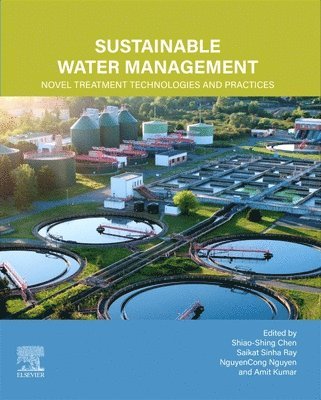
Häftad, Engelska, 2026
Sustainable Water Management
Av Shiao-Shing Chen, Saikat Sinha Ray, Nguyen Cong Nguyen, Amit Kumar
1829 kr
Beställningsvara. Skickas inom 10-15 vardagar. Fri frakt över 249 kr.
Beskrivning
Sustainable Water Management: Novel Treatment Technologies and Practices offers a comprehensive and interdisciplinary resource that connects cutting-edge water treatment technologies with sustainable management strategies. The book covers essential information about Advanced desalination technologies (RO), forward osmosis (FO), multistage flash (MSF), membrane distillation (MD), brine valorization, and their comparative efficiency. It covers digital innovations such as Digital Twins, artificial intelligence (AI), Internet of Things (IoT), and real-time data monitoring for smart water systems. By bridging the domains of environmental engineering, digital innovation, water science, and policy to support SDG -6 and global water security, this book provides a comprehensive resource.
It is designed for students and researchers, practitioners, engineers, and policymakers who want to learn more about integrating emerging innovations in membrane science, desalination, electrochemical methods, and smart digital systems with climate-resilient and circular economy principles. Special emphasis is placed on low-cost, decentralized solutions for resource-limited and water-stressed regions.
It is designed for students and researchers, practitioners, engineers, and policymakers who want to learn more about integrating emerging innovations in membrane science, desalination, electrochemical methods, and smart digital systems with climate-resilient and circular economy principles. Special emphasis is placed on low-cost, decentralized solutions for resource-limited and water-stressed regions.
- Covers a comprehensive spectrum of topics, including policy-driven technological shifts, circular economy approaches, climate-resilient water strategies, and the management of emerging contaminants
- Includes a holistic array of advanced and emerging treatment technologies-from sustainable desalination and anti-fouling membranes to electrochemical processes and digital innovations such as Digital Twins and IoT-enabled smart water systems-all illustrated with real-world case studies
- Provides integrated frameworks for community participation, policy innovation, and global collaboration, offering actionable insights and practical examples to empower researchers in advancing water security and achieving Sustainable Development Goals (SDGs)
Produktinformation
- Utgivningsdatum: 2026-08-13
- Mått: 191 x 235 x 31 mm
- Vikt: 450 g
- Format: Häftad
- Språk: Engelska
- Antal sidor: 554
- Förlag: Elsevier Science
- ISBN: 9780443448539
Utforska kategorier
Betyg & recensioner
0 recensioner
Inga recensioner tillgängliga.