• Fri frakt över 249 kr
  • •
  • Snabba leveranser
  • •
  • Billiga böcker
Kundservice

Du är på sajten för privatpersoner.

Företag, bibliotek eller offentlig verksamhet?

Du handlar på classic.bokus.com, där alla dina funktioner finns intakta.
Till classic.bokus.com
Bokus logotyp. Gå till startsidan.
  • Erbjudanden
  • Nyheter
  • Student
  • Topplistor
  • Barn & ungdom
  • Bokus Play
  • E-böcker
  • Pocketböcker
  • Spel & pussel

10% rabatt på allt med kod: NYSTART10 →

Sidfot

Mina sidor

    Hjälp

    • Kundservice
    • Vanliga frågor och svar
    • Frakt och leverans
    • Retur vid ångerrätt
    • Reklamera vara
    • Betalning
    • Köpvillkor
    • Allmänna villkor
    • Information om webbplatsens tillgänglighet

    Om Bokus

    • Om oss
    • Pressrum
    • För studenter
    • För företag
    • För bibliotek och offentlig verksamhet
    • För leverantörer
    • Hållbarhet

    Populärt

    • Aktuella erbjudanden
    • Presentkort
    • Studentlitteratur
    • Nya böcker
    • Topplistor
    • Signerade böcker
    • Engelska böcker

    Inspiration

    • Boktips
    • BookTok
    • Populära bokserier
    • Barnbokskaraktärer
    • Populära författare
    Logotyp för Bokus
    Följ oss på Facebook (extern länk)Följ oss på Instagram (extern länk)Följ oss på YouTube (extern länk)Följ oss på TikTok (extern länk)
    bokus @ CookiesAnpassa cookiesIntegritetspolicyKöpvillkor
    Till Citymail hemsida (extern länk)Till Budbee hemsida (extern länk)Till Postnord hemsida (extern länk)Till Schenker hemsida (extern länk)Till Early Bird hemsida (extern länk)Till Walleys hemsida (extern länk)
    1. Naturvetenskap och teknik
    2. Teknik och industri
    3. Energiteknik

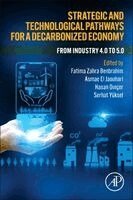
    Strategic and Technological Pathways for a Decarbonized Economy

    From Industry 4.0 to 5.0

    AvFatima Zahra Benbrahim,Asmae El Jaouhari

    Häftad, Engelska, 2026

    1 970 kr

    Kommande

    Beskrivning

    Strategic and Technological Pathways for a Decarbonized Economy offers readers, including researchers, energy professionals, investors, policymakers and corporate leaders, credible, forward-looking information to support the transition to a low-carbon economy. For researchers, there is a wealth of data and frameworks to advance innovation. Provides energy stakeholders with expert insights into technology deployment and regulation. Risk-return profiles, market trends, and ESG metrics will be of particular interest to investors and innovators. For policymakers, the book includes modeling and impact assessments to guide climate policy. Presents corporate leaders with strategic roadmaps, emissions benchmarks and tools to align sustainability with business goals. By offering a framework for understanding the evolution of industrial practices, the book enables readers to prepare for future challenges while equipping them with the tools needed to succeed in a decarbonized economy.

    • Provides a comprehensive guide for industries aiming to transition toward sustainability
    • Explores the profound transformations industries are undergoing, emphasizing the transition towards a decarbonized and sustainable economy. It investigates how strategic approaches and technological advancements are reshaping industrial practices across various sectors, moving beyond productivity-focused models toward environmentally and socially responsible paradigms
    • Is a comprehensive and critical examination of innovation cycles from Industry 1.0 through to 5.0, helping readers understand the trajectory and nature of industrial revolutions. It offers a conceptual and empirical basis for understanding the paradigm shift at the heart of Industry 5.0 through the lens of innovation dynamics, sustainability, and industrial strategy

    Produktinformation

    • Utgivningsdatum:2026-10-01
    • Mått:152 x 229 x undefined mm
    • Vikt:450 g
    • Format:Häftad
    • Språk:Engelska
    • Antal sidor:250
    • Förlag:Elsevier Science
    • ISBN:9780443458316

    Utforska kategorier

    • Energiteknik inom Naturvetenskap och teknik

    Mer om författaren

    Professor Fatima Zahra Benbrahim is a research professor in creativity and innovation at the National School of Applied Sciences, Ibn Tofaïl University, Morocco, and a part-time lecturer at ENSAM Meknes, teaching strategic management, innovation, and entrepreneurship. She earned her PhD in Economic Sciences and Management (2022) from the National School of Business and Management of Kenitra. Her doctoral research examined firms’ innovation behavior through a large-scale survey of over 500 Moroccan companies, combining academic insight with practical recommendations for regional development. Originally an Agronomist Engineer in Animal Production (2008), she later specialized in management sciences. From 2009 to 2024, she served at the Ministry of Industry and Trade, leading strategic and sectoral studies. Certified in intellectual property (WIPO, AMAPIC, CAPI), she has co-authored and supervised around thirty patent filings. Her research focuses on innovation strategy, IP, technology transfer, Industry 4.0/5.0, and sustainable supply chains.Professor Asmae El Jaouhari is currently an Associate Professor at the National School of Applied Sciences, Hassan First University, Berrechid, Morocco, and an academic research member in the Systems Analysis and Modeling Laboratory and Decision Support within Hassan First University. She holds a PhD in Industrial Engineering (2023) from the Faculty of Sciences and Techniques, Sidi Mohamed Ben Abdellah University, Fès, Morocco, where her research focused on Digital Transformation Management in Supply Chain and Logistics. Earlier, she earned her State Engineering Diploma in Industrial Engineering (2019) from the National School of Applied Sciences (ENSA), Fès Professor Hasan Dincer is a distinguished academic in finance and banking, currently serving at Istanbul Medipol University in Turkey. He earned his B.A., M.A., and Ph.D. in finance-related disciplines from Marmara University, with his doctoral research focusing on the impact of new service development on competitive strategies in the banking sector. Prof. Dinçer has held academic positions at Beykent University and has conducted research at Hamburg University in Germany and the University of Hertfordshire in the UK. His prolific scholarship includes over 400 scientific articles in high-impact journals, addressing topics such as strategic management, sustainability, circular economy, renewable energy investments, and decision-making models. He serves as the executive editor of the International Journal of Finance and Banking Studies and is a founding member of the Society for the Study of Business and Finance.Professor Serhat Yüksel is Professor of finance in İstanbul Medipol University. Before this position, he worked as a senior internal auditor for seven years in Finansbank, Istanbul-Turkey and 1 year in Konya Food and Agriculture University as an assistant professor. Dr. Yüksel has a BS in Business Administration (in English) from Yeditepe University (2006) with full scholarship. He got his master degree from the economics in Boğaziçi University (2008). He also has a PhD in Banking from Marmara University (2015). His research interests lie in energy economics, banking, finance and financial crises

    Innehållsförteckning

    • Part I Understanding the shift: from industry 1.0 to 5.01. Revolutions revisited: tracing the industrial evolution from 1.0 to 5.02. Disruptive innovation and technological waves : a Schumpeterian perspective3. The essence of industry 5.0: beyond automation, toward human-centricityPart II The essence of industry 5.0: beyond automation, toward human-centricity4. Decarbonization as strategy: industrial models in the age of climate emergency5. From linear to circular: reimagining industrial processes6. Green tech and smart manufacturing: convergence for climate action7. Data, intelligence and decision-making in sustainable industries8. Digital sovereignty and ethical governance in industry 5.0Part III Sectoral transitions: case studies and applications9. Energy transition and industry 5.0: the rise of decentralized systems10. Agri-food systems at the crossroads: innovation for resilience and regeneration11. Sustainable mobility and logistics 5.0: designing low-impact networks12. Textile and fashion under transformation: toward regenerative design13. Industrial ecosystems in the global south: innovation under constraintsPart IV Empowering the human factor14. Skills, jobs, and learning in the era of industry 5.015. Co-creation, inclusion, and wellbeing in the workplace of tomorrow16. Digital craftsmanship: rediscovering the human in the machinePart V Beyond the present: imagining industry 6.017. Creative destruction reimagined: from collapse to regeneration18. Interdisciplinary futures: crossing boundaries to shape the next industrial wave19. Industry 6.0? Speculations on the post-digital, post-carbon economy20. Conclusion: rethinking progress – industry as a vector for planetary health