• Fri frakt över 249 kr
  • •
  • Snabba leveranser
  • •
  • Billiga böcker
Kundservice

Du är på sajten för privatpersoner.

Företag, bibliotek eller offentlig verksamhet?

Du handlar på classic.bokus.com, där alla dina funktioner finns intakta.
Till classic.bokus.com
Bokus logotyp. Gå till startsidan.
  • Erbjudanden
  • Nyheter
  • Student
  • Topplistor
  • Barn & ungdom
  • Bokus Play
  • E-böcker
  • Pocketböcker
  • Spel & pussel

Må bättre, för mindre! Upp till 50% rabatt på hälsoböcker

Sidfot

Mina sidor

    Hjälp

    • Kundservice
    • Vanliga frågor och svar
    • Frakt och leverans
    • Retur vid ångerrätt
    • Reklamera vara
    • Betalning
    • Köpvillkor
    • Allmänna villkor
    • Information om webbplatsens tillgänglighet

    Om Bokus

    • Om oss
    • Pressrum
    • För studenter
    • För företag
    • För bibliotek och offentlig verksamhet
    • För leverantörer
    • Hållbarhet

    Populärt

    • Aktuella erbjudanden
    • Presentkort
    • Studentlitteratur
    • Nya böcker
    • Topplistor
    • Signerade böcker
    • Engelska böcker

    Inspiration

    • Boktips
    • BookTok
    • Populära bokserier
    • Barnbokskaraktärer
    • Populära författare
    Logotyp för Bokus
    Följ oss på Facebook (extern länk)Följ oss på Instagram (extern länk)Följ oss på YouTube (extern länk)Följ oss på TikTok (extern länk)
    bokus @ CookiesAnpassa cookiesIntegritetspolicyKöpvillkor
    Till Citymail hemsida (extern länk)Till Budbee hemsida (extern länk)Till Postnord hemsida (extern länk)Till Schenker hemsida (extern länk)Till Early Bird hemsida (extern länk)Till Walleys hemsida (extern länk)
    1. Ekonomi och Ledarskap
    2. Nationalekonomi

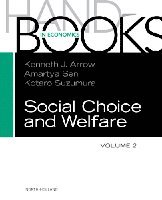
    Handbook of Social Choice and Welfare

    AvKenneth J. Arrow,A. Sen

    Inbunden, Engelska, 2010

    Del 2 i serien Handbooks in Economics

    1 521 kr

    Beställningsvara. Skickas inom 10-15 vardagar. Fri frakt över 249 kr.

    Beskrivning

    This second part of a two-volume set continues to describe economists' efforts to quantify the social decisions people necessarily make and the philosophies that those choices define. Contributors draw on lessons from philosophy, history, and other disciplines, but they ultimately use editor Kenneth Arrow's seminal work on social choice as a jumping-off point for discussing ways to incentivize, punish, and distribute goods.

    • Develops many subjects from Volume 1 (2002) while introducing new themes in welfare economics and social choice theory
    • Features four sections: Foundations, Developments of the Basic Arrovian Schemes, Fairness and Rights, and Voting and Manipulation
    • Appeals to readers who seek introductions to writings on human well-being and collective decision-making
    • Presents a spectrum of material, from initial insights and basic functions to important variations on basic schemes

    Produktinformation

    • Utgivningsdatum:2010-10-13
    • Mått:191 x 235 x 38 mm
    • Vikt:1 758 g
    • Format:Inbunden
    • Språk:Engelska
    • Serie:Handbooks in Economics
    • Antal sidor:992
    • Förlag:Elsevier Science
    • ISBN:9780444508942

    Utforska kategorier

    • Nationalekonomi inom Ekonomi och Ledarskap

    Mer om författaren

    Kenneth Arrow is the Joan Kenney Professor of Economics and Professor of Operations Research, emeritus; a CHP/PCOR fellow; and an FSI senior fellow by courtesy. He is the joint winner of the Nobel Memorial Prize in Economics with John Hicks in 1972. To date, he is the youngest person to have received this award, at 51. In economics, he is a figure in post-World War II neo-classical economic theory. Many of his former graduate students have gone on to win the Nobel Memorial Prize themselves. His most significant works are his contributions to social choice theory, notably "Arrow's impossibility theorem", and his work on general equilibrium analysis. He has also provided foundational work in many other areas of economics, including endogenous growth theory and the economics of information. He has been co-editor of the Handbooks in Economics series since the mid-1980s.

    Recensioner i media

    "This volume continues the strong tradition of volume I (2002), supplementing it with foundational material and new results on Arrovian social choice.  It also includes new material on fairness, rights, and manipulation, making the two volumes a masterful presentation of all the important topics in the field by its leading experts, including three Nobel laureates." --Steven Brams, New York University"This much awaited volume provides authoritative surveys of some of the most important aspects of the theory of social choice and welfare economics. It will be a highly valuable resource for scholars interested in this area." --Prasanta K. Pattanaik, University of California, Riverside"Social choice theory has produced some of the most powerful (and beautiful) findings in theoretical social science. This long-awaited volume will be a valuable resource to both students and scholars interested in exploring this important field." --Eric Maskin, Nobel Laureate in Economics

    Innehållsförteckning

    • Preface to Volume 2Part 5: Foundations.13. Functions of social choice theory (K. Arrow)14. Informational basis of social choice theory (A. Sen). 15. Competitive market mechanism as a social choice procedure (P. Hammond)16. Functionings and Capabilities (K. Basu, L.F. Lopez-Calva)Part 6: Developments of the basic arrovian schemes. 17. Arrovian social choice theory on economic domains (M. LeBreton, J. Weymark)18. Topological theories of social choice (N. Baigent)19. Non-binary social choice theory (R. Deb)Part 7: Non-welfaristic issues in social choice20. Social choice with fuzzy preferences (M. Salles, C.R. Barrett)21. Fair Allocation Rules (W. Thompson)22. Compensation and responsibility (M. Fleurbaey, F. Maniquet)23. Welfarism, Individual Rights, and Procedural Fairness (K. Suzumura)24. Freedom, opportunity and well-being (J. Foster)Part 8: Voting, manipulation and fairness25. Strategy proofness (S. Barbera)26. Probabilistic and spatial models of voting (P. Coughlin). 27. Geometry of voting (D. Saari).