• Fri frakt över 249 kr
  • •
  • Snabba leveranser
  • •
  • Billiga böcker
Kundservice

Du är på sajten för privatpersoner.

Företag, bibliotek eller offentlig verksamhet?

Du handlar på classic.bokus.com, där alla dina funktioner finns intakta.
Till classic.bokus.com
Bokus logotyp. Gå till startsidan.
  • Erbjudanden
  • Nyheter
  • Student
  • Topplistor
  • Barn & ungdom
  • Bokus Play
  • E-böcker
  • Pocketböcker
  • Spel & pussel

10% rabatt på allt med kod: NYSTART10 →

Sidfot

Mina sidor

    Hjälp

    • Kundservice
    • Vanliga frågor och svar
    • Frakt och leverans
    • Retur vid ångerrätt
    • Reklamera vara
    • Betalning
    • Köpvillkor
    • Allmänna villkor
    • Information om webbplatsens tillgänglighet

    Om Bokus

    • Om oss
    • Pressrum
    • För studenter
    • För företag
    • För bibliotek och offentlig verksamhet
    • För leverantörer
    • Hållbarhet

    Populärt

    • Aktuella erbjudanden
    • Presentkort
    • Studentlitteratur
    • Nya böcker
    • Topplistor
    • Signerade böcker
    • Engelska böcker

    Inspiration

    • Boktips
    • BookTok
    • Populära bokserier
    • Barnbokskaraktärer
    • Populära författare
    Logotyp för Bokus
    Följ oss på Facebook (extern länk)Följ oss på Instagram (extern länk)Följ oss på YouTube (extern länk)Följ oss på TikTok (extern länk)
    bokus @ CookiesAnpassa cookiesIntegritetspolicyKöpvillkor
    Till Citymail hemsida (extern länk)Till Budbee hemsida (extern länk)Till Postnord hemsida (extern länk)Till Schenker hemsida (extern länk)Till Early Bird hemsida (extern länk)Till Walleys hemsida (extern länk)
    1. Naturvetenskap och teknik
    2. Teknik och industri
    3. Energiteknik

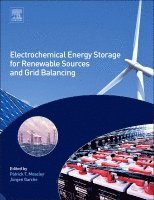
    Electrochemical Energy Storage for Renewable Sources and Grid Balancing

    AvPatrick T. Moseley,J�rgen Garche

    Inbunden, Engelska, 2014

    1 598 kr

    Beställningsvara. Skickas inom 10-15 vardagar. Fri frakt över 249 kr.

    Beskrivning

    Electricity from renewable sources of energy is plagued by fluctuations (due to variations in wind strength or the intensity of insolation) resulting in a lack of stability if the energy supplied from such sources is used in 'real time'. An important solution to this problem is to store the energy electrochemically (in a secondary battery or in hydrogen and its derivatives) and to make use of it in a controlled fashion at some time after it has been initially gathered and stored. Electrochemical battery storage systems are the major technologies for decentralized storage systems and hydrogen is the only solution for long-term storage systems to provide energy during extended periods of low wind speeds or solar insolation. Future electricity grid design has to include storage systems as a major component for grid stability and for security of supply. The technology of systems designed to achieve this regulation of the supply of renewable energy, and a survey of the markets that they will serve, is the subject of this book. It includes economic aspects to guide the development of technology in the right direction.


    • Provides state-of-the-art information on all of the storage systems together with an assessment of competing technologies
    • Features detailed technical, economic and environmental impact information of different storage systems
    • Contains information about the challenges that must be faced for batteries and hydrogen-storage to be used in conjunction with a fluctuating (renewable energy) power supply

    Produktinformation

    • Utgivningsdatum:2014-10-23
    • Mått:216 x 279 x 27 mm
    • Vikt:1 370 g
    • Format:Inbunden
    • Språk:Engelska
    • Antal sidor:492
    • Förlag:Elsevier Science
    • ISBN:9780444626165

    Utforska kategorier

    • Energiteknik inom Naturvetenskap och teknik

    Mer om författaren

    Pat was awarded a Ph. D. for crystal structure analysis in 1968 by the University of Durham, U.K., and a D. Sc. for research publications in materials science, by the same university, in 1994. He worked for 23 years at the Harwell Laboratory of the U.K. Atomic Energy Authority where he brought a background of crystal structure and materials chemistry to the study of lead-acid and other varieties of battery, thus supplementing the traditional electrochemical emphasis of the subject. From1995 he was Manager of Electrochemistry at the International Lead Zinc Research Organization in North Carolina and Program Manager of the Advanced Lead-Acid Battery Consortium. In 2005 he also became President of the Consortium. Dr. Moseley was one of the editors of the Journal of Power Sources for 25 years from 1989 to 2014. In 2008 he was awarded the Gaston Planté medal by the Bulgarian Academy of Sciences. Jürgen Garche, graduated in chemistry at the Dresden University of Technology (DTU) in Germany in 1967. He was awarded his PhD in theoretical electrochemistry in 1970 and his habilitation in applied electrochemistry in 1980 from the same university. He worked at the DTU in the Electrochemical Power Sources Group for many years in different projects, mainly related to conventional batteries, before he moved 1991 to the Centre for Solar Energy and Hydrogen Research (ZSW) in Ulm, where he was, until 2004, the Head of the Electrochemical Energy Storage and Energy Conversion Division.He was Professor of Electrochemistry at Ulm University and Guest Professor at Shandong University – China, 2005, Sapienca University Roma - Italy, 2009, 2013, 2016, and 2023, TUM-CREATE – Singapore, 2014, 2015, 2016- 2016, Dalian Institute of Chemical Physics - China, 2016, CNR Institute for Advanced Energy Technologies, Messina - Italy, 2019. After he retired from the ZSW he founded in 2004 the consulting firm Fuel Cell and Battery Consulting (FCBAT). Since 2015 he is senior professor at Ulm University. He has published more than 300 papers, 10 patents, and 11 books, among others as editor-in-chief of the first edition of Encyclopedia of Electrochemical Power Sources. He is listed in “World’s most Influential Scientific Minds” by Thomas Reuters (2014) and in the book “Profiles of 93 Influential Electrochemists” (2015).

    Innehållsförteckning

    • Introduction – Renewable energies, markets and storage technology classification1. Renewable Energies for power generation – Technologies, potentials, needs for balancing power2. Classification of technologies for balancing power in grids3. Challenges for the power supply systems – grid restrictions, demand side management, conventional power plant operation4. Existing markets and operation profiles for grid connected storage systems – Primary control, secondary control, minute reserve, energy trading, power plant scheduling, UPS systems, self-consumption5. Existing markets for storage systems in off-grid applications6. Review on the need of storage capacities depending on the share of renewable energiesStorage Technologies7. Overview about non-electrochemical storage technologies8. Hydrogen production from renewable energies – electrolyser technologies9. Hydrogen storage technologies10. Hydrogen conversion into electricity and thermal use11. Reversible fuel cell12. Energy carriers made from hydrogen13. Lead–Acid Battery Energy Storage14. Nickel–cadmium Battery Energy Storage15. Sodium High Temperature Batteries Energy Storage16. Lithium-ion Battery Energy Storage17. Redox Flow Battery Energy Storage18. Metal storage / Metal air (Zn, Al, Mg, Li)19. Electrochemical Double Layer CapacitorsSystem Aspects20. Battery management and battery diagnostics21. Life cycle cost calculation and comparison for different reference cases and market segments22. ‘Double use’ storage systems – ‘PV Self-Consumption’ and ‘Vehicle to Grid’