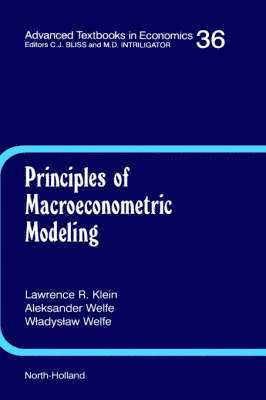
Inbunden, Engelska, 1999
Principles of Macroeconometric Modeling
Av L.R. Klein, W. Welfe, A. Welfe
1557 kr
Skickas inom 5-8 vardagar
Beskrivning
The information revolution has had significant effect on data flows, making them much more timely, accessible, and descriptive of more parts of the economy. At the same time, it has changed the industrial structure of many economies, giving rise to increasing importance of the tertiary sectors (e.g. services). The new generation of hardware and software enables econometricians to handle larger and more complex problems, especially those that are data intensive and computer intrusive.
These major events require reconsideration and redrafting of some of the materials of the original edition.
The present volume retains the original structure of "Lectures on Microeconomic Theory" and takes up principles of constructing dynamic macroeconometric models and their use in economic analyses and forecasting, while introducing many updates, revisions and extensions. The description of the econometric methodology has been limited to specific applications of time series analysis, and the title has been changed to "Principles of Macroeconometric Modeling".
The first four chapters discuss the principles of specifying equations of structural macromodels, covering both developed marked economies, transition economies and world-wide models. The remaining chapters cover some major issues in the use of macromodels. The point of departure is model simulation, especially of the prevailing non-linear models, which is followed by model validation. The analysis of model dynamics covers economic fluctuations and the relevant implications of non-stationarity. The use of macromodels in policy analysis is presented next; it includes multiplier analysis and scenario simulations. The monograph ends up with forecasting being a special case of simulation analysis.
Produktinformation
- Utgivningsdatum: 1999-09-30
- Mått: 156 x 234 x 21 mm
- Vikt: 690 g
- Format: Inbunden
- Språk: Engelska
- Antal sidor: 368
- Förlag: Elsevier Science
- Serie: Advanced Textbooks in Economics (del 36)
- ISBN: 9780444818782
Utforska kategorier
- Inga kategorier tillgängliga.
Betyg & recensioner
0 recensioner
Inga recensioner tillgängliga.