• Fri frakt över 249 kr
  • •
  • Snabba leveranser
  • •
  • Billiga böcker
Kundservice

Du är på sajten för privatpersoner.

Företag, bibliotek eller offentlig verksamhet?

Du handlar på classic.bokus.com, där alla dina funktioner finns intakta.
Till classic.bokus.com
Bokus logotyp. Gå till startsidan.
  • Erbjudanden
  • Nyheter
  • Student
  • Topplistor
  • Barn & ungdom
  • Bokus Play
  • E-böcker
  • Pocketböcker
  • Spel & pussel

10% rabatt på allt med kod NYSTART10 →

Sidfot

Mina sidor

    Hjälp

    • Kundservice
    • Vanliga frågor och svar
    • Frakt och leverans
    • Retur vid ångerrätt
    • Reklamera vara
    • Betalning
    • Köpvillkor
    • Allmänna villkor
    • Information om webbplatsens tillgänglighet

    Om Bokus

    • Om oss
    • Pressrum
    • För studenter
    • För företag
    • För bibliotek och offentlig verksamhet
    • För leverantörer
    • Hållbarhet

    Populärt

    • Aktuella erbjudanden
    • Presentkort
    • Studentlitteratur
    • Nya böcker
    • Topplistor
    • Signerade böcker
    • Engelska böcker

    Inspiration

    • Boktips
    • BookTok
    • Populära bokserier
    • Barnbokskaraktärer
    • Populära författare
    Logotyp för Bokus
    Följ oss på Facebook (extern länk)Följ oss på Instagram (extern länk)Följ oss på YouTube (extern länk)Följ oss på TikTok (extern länk)
    bokus @ CookiesAnpassa cookiesIntegritetspolicyKöpvillkor
    Till Citymail hemsida (extern länk)Till Budbee hemsida (extern länk)Till Postnord hemsida (extern länk)Till Schenker hemsida (extern länk)Till Early Bird hemsida (extern länk)Till Walleys hemsida (extern länk)
    1. Naturvetenskap och teknik
    2. Teknik och industri
    3. Elektronik och kommunikationer

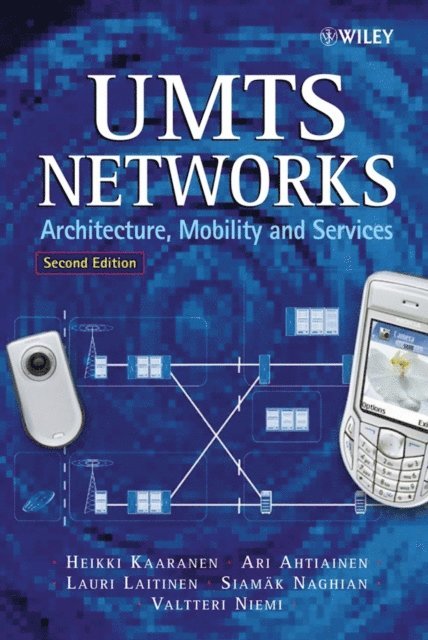
    UMTS Networks

    Architecture, Mobility and Services

    AvHeikki Kaaranen,Ari Ahtiainen

    Inbunden, Engelska, 2005

    1 478 kr

    Beställningsvara. Skickas inom 5-8 vardagar. Fri frakt över 249 kr.

    Beskrivning

    Building on the success of the first edition, UMTS Networks second edition allows readers to continue their journey through UMTS up to the latest 3GPP standardization phase, Release 5. Containing revised, updated and brand new material, it provides a comprehensive view on the UMTS network architecture and its latest developments. Accompanied by numerous illustrations, the practical approach of the book benefits from the authors’ pioneering research and training in this field.  Provides a broad yet detailed overview of the latest worldwide developments in UMTS technology.Includes  brand new sections on the IP Multimedia Subsystem and High Speed Downlink Packet Access according to 3GPP Release 5 specifications.Contains heavily revised sections on the evolution from GSM to UMTS Multi-access, the UMTS Radio Access Network, the UMTS Core Network and services.Includes updated versions on services in the UMTS environment, security in the UMTS environment and UMTS protocols.Illustrates all points with cutting-edge practical examples gleaned from the authors’ research and training at the forefront of UMTS.The illustrative, hands-on approach will appeal to operators, equipment vendors, systems designers, developers and marketing professionals who require comprehensive, practical information on the latest developments in UMTS. This second edition will also benefit students and researchers in the field of mobile networking.

    Produktinformation

    • Utgivningsdatum:2005-02-04
    • Mått:175 x 252 x 30 mm
    • Vikt:935 g
    • Format:Inbunden
    • Språk:Engelska
    • Antal sidor:432
    • Upplaga:2
    • Förlag:John Wiley & Sons Inc
    • ISBN:9780470011034

    Utforska kategorier

    • Elektronik och kommunikationer inom Naturvetenskap och teknik

    Mer om författaren

    Heikki Kaaranen, Cellular System Consultant, OY Aqua Records Ltd, Jokela, FINLAND.Ari Ahtiainen, Senior Research Manager, Nokia Research Center, Mobile Networks, Nokia Group, FINLAND.Lauri Laitinen, Senior Research Engineer, Nokia Research Center, Mobile Networks, Nokia Group, FINLAND.Siamäk Naghian, Competence Manager, NET IP Mobile Networks, Nokia Networks, Nokia Group, FINLAND.Valtteri Niemi, Nokia Research Center, Mobile Networks, Nokia Group, FINLAND.

    Innehållsförteckning

    • Preface xiAcknowledgements xvPART ONE 11 Introduction 31.1 Specification Process for 3G 51.2 Introduction to the 3G Network Architecture 81.2.1 Conceptual Network Model 81.2.2 Structural Network Architecture 91.2.3 Resource Management Architecture 111.2.4 Bearer Architecture 132 Evolution from GSM to UMTS Multi-access 152.1 From Analogue to Digital 162.2 From Digital to Reachability 182.3 Jump to Packet World and Higher Speeds 192.4 3GPP Release 99 212.5 3GPP Release 4 242.6 3GPP Release 5 252.7 Trends beyond 3GPP Release 5 26PART TWO 293 The Key Challenges Facing the Mobile Network Architecture 313.1 Radio Communication Constraints 313.2 Cellular Radio Communication Principles 363.3 Multi-access Techniques 393.4 Device Mobility 443.5 Network Transport 453.6 Transport Alternatives for UMTS 463.6.1 Asynchronous Transfer Mode in UMTS 483.6.2 IPTran sport 493.7 Network Management 513.7.1 High-level Architecture of a Network Management System 513.8 Spectrum and Regulatory 533.8.1 UMTS Spectrum Allocation 564 Overview of UMTS Radio Access Technologies 594.1 WCDMA Essentials 594.1.1 Basic Concepts 604.1.2 WCDMA Radio Channels 654.1.3 WCDMA Frame Structure 724.2 WCDMA Enhancement—HSDPA 754.2.1 Introduction 754.2.2 The Benefits and Impacts 764.2.3 Basic Concept 784.2.4 Adaptive Modulation and Coding 784.2.5 Hybrid Automatic Repeat Request 804.2.6 Fast Scheduling 804.2.7 Seamless Cell Change 814.2.8 Basic Operation and Architectural Considerations 814.3 GSM/EDGE 834.3.1 Basic Concepts 834.3.2 Radio Channels and Frame Structures 854.3.3 General Packet Radio Service (GPRS) 894.3.4 Enhanced Data Rates for Global/GSM Evolution (EDGE) 914.4 WLAN Technology 934.4.1 Physical Technology 934.4.2 Medium Access Control 944.4.3 Network Formation 975 UMTS Radio Access Network 995.1 UTRAN Architecture 1005.2 Base Station (BS, Node B) 1015.2.1 Base Station Structure 1015.2.2 Modulation Method 1035.2.3 Receiver Technique 1065.2.4 Cell Capacity 1085.2.5 Control Functions in BS 1105.3 Radio Network Controller (RNC) 1105.3.1 Radio Resource Management (RRM) 1125.3.2 UTRAN Control Functions 1346 UMTS Core Network 1436.1 UMTS Core Network Architecture 1456.1.1 Core Network Entities that Are Common to All Domains and Subsystems 1466.1.2 CS Domain 1486.1.3 PS Domain 1506.2 CN Management Tasks and Control Duties 1526.2.1 Mobility Management (MM) 1536.2.2 Communication Management (CM) 1676.3 Charging, Billing and Accounting 1736.3.1 Charging and Accounting 1736.3.2 Billing 1766.4 IPMu ltimedia Subsystem (IMS) 1806.5 IPMu ltimedia Subsystem Fundamentals 1816.6 IMS Entities and Functionalities 1856.6.1 Call Session Control Functions (CSCFs) 1856.6.2 Databases 1886.6.3 Interworking Functions 1896.6.4 Service-related Functions 1906.6.5 Support Functions 1916.6.6 Charging Functions 1937 The UMTS Terminal 1957.1 Terminal Architecture 1957.2 Differentiation of Terminals 1997.3 Terminal Capabilities 2037.4 UMTS Subscription 2037.5 User Interface 2058 Services in the UMTS Environment 2078.1 About Services in General 2078.1.1 What Do Users Really Want? 2088.1.2 How Can We Make Money out of This? 2098.1.3 What Are the Most Adequate Design Principles in a Complex System? 2108.1.4 Do Service-related Facts in Mobile Networks Differ from Those in Fixed Networks? 2118.2 Quality of Service (QoS) 2118.2.1 Traffic Classes and QoS Attributes 2118.2.2 About QoS Mechanisms 2168.2.3 ReSerVation Protocol (RSVP) 2178.2.4 Differentiated Services (DiffServ) 2188.2.5 Multi Protocol Label Switching (MPLS) 2198.3 About Service Subsystems 2218.3.1 Services Inherited from the GSM 2218.3.2 UMTS SIM Application Toolkit (USAT) 2238.3.3 Browsing Facilities 2248.3.4 Location Communication Services (LCS) 2268.3.5 IMS Service Mechanism—Messaging 2488.3.6 IMS Service Mechanism—Presence 2498.4 Conclusions 2519 Security in the UMTS Environment 2539.1 Access Security in UMTS 2549.1.1 Legacy from 2G 2559.1.2 Mutual Authentication 2569.1.3 Cryptography for Authentication 2589.1.4 Temporary Identities 2619.1.5 UTRAN Encryption 2629.1.6 Integrity Protection of Radio Resource Control (RRC) Signalling 2649.1.7 Summary of Access Security 2669.2 Additional Security Features in 3GPP R99 2669.2.1 Ciphering Indicator 2669.2.2 Identification of the UE 2669.2.3 Security for Location Services (LCSs) 2689.2.4 User-to-USIM Authentication 2689.2.5 Security in Universal Subscriber Identity Module (USIM) Application Toolkit 2689.3 Security Aspects at the System and Network Level 2689.3.1 Typical Security Attacks 2699.3.2 Overview of 3GPP Network Domain Security 2719.3.3 IPSecu rity (IPSec) 2719.3.4 MAPSec 2749.4 Protection of Applications and Services 2749.4.1 IPMu ltimedia CN Subsystem (IMS) Security 2759.4.2 Examples of Application-layer Security Mechanisms 2799.4.3 Security for Session Layer 2799.4.4 AAA Mechanisms 2809.5 Lawful Interception 280PART THREE 28510 UMTS Protocols 28710.1 Protocol Reference Architectures at 3GPP 28710.1.1 The Radio Interface Protocol Reference Model 28710.1.2 UTRAN Protocol Reference Model 28910.1.3 The CN Protocol Reference Model 29110.2 UMTS Protocol Interworking Architecture 29410.3 Transport Network Protocols 29710.3.1 Transport Network Protocol Architecture 29710.3.2 WCDMA Physical Layer in the Uu Interface 29910.3.3 Backbone Networking in Other Interfaces 30010.3.4 UMTS Transport Network Protocols 30810.4 Radio Network Protocols 31810.4.1 Radio Network Control Plane 31810.4.2 Radio Network User Plane 32610.5 System Network Protocols 33010.5.1 Non-Access Stratum Protocols 33010.5.2 Control Plane between CN Nodes 33910.5.3 The User Plane in the System Network 34110.6 Summary of UMTS Network Protocols 34110.7 Overview of IMS Protocols 34511 Procedure Examples 35111.1 Elementary Procedures 35111.1.1 Paging 35311.1.2 RRC Connection Set-up 35411.1.3 Transaction Reasoning 35611.1.4 Authentication and Security Control 35711.1.5 Transaction Set-up with Radio Access Bearer (RAB) Allocation 35811.1.6 Transaction 36011.1.7 Transaction Clearing and RAB Release 36011.1.8 RRC Connection Release 36411.2 RRM Procedure Examples 36411.2.1 Soft Handover—Link Addition and Link Deletion 36411.2.2 SRNS Relocation—Circuit Switched 36711.2.3 Inter-System Handover from UMTS to GSM—Circuit Switched 36911.3 MM Procedure Examples 37111.3.1 Cell Update 37111.3.2 URA Update 37311.3.3 Location Update to the CN CS Domain 37311.3.4 Routing Area Update to the CN PS Domain 37411.4 CC Procedure Example 37611.5 Packet Data Example 37811.6 IMS Examples 37911.6.1 IMS Registration Example 38011.6.2 IMS Session Example 383List of Abbreviations 387Bibliography 399Index 401