• Fri frakt över 249 kr
  • •
  • Snabba leveranser
  • •
  • Billiga böcker
Kundservice

Du är på sajten för privatpersoner.

Företag, bibliotek eller offentlig verksamhet?

Du handlar på classic.bokus.com, där alla dina funktioner finns intakta.
Till classic.bokus.com
Bokus logotyp. Gå till startsidan.
  • Erbjudanden
  • Nyheter
  • Student
  • Topplistor
  • Barn & ungdom
  • Bokus Play
  • E-böcker
  • Pocketböcker
  • Spel & pussel

10% rabatt på allt med kod NYSTART10 →

Sidfot

Mina sidor

    Hjälp

    • Kundservice
    • Vanliga frågor och svar
    • Frakt och leverans
    • Retur vid ångerrätt
    • Reklamera vara
    • Betalning
    • Köpvillkor
    • Allmänna villkor
    • Information om webbplatsens tillgänglighet

    Om Bokus

    • Om oss
    • Pressrum
    • För studenter
    • För företag
    • För bibliotek och offentlig verksamhet
    • För leverantörer
    • Hållbarhet

    Populärt

    • Aktuella erbjudanden
    • Presentkort
    • Studentlitteratur
    • Nya böcker
    • Topplistor
    • Signerade böcker
    • Engelska böcker

    Inspiration

    • Boktips
    • BookTok
    • Populära bokserier
    • Barnbokskaraktärer
    • Populära författare
    Logotyp för Bokus
    Följ oss på Facebook (extern länk)Följ oss på Instagram (extern länk)Följ oss på YouTube (extern länk)Följ oss på TikTok (extern länk)
    bokus @ CookiesAnpassa cookiesIntegritetspolicyKöpvillkor
    Till Citymail hemsida (extern länk)Till Budbee hemsida (extern länk)Till Postnord hemsida (extern länk)Till Schenker hemsida (extern länk)Till Early Bird hemsida (extern länk)Till Walleys hemsida (extern länk)
    1. Ekonomi och Ledarskap
    2. Ledarskapsböcker
    3. Projektledning

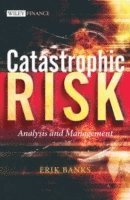
    Catastrophic Risk

    Analysis and Management

    AvErik Banks

    Inbunden, Engelska, 2005

    Del 320 i serien Wiley Finance Series

    939 kr

    Beställningsvara. Skickas inom 5-8 vardagar. Fri frakt över 249 kr.

    Fler format och utgåvor

    E-bok

    1 105 kr

    Beskrivning

    Catastrophic risk is one of the most significant and challenging areas of corporate risk management. Analyze this risk for your company with Catastrophic Risk and make sure you have sufficient resources to absorb losses and avoid financial distress. The first comprehensive volume to address this topic from a financial perspective, this book is a guide to the worst financial risks threatening companies and industries today. Author Eric Banks begins with a consideration of ?catastrophe? and its mplications, looks at the state of actuarial and financial modelling of catastrophe risks, and discusses the creation of a risk management framework that will enable the efficient and secure management of exposure. Catastrophic Risk is essential reading if you're a corporate treasurer, CFO, or insurance/financial risk manager responsible for corporate risk management. Order your copy today.

    Produktinformation

    • Utgivningsdatum:2005-03-18
    • Mått:177 x 249 x 19 mm
    • Vikt:482 g
    • Format:Inbunden
    • Språk:Engelska
    • Serie:Wiley Finance Series
    • Antal sidor:192
    • Förlag:John Wiley & Sons Inc
    • ISBN:9780470012369

    Utforska kategorier

    • Projektledning inom Ekonomi och Ledarskap

    Mer om författaren

    ERIK BANKS, an independent risk consultant, writer, and lecturer, has held senior risk management positions at several global financial institutions over the past 20 years, including Merrill Lynch, Citibank, and XL Capital. He is the author of 18 books on risk, derivatives, governance, and merchant banking, including the John Wiley titles Alternative Risk Transfer, Exchange-Traded Derivatives, The Simple Rules of Risk, and E-Finance.

    Recensioner i media

    "...useful to have at hand...Risk, of whatever nature, remains something that needs to be addressed at all times." (Accounting Technician, August 2005) “It is a beautifully clear book…enlightening… one which turns a complex and potentially off-putting subject into a remarkably interesting one.” (Strategic Risk, June 2007)

    Innehållsförteckning

    • Acknowledgments ixAbout the author xiPART I IDENTIFICATION AND ANALYSIS OF CATASTROPHIC RISK 11 Catastrophe and Risk 31.1 Introduction 31.2 The nature of catastrophe 51.2.1 A definition 51.2.2 Frequency 51.2.3 Vulnerability 81.2.4 Measuring severity 111.3 The scope of impact 111.4 Catastrophe and the risk management framework 131.5 Overview of the book 152 Risk Identification I: Perils 172.1 Natural catastrophe 182.1.1 Geophysical 192.1.2 Meteorological/atmospheric 222.1.3 Other natural disasters 262.2 Man-made catastrophe 292.2.1 Terrorism 292.2.2 Industrial contamination 312.2.3 Technological failure 322.2.4 Financial dislocation 332.3 Mega-catastrophe and clash loss 343 Risk Identification II: Regional Vulnerability 353.1 Spatial impact of natural catastrophes 363.1.1 Bermuda and the North American Atlantic Coast 363.1.2 Florida 363.1.3 North American West Coast 373.1.4 US Great Plains/Midwest 383.1.5 Caribbean 393.1.6 Mexico 393.1.7 Japan 403.1.8 South Asia/Southeast Asia 413.1.9 Middle East/Near East 433.1.10 Europe 433.2 Spatial impact of man-made catastrophes 443.2.1 North America 463.2.2 Europe 473.2.3 Asia/Pacific 473.3 Urban vulnerabilities 474 Modeling Catastrophic Risk 494.1 The development and use of models 494.2 The goals of catastrophe modeling 504.3 General model construction 514.3.1 Phase one: Hazard/peril assessment 524.3.2 Phase two: Vulnerability assessment 554.3.3 Phase three: Contract assessment 594.3.4 A general example 604.3.5 Other perils 634.4 Challenges 644.4.1 Model characteristics and assumptions 654.4.2 Model validation 664.4.3 Tail risks 674.4.4 Data quality and granularity 67PART II MANAGEMENT OF CATASTROPHIC RISK 695 Catastrophe and the Risk Management Framework 715.1 Active risk management 715.1.1 Enterprise value, liquidity, and solvency 725.1.2 Loss control, loss financing, and risk reduction 745.2 Risk monitoring 815.3 Private and public sector efforts 825.4 Sources of capital 835.4.1 Insurers/reinsurers 835.4.2 Investment funds 845.4.3 Financial institutions 855.5 Toward active risk management 856 Catastrophe Insurance and Reinsurance 876.1 Insurable risk and insurance 876.1.1 Full insurance 886.1.2 Partial insurance 886.1.3 Captives 896.2 Catastrophe insurance 896.3 Reinsurance 926.3.1 Facultative and treaty reinsurance 926.3.2 Proportional and excess of loss agreements 936.4 Catastrophe reinsurance 956.5 Market cycles 986.6 Internal risk management 1016.7 Challenges 1036.7.1 Pricing difficulties 1036.7.2 Earnings and capital volatility 1046.7.3 Concentrations 1066.7.4 Limits to insurability/uninsurable risks 1066.7.5 Lack of insurance/reinsurance penetration 1076.7.6 Capacity constraints 1076.7.7 Contagion effects and systemic concerns 1087 Catastrophe Bonds and Contingent Capital 1117.1 Overview of securitization 1117.2 Catastrophe bonds 1127.2.1 Standard structures 1127.2.2 Innovations 1207.2.3 Market focus and direction 1237.3 Contingent capital 1247.3.1 Standard structures 1257.3.2 Contingent debt 1267.3.3 Contingent equity 1287.4 Challenges 1317.4.1 Structural flaws 1327.4.2 Regulatory differences 1328 Catastrophe Derivatives 1358.1 Overview of derivatives 1358.1.1 Exchange-traded derivatives 1368.1.2 OTC derivatives 1378.2 Exchange-traded catastrophe derivatives 1398.3 OTC Catastrophe derivatives 1408.3.1 Catastrophe reinsurance swaps 1408.3.2 Pure catastrophe swaps 1428.3.3 Synthetic OTC structures 1428.4 Challenges 1448.4.1 Index construction and basis risks 1448.4.2 Lack of contract transparency 1448.4.3 One-way markets 1458.4.4 Pricing difficulties 1458.4.5 Regulatory barriers 1459 Public Sector Management and Financing 1479.1 Forms of public sector involvement 1479.1.1 Ex ante loss control measures 1479.1.2 Insurance/reinsurance 1489.1.3 Ex post crisis management 1569.1.4 Financing and subsidies 1579.1.5 Financial regulation 1589.2 Challenges 1599.2.1 Voluntary versus mandatory measures 1599.2.2 Public and private sector responsibilities 1609.2.3 Lack of market access and capacity 16110 Outlook and Conclusions 16310.1 Loss control 16310.1.1 Loss control implementation 16310.1.2 Enforcing urban planning 16310.2 Quantification 16410.2.1 Modeling requirements 16410.2.2 Transparency 16410.2.3 Complexity of terrorism 16510.3 Loss financing 16510.3.1 Vulnerabilities and risk capacity 16510.3.2 Discriminatory funding and insurance 16610.4 Government participation 16610.4.1 Optimal government role 16610.4.2 Limited government resources 16710.4.3 Adverse incentives 16710.4.4 Market deregulation 16810.5 General management 16810.5.1 Sub-optimal management 16810.5.2 Sustainability of solutions 16910.5.3 Preparing for the mega-catastrophe 16910.5.4 Amalgamated solutions 16910.5.5 Learning from past events 170Bibliography 171Index 175