• Fri frakt över 249 kr
  • •
  • Snabba leveranser
  • •
  • Billiga böcker
Kundservice

Du är på sajten för privatpersoner.

Företag, bibliotek eller offentlig verksamhet?

Du handlar på classic.bokus.com, där alla dina funktioner finns intakta.
Till classic.bokus.com
Bokus logotyp. Gå till startsidan.
  • Erbjudanden
  • Nyheter
  • Student
  • Topplistor
  • Barn & ungdom
  • Bokus Play
  • E-böcker
  • Pocketböcker
  • Spel & pussel

Må bättre, för mindre! Upp till 50% rabatt på hälsoböcker

Sidfot

Mina sidor

    Hjälp

    • Kundservice
    • Vanliga frågor och svar
    • Frakt och leverans
    • Retur vid ångerrätt
    • Reklamera vara
    • Betalning
    • Köpvillkor
    • Allmänna villkor
    • Information om webbplatsens tillgänglighet

    Om Bokus

    • Om oss
    • Pressrum
    • För studenter
    • För företag
    • För bibliotek och offentlig verksamhet
    • För leverantörer
    • Hållbarhet

    Populärt

    • Aktuella erbjudanden
    • Presentkort
    • Studentlitteratur
    • Nya böcker
    • Topplistor
    • Signerade böcker
    • Engelska böcker

    Inspiration

    • Boktips
    • BookTok
    • Populära bokserier
    • Barnbokskaraktärer
    • Populära författare
    Logotyp för Bokus
    Följ oss på Facebook (extern länk)Följ oss på Instagram (extern länk)Följ oss på YouTube (extern länk)Följ oss på TikTok (extern länk)
    bokus @ CookiesAnpassa cookiesIntegritetspolicyKöpvillkor
    Till Citymail hemsida (extern länk)Till Budbee hemsida (extern länk)Till Postnord hemsida (extern länk)Till Schenker hemsida (extern länk)Till Early Bird hemsida (extern länk)Till Walleys hemsida (extern länk)
    1. Ekonomi och Ledarskap
    2. Företagsekonomi
    3. Redovisning och finansiering
    4. Finansiering

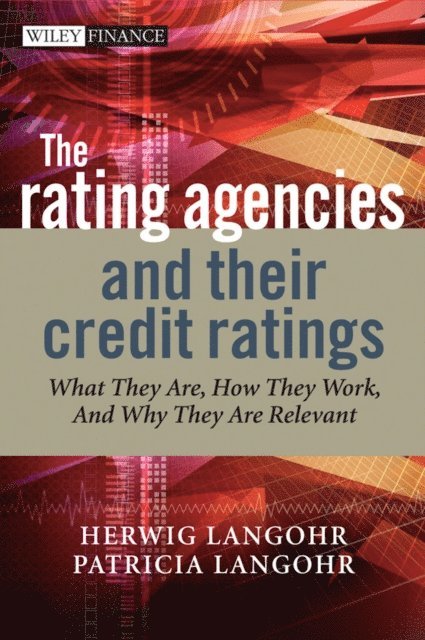
    Rating Agencies and Their Credit Ratings

    What They Are, How They Work, and Why They are Relevant

    AvHerwig Langohr,Patricia Langohr

    Inbunden, Engelska, 2009

    Del 661 i serien Wiley Finance Series

    853 kr

    Beställningsvara. Skickas inom 5-8 vardagar. Fri frakt över 249 kr.

    Beskrivning

    Credit rating agencies play a critical role in capital markets, guiding the asset allocation of institutional investors as private capital moves freely around the world in search of the best trade-off between risk and return. However, they have also been strongly criticised for failing to spot the Asian crisis in the early 1990s, the Enron, WorldCom and Parmalat collapses in the early 2000s and finally for their ratings of subprime-related structured finance instruments and their role in the current financial crisis. This book is a guide to ratings, the ratings industry and the mechanics and economics of obtaining a rating. It sheds light on the role that the agencies play in the international financial markets. It avoids the sensationalist approach often associated with studies of rating scandals and the financial crisis, and instead provides an objective and critical analysis of the business of ratings. The book will be of practical use to any individual who has to deal with ratings and the ratings industry in their day-to-day job.Reviews"Rating agencies fulfil an important role in the capital markets, but given their power, they are frequently the object of criticism.  Some of it is justified but most of it portrays a lack of understanding of their business.  In their book The Rating Agencies and their Credit Ratings, Herwig and Patricia Langohr provide an excellent economic background to the role of rating agencies and also a thorough understanding of their business and the problems they face.  I recommend this book to all those who have an interest in this somewhat arcane but extremely important area."-Robin Monro-Davies, Former CEO, Fitch Ratings. "At a time of unprecedented public and political scrutiny of the effectiveness and indeed the basic business model of the Credit Rating industry, and heightened concerns regarding the transparency and accountability of the leading agencies, this book provides a commendably comprehensive overview, and should provide invaluable assistance in the ongoing debate."-Rupert Atkinson, Managing Director, Head of Credit Advisory Group, Morgan Stanley and member of the SIFMA Rating Agency Task Force "The Langohrs have provided useful information in a field where one frequently finds only opinions or misconceptions. They supply a firm base from which to understand changes now underway. A well-read copy of this monograph should be close to the desk of every investor, issuer and financial regulator, legislator or commentator."-John Grout, Policy and Technical Director, The Association of Corporate Treasurers

    Produktinformation

    • Utgivningsdatum:2009-01-23
    • Mått:175 x 246 x 36 mm
    • Vikt:1 066 g
    • Format:Inbunden
    • Språk:Engelska
    • Serie:Wiley Finance Series
    • Antal sidor:528
    • Förlag:John Wiley & Sons Inc
    • ISBN:9780470018002

    Utforska kategorier

    • Finansiering inom Ekonomi och Ledarskap

    Mer om författaren

    HERWIG LANGOHR was Professor of Finance and Banking at INSEAD, in Fontainebleau, France, which he joined in 1976, specialising in corporate finance, financial services and corporate governance. Professor Langohr served on several boards of directors, including the Board of Directors and the Audit Committee of the financial services group KBC Group N.V. He was also a regular advisor in corporate finance and strategy in the banking sector. He contributed to academic journals such as The Journal of Monetary Economics, The Journal of Financial Economics and The Journal of Money, Credit and Banking and a number of professional journals. He passed away on 28 May 2008 at the age of 64.PATRICIA LANGOHR is Professor of Economics at the ESSEC Business School, in Cergy, France, since 2005. Her research specializes in industrial organization, dynamic models of competition and the financial services industry. Prior to that, she was a researcher at the Bureau of Labor Statistics in Washington D.C. Professor Langohr obtained her PhD in Managerial Economics from Kellogg at Northwestern University. She has a Diploma in Economics from the Humboldt Universität in Berlin and a Maîtrise in Monetary Economics and Banking from the Université Paris IX Dauphine.

    Innehållsförteckning

    • Foreword ixPreface xiii1 Introduction 11.1 Context and Premises 11.1.1 The Benchmarking of Default Prospects Remains Deeply Rooted in Business Analysis 11.1.2 Credit Ratings Play a Unique Role in Overcoming Information Asymmetries on the Information Exchanges 91.1.3 Under the Spotlight as Unique Infomediaries, the CRAs became Strictly Regulated 131.2 Book Chapters 171.3 Supporting Materials 18Part A Credit Rating Foundations 212 Credit Ratings 232.1 The World of Corporate Defaults 242.1.1 What are Corporate Defaults? 272.1.2 The Drivers of Corporate Defaults 352.1.3 Recovery Rates from Defaults 392.2 Credit Rating Scales 402.2.1 Fundamental Ordinal Credit Rating Scales 432.2.2 Rating Scales and Observed Bond Market Credit Spreads 642.2.3 Market-Implied Cardinal Rating Scales and Default Probabilities 722.3 The Interpretation of Credit Ratings 742.3.1 Interpreting from the Scale 752.3.2 Correctly Interpreting versus Misinterpreting Ratings 782.3.3 Special Issues 852.4 Credit Ratings: Summary and Conclusions 883 The Raison d’Etre ˆ of Credit Ratings and their Market 893.1 Needs for Credit Ratings – or the Demand Side of Ratings 893.1.1 Principals: Issuers/Borrowers 913.1.2 Principals: Fixed Income Investors 993.1.3 Prescribers 1043.2 Credit Ratings as a Solution to Information Asymmetry: Economic Analysis 1113.2.1 Economics of Ratings: Intuition 1113.2.2 Economics of Ratings: Analysis 1133.2.3 The Economic Analysis of Ratings: Summary and Implications 1243.3 Credit Rating Segments – or Scale and Scope of the Rated Universe 1263.3.1 Industry Segments or Type of Rated Issuers 1263.3.2 Product Segments or Types of Rated Issues 1383.3.3 Geographical Segments or Location of the Obligor 1493.4 Summary 1583.5 Technical Appendix 1584 How to Obtain and Maintain a Credit Rating 1614.1 The Rating Preparation 1614.1.1 The Issuer Client 1634.1.2 The Rating Adviser-Intermediary 1654.1.3 The Credit Rating Agency Supplier 1684.2 The Rating 1704.2.1 The Rating Action 1704.2.2 Rating Follow-Up 1744.2.3 The Rating Agreement 1794.3 Quality of the Rating Process 1874.3.1 Objectivity 1884.3.2 Diligence 1894.3.3 Transparency 191Part B Credit Rating Analysis 1955 The France Telecom Credit Rating Cycle: 1995–2004 1975.1 From Sovereign Status to Near Speculative Grade (1995–2002) 1985.1.1 How Sovereign Aaa Status of June 1995 Adjusts to Corporate Aa1 in July 1996 1985.1.2 A Company that went Public on Aa1 Status in October 1997 is Downgraded to Aa2 in December 1999 2005.1.3 Rapid Extension of FT’s Reach and Two Notches Downgrade to A1 in September 2000 2025.1.4 A Wake-up Call: the Orange IPO and Surprise Two Notches Downgrade to A3 in February 2001 2115.1.5 The Slide Downward to Baa1 in September 2001 2195.1.6 Looming Crisis and Two Notches Downgrade to Baa3 in June 2002 2225.2 Turning Point and Rating Recovery (Fall 2002–Winter 2004) 2295.2.1 Improvement in Outlook in September 2002 2295.2.2 A New Start in October 2002 and Recovery Actions 2385.2.3 Recovery Implementation and the Sequence of Rating Upgrades through February 2005 2445.3 Analysis and Evaluation 2475.3.1 Risk Shifting at France Telecom and its Fundamental and MarketImplied Ratings 2485.3.2 The Restraint of the CRAs during the 2002 Crisis 2535.3.3 The Value of Ratings to Issuers 2546 Credit Rating Analysis 2576.1 Fundamental Corporate Credit Ratings 2576.1.1 Corporate Credit Risk2 2576.1.2 Credit Risk of Corporate Debt Instruments 2606.1.3 Putting it All Together: the Rating8 2656.2 Corporate Ratings Implied by Market Data 2746.2.1 The Concept 2746.2.2 Mechanics of Extracting Default Probabilities from Market Prices21 2766.2.3 Market-Implied Ratings 2846.3 Special Sector Ratings 2866.3.1 Sovereign Ratings 2866.3.2 Financial Strength Ratings 2916.3.3 Structured Finance Instruments Ratings 2966.4 Technical Appendix 3046.4.1 Step 1: Computing the Implied Market Value of Assets and Asset Volatility 3056.4.2 Step 2: Computing the Distance to Default 3056.4.3 Step 3: Calculating the Default Probability Corresponding to the Distance to Default 3067 Credit Rating Performance 3077.1 Relevance: Ratings and Value 3077.1.1 Structural Relevance: Rating and Credit Spreads 3107.1.2 Impact Relevance: Rating Actions and Security Price Changes 3257.1.3 Evaluation: How Relevant are Fundamental Credit Ratings? 3317.2 Preventing Surprise in Defaults: Rating Accuracy and Stability 3327.2.1 Metrics of Accuracy and Stability 3347.2.2 Analysis of the Prevention of Surprise in Defaults 3537.2.3 Summary, Evaluation and Conclusion 3567.3 Efficiency Enhancement: Stabilization in Times of Crisis? 3567.3.1 The Asian Macroeconomic Financial Crisis 3567.3.2 The Western Microeconomic Equity Crisis 3637.3.3 The Subprime Mortgage Related Crisis 3647.3.4 Criticisms: the Ratings in Crisis? 369Part C The Credit Rating Business 3718 The Credit Rating Industry 3758.1 The Rise of the Credit Rating Agencies 3758.1.1 Origins 3758.1.2 Macroeconomic Forces Shaping the Current Industry 3788.1.3 The Current Structure of the Industry 3848.2 Industry Specifics and How They Affect Competition 4078.2.1 Agencies Compete for the Market rather than in the Market 4078.2.2 The Business Model and Profit Drivers 4118.2.3 Some Dynamic Aspects of Competition among CRAs: A Small Number of Players can be Consistent with Intense Rivalry 4188.3 Industry Performance 4198.3.1 Performance for CRA Shareholders 4198.3.2 Performance of Ratings as a Public Good 4208.3.3 Performance for Issuers 4278.3.4 Performance for Investors 4278.4 Conclusion 4289 Regulatory Oversight of the Credit Rating Industry 4299.1 The Regulatory Uses of Ratings 4309.1.1 Prudence 4359.1.2 Market Access 4369.1.3 Investor Protection 4399.2 The Regulation of the Industry 4409.2.1 The Regulatory Options 4409.2.2 Worldwide Regulatory Initiative: the 2004 IOSCO Code of Conduct 4439.2.3 The 2005 European Union Policy on Credit Rating Agencies 4449.2.4 The US ‘Credit Rating Agency Reform Act of 2006’ 4489.3 Analysis and Evaluation 4559.3.1 The EU and the US Approaches Compared 4559.3.2 The Positions of the Main Stakeholders 4619.3.3 Comments and Evaluation on Regulatory Options 46610 Summary and Conclusions 46910.1 The Challenges Facing Rating Agencies Today 46910.1.1 From Regulatory Legitimacy to Market Legitimacy 46910.1.2 Financial Innovation 47210.1.3 Growth and Globalization 47310.2 Conclusion 473References 475Index 495