• Fri frakt över 249 kr
  • •
  • Snabba leveranser
  • •
  • Billiga böcker
Kundservice

Du är på sajten för privatpersoner.

Företag, bibliotek eller offentlig verksamhet?

Du handlar på classic.bokus.com, där alla dina funktioner finns intakta.
Till classic.bokus.com
Bokus logotyp. Gå till startsidan.
  • Erbjudanden
  • Nyheter
  • Student
  • Topplistor
  • Barn & ungdom
  • Bokus Play
  • E-böcker
  • Pocketböcker
  • Spel & pussel

10% rabatt på allt med kod: NYSTART10 →

Sidfot

Mina sidor

    Hjälp

    • Kundservice
    • Vanliga frågor och svar
    • Frakt och leverans
    • Retur vid ångerrätt
    • Reklamera vara
    • Betalning
    • Köpvillkor
    • Allmänna villkor
    • Information om webbplatsens tillgänglighet

    Om Bokus

    • Om oss
    • Pressrum
    • För studenter
    • För företag
    • För bibliotek och offentlig verksamhet
    • För leverantörer
    • Hållbarhet

    Populärt

    • Aktuella erbjudanden
    • Presentkort
    • Studentlitteratur
    • Nya böcker
    • Topplistor
    • Signerade böcker
    • Engelska böcker

    Inspiration

    • Boktips
    • BookTok
    • Populära bokserier
    • Barnbokskaraktärer
    • Populära författare
    Logotyp för Bokus
    Följ oss på Facebook (extern länk)Följ oss på Instagram (extern länk)Följ oss på YouTube (extern länk)Följ oss på TikTok (extern länk)
    bokus @ CookiesAnpassa cookiesIntegritetspolicyKöpvillkor
    Till Citymail hemsida (extern länk)Till Budbee hemsida (extern länk)Till Postnord hemsida (extern länk)Till Schenker hemsida (extern länk)Till Early Bird hemsida (extern länk)Till Walleys hemsida (extern länk)
    1. Kultur
    2. Arkitektur

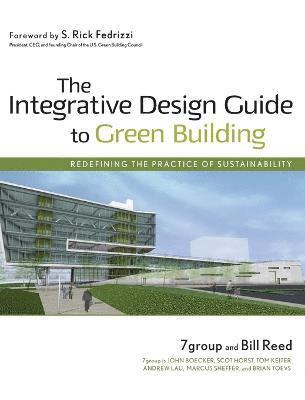
    Integrative Design Guide to Green Building

    Redefining the Practice of Sustainability

    Av7group,Bill Reed

    Inbunden, Engelska, 2009

    Del 43 i serien Wiley Series in Sustainable Design

    1 109 kr

    Beställningsvara. Skickas inom 5-8 vardagar. Fri frakt över 249 kr.

    Beskrivning

    "The members of 7group and Bill Reed are examples writ large of the kind of leadership that is taking this idea of green building and forming it into reality, by helping change minds, building practice, and design process."—from the Foreword by S. Rick Fedrizzi President, CEO, and Founding Chair, U.S. Green Building CouncilA whole-building approach to sustainabilityThe integrative design process offers a new path to making better green building decisions and addressing complex issues that threaten living systems. In The Integrative Design Guide to Green Building: Redefining the Practice of Sustainability, 7group's principals and integrative design pioneer Bill Reed introduce design and construction professionals to the concepts of whole building design and whole systems. With integrative thinking that reframes what sustainability means, they provide a how-to guide for architects, designers, engineers, developers, builders, and other professionals on incorporating integrative design into every phase of a project.This practical manual: Explains the philosophy and underpinnings of effective integrative design, addressing systems thinking and building and community design from a whole-living system perspectiveDetails how to implement integrative design from the discovery phase to occupancy, supported by process outlines, itemized tasks, practice examples, case studies, and real-world stories illustrating the nature of this workExplores the deeper understanding of integration that is required to transform architectural practice and our role on the planetThis book, both practical and thoughtful, will help you deliver your vision of a sustainable environment.

    Produktinformation

    • Utgivningsdatum:2009-04-29
    • Mått:211 x 238 x 29 mm
    • Vikt:1 007 g
    • Format:Inbunden
    • Språk:Engelska
    • Serie:Wiley Series in Sustainable Design
    • Antal sidor:416
    • Förlag:John Wiley & Sons Inc
    • Medarbetare:S.Rick Fedrizzi
    • ISBN:9780470181102

    Utforska kategorier

    • Arkitektur inom Kultur

    Mer om författaren

    7group, based in Kutztown, Pennsylvania, includes principals John Boecker, Scot Horst, Tom Keiter, Andrew Lau, Marcus Sheffer, and Brian Toevs, who bring a unique integration of expertise in design, engineering, energy and daylight modeling, materials assessments, commissioning, education, and communications to their work. Internationally recognized thought leaders in the green building movement, they have led countless teams through the practical implementation of integrative design on building projects of all types around the world. 7group also has been directly and deeply involved with the development of the LEED Green Building Rating System, including experience on more than 100 LEED projects. Scot Horst currently serves as chair of the U.S. Green Building Council’s LEED Steering Committee. Bill Reed is an architect and internationally recognized proponent and practitioner of integrative design. He is a principal in three firms: the Integrative Design Collaborative, Regenesis, Inc., and Delving Deeper—organizations working to lift development into full integration with living systems. He served as co-chair of the LEED Technical Committee from its inception in 1994 through 2003, is a member of the LEED Advanced faculty, and one of the first of twelve USGBC trainers of the LEED Rating System.

    Recensioner i media

    "The book is an in-depth study of sustainable design practices, but particularly as it relates to new building construction. The book's primary audience is commercial construction consultants. However, their concepts apply to residential design, too." (The Designer, Winter 2009/2010)

    Innehållsförteckning

    • Acknowledgments ixForeword xiIntroduction xiiiChapter 1: Many Minds 1From Master Builder to the Twenty-first Century: Where We Are and How We Got Here 1The Master Builder 1The Siena Duomo 5The Age of Specialization 8Stop and Reflect: Our Current Process 9Siloed Optimization 9The Abyss between Design and Construction Professionals 10Doing Less Damage by Adding Technologies 11The Call Before Us 13Chapter 2: Building as an Organism 15A Shift in Thinking: No Part or System in Isolation 15Buildings as Organisms 23Tunneling through the Cost Barrier 24Lessons Learned from High-Performance Windows 25Project Teams as Organisms 29Fostering an Interdisciplinary Process: “A Deer in the Headlights” 31A Team of Colearners and the Learning Wheel 34The Composite Master Builder 39Chapter 3: Reframing Sustainability 41What Is Sustainability? 41The Trajectory of Sustainability Practice 44The Technical Story of the Willow School 47A More Compelling and Vital Story of Place 47Re-Membering Our Role in Nature 48Reciprocal Relationships within the Larger System 51The Role of the Mental Model: From Products to a New Mind-set 52Nested Subsystems 54Solving for Pattern 58Chapter 4: Aligning Values, Purpose, and Process 61Introduction to the Discovery Phase X 61The Four Es 62Questioning Assumptions 63Creating Alignment 64Aligning the Team 64Aligning with the Client 66Fostering an Iterative Process 68Integrating Intentions with Purpose 68The Four Key Subsystems 70Aligning Dollars and Resources 80The “Touchstones” Exercise 82Aligning with Values 87Redefining Success 98Chapter 5: The Discovery Phase 99This Is Not a Cookbook 99Here’s Where We Are 101Stop and Reflect 101What’s Working? 102What’s Not Working? 102How Can We Do (and Think about) This Differently? 103Integrative Process Overview 103Three-part Structure 107Part A: Discovery 108Part B: Design and Construction 108Part C: Occupancy, Operations, and Performance Feedback 108Part A: Discovery 109Stage A.1—Research and Analysis: Preparation 110Stage A.2—Workshop No. 1: Alignment of Purpose and Goal-Setting 127Stage A.3—Research and Analysis: Evaluating Possible Strategies 145Stage A.4—Workshop No. 2: Conceptual Design Exploration 157Stage A.5—Research and Analysis: Testing Conceptual Design Ideas 168Chapter 6: Schematic Design 197Entering Part B—Design and Construction 197Here’s Where We Are 202Stop and Reflect 203What’s Working? 203What’s Not Working? 203How Can We Do (and Think about) This Differently? 205Questioning Assumptions 205Engaging an Interdisciplinary Process 206Creating Alignment 209Mental Model Shift 214Life Cycle Assessment (LCA) Tools and Environmental Benefits 214Energy-Modeling Tools and Costs Benefits 218Revisiting Nested Subsystems 219Part B: Design and Construction 220Stage B.1—Workshop No. 3: Schematic Design Kickoff—Bringing It All Together (without committing to building form) 221Stage B.2—Research and Analysis: Schematic Design—Bringing It All Together (and now committing to building form) 237Chapter 7: Design Development and Documentation 259Here’s Where We Are 260Stop and Reflect 262What’s Working? 262What’s Not Working? 258How Can We Do (and Think about) This Differently? 263Stage B.3—Workshop No. 4: Design Development Kickoff—It Is Brought Together; Does It Work? 267Stage B.4—Research and Analysis: Design Development—Optimization 278Stage B.5—Workshop No. 5: Construction Documents Kickoff—Perfomance Verification and Quality Control 299Stage B.6—Construction Documents—No More Designing 304Chapter 8: Construction, Operations, and Feedback 309The Evolving Commissioning Process 310Learning From Feedback 312Here’s Where We Are 314Stop and Reflect 315What’s Working? 315What’s Not Working? 316How Can We Do (and Think about) This Differently? 322Stage B.7—Bidding and Construction—Aligning with the Builder: Becoming a Team 330Part C—Occupancy, Operations, and Performance Feedback 346Stage C.1—Occupancy: Feedback from All Systems 347The Call for Performance Feedback 347Epilogue—Evolving the Field 375A Transformational Process 376Shifting the Paradigm 377The Fifth System 385Index 387