• Fri frakt över 249 kr
  • •
  • Snabba leveranser
  • •
  • Billiga böcker
Kundservice

Du är på sajten för privatpersoner.

Företag, bibliotek eller offentlig verksamhet?

Du handlar på classic.bokus.com, där alla dina funktioner finns intakta.
Till classic.bokus.com
Bokus logotyp. Gå till startsidan.
  • Erbjudanden
  • Student
  • Topplistor
  • Barn & ungdom
  • Bokus Play
  • E-böcker
  • Ljudböcker
  • Pocketböcker
  • Spel & pussel

10% rabatt på allt med kod NYSTART10 →

Sidfot

Mina sidor

    Hjälp

    • Kundservice
    • Vanliga frågor och svar
    • Frakt och leverans
    • Retur vid ångerrätt
    • Reklamera vara
    • Betalning
    • Köpvillkor
    • Allmänna villkor
    • Information om webbplatsens tillgänglighet

    Om Bokus

    • Om oss
    • Pressrum
    • För studenter
    • För företag
    • För bibliotek och offentlig verksamhet
    • För leverantörer
    • Hållbarhet

    Populärt

    • Aktuella erbjudanden
    • Presentkort
    • Studentlitteratur
    • Nya böcker
    • Topplistor
    • Signerade böcker
    • Engelska böcker

    Inspiration

    • Boktips
    • BookTok
    • Populära bokserier
    • Barnbokskaraktärer
    • Populära författare
    Logotyp för Bokus
    Följ oss på Facebook (extern länk)Följ oss på Instagram (extern länk)Följ oss på YouTube (extern länk)Följ oss på TikTok (extern länk)
    bokus @ CookiesAnpassa cookiesIntegritetspolicyKöpvillkor
    Till Citymail hemsida (extern länk)Till Budbee hemsida (extern länk)Till Postnord hemsida (extern länk)Till Schenker hemsida (extern länk)Till Early Bird hemsida (extern länk)Till Walleys hemsida (extern länk)
    1. Data och IT
    2. Systemvetenskap och AI

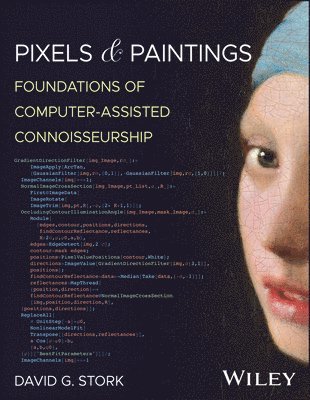
    Pixels & Paintings

    Foundations of Computer-assisted Connoisseurship

    AvDavid G. Stork

    Inbunden, Engelska, 2023

    1 868 kr

    Beställningsvara. Skickas inom 5-8 vardagar. Fri frakt över 249 kr.

    Fler format och utgåvor

    E-bok

    2 099 kr

    E-bok

    2 098 kr

    Beskrivning

    PIXELS & PAINTINGS “The discussion is firmly grounded in established art historical practices, such as close visual analysis and an understanding of artists’ working methods, and real-world examples demonstrate how computer-assisted techniques can complement traditional approaches.”—Dr. Emilie Gordenker, Director of the Van Gogh Museum The pioneering presentation of computer-based image analysis of fine art, forging a dialog between art scholars and the computer vision community In recent years, sophisticated computer vision, graphics, and artificial intelligence algorithms have proven to be increasingly powerful tools in the study of fine art. These methods—some adapted from forensic digital photography and others developed specifically for art—empower a growing number of computer-savvy art scholars, conservators, and historians to answer longstanding questions as well as provide new approaches to the interpretation of art. Pixels & Paintings provides the first and authoritative overview of the broad range of these methods, which extend from image processing of palette, marks, brush strokes, and shapes up through analysis of objects, poses, style, composition, to the computation of simple interpretations of artworks. This book stresses that computer methods for art analysis must always incorporate the cultural contexts appropriate to the art studies at hand—a blend of humanistic and scientific expertise. Describes powerful computer image analysis methods and their application to problems in the history and interpretation of fine artDiscusses some of the art historical lessons and revelations provided by the use of these methodsClarifies the assumptions and applicability of methods and the role of cultural contexts in their useShows how computation can be used to analyze tens of thousands of artworks to reveal trends and anomalies that could not be found by traditional non-computer methodsPixels & Paintings is essential reading for computer image analysts and graphics specialists, conservators, historians, students, psychologists and the general public interested in the study and appreciation of art.

    Produktinformation

    • Utgivningsdatum:2023-11-23
    • Mått:224 x 282 x 36 mm
    • Vikt:1 746 g
    • Format:Inbunden
    • Språk:Engelska
    • Antal sidor:784
    • Förlag:John Wiley & Sons Inc
    • ISBN:9780470229446

    Utforska kategorier

    • Systemvetenskap och AI inom Data och IT
    • Konstböcker inom Kultur
    • Internet och digitala medier inom Kultur

    Mer om författaren

    Dr. David G. Stork is a graduate of MIT and the University of Maryland and studied art history at Wellesley College. He is an Adjunct Professor at Stanford University. Dr. Stork holds 64 U.S. patents and has published over 220 peer-reviewed scholarly works in machine learning, pattern recognition, computational optics, and image understanding of art. His many books include Seeing the Light, Pattern Classification Second Edition, and HAL’s Legacy. He is a Fellow of IEEE, OSA, SPIE, IS&T, IAPR, IARIA, and AAIA, and a 2023 Leonardo@ Djerassi Fellow.

    Innehållsförteckning

    • List of Figures xxiList of Tables xlvList of Algorithms xlviiPreface xlixLorenzo Lotto lviiiGiovanni Morelli and the birth of "scientific" connoisseurship lixOverview lxiIntended audience lxiiPrerequisites lxiiiAcknowledgements lxiv1 Digital imaging 11.1 Introduction 11.2 Electromagnetic radiation and light 41.3 Interaction of electromagnetic radiation with art materials 71.4 Cameras and scanners 91.4.1 Cameras 101.4.2 Flatbed scanners 111.5 Parameters for image acquisition in the visible 12Billy Pappas 131.5.1 Spatial resolution 151.5.2 Bit depth 161.5.3 Dynamic range and contrast 171.6 Reading digital images of art on–screen 181.6.1 Reading a digital image of Leonardo's La Bella Principessa 22Leonardo da Vinci 221.7 Infrared photography and reflectography 251.8 Ultraviolet imaging 261.9 Multispectral and hyperspectral imaging 271.9.1 Hyperspectral imaging of the Archimedes Palimpsest 301.10 X-radiographic imaging 321.11 Fluorescence imaging 351.12 Capture of three–dimensional surfaces of art 371.12.1 Raking illumination 381.12.2 Reflectance transformation imaging (RTI) 401.12.3 Stereographic imaging 421.13 Optical coherence tomography (OCT) 431.14 Raman spectroscopic imaging and X-ray fluorescence imaging 451.14.1 Raman spectroscopic imaging (RSI) 451.14.2 X-ray fluorescence imaging (XRF) 461.15 Summary 471.16 Bibliographical remarks 492 Image processing 532.1 Introduction 532.2 Pixel–based image processing 572.3 Region–based image processing 612.3.1 Linear image processing 622.3.2 Nonlinear region–based image processing 632.3.3 Color quantization 642.3.4 Edge and line detection 692.3.5 Dilation and erosion 712.3.6 Skeletonization 722.4 Inpainting 722.5 Feature extraction 742.5.1 Keypoint extraction 752.5.2 Craquelure and crazing analysis 782.5.3 Computational tests for counterproofing by Jan van der Heyden 81Jan van der Heyden 832.6 Segmentation 862.6.1 Deep nets for image segmentation 882.7 Geometric transformations 952.8 Chamfer transform and Chamfer distance 1012.8.1 Tests for copying of Jan van Eyck's portraits of Niccolò Albergati 1032.9 Discrete Fourier and wavelet transforms 1112.9.1 Discrete Fourier transform (DFT) 1112.9.2 Canvas support weave analysis 1142.9.3 Discrete wavelet transform (DWT) 1162.10 Compositing and integrating art images 1182.10.1 Image compositing 1182.10.2 Superresolution 1192.11 Image separation 1232.12 Summary 1232.13 Bibliographical remarks 1253 Color analysis 1293.1 Introduction 1293.2 Visible–light spectra and color appearance 1323.3 Overview of human color vision 1333.3.1 Properties of color descriptions 1343.3.2 Opponent color processing and unique hues 1373.3.3 Humanist descriptions of color 1383.3.4 Spatial aspects of color perception 139Josef Albers 1403.3.5 Color and lightness constancy and brightness perception 1413.3.6 Quantitative descriptions and additive color mixing 1413.3.7 Representing artists' palettes 1453.4 Physics of color in art materials 1473.4.1 Pigments and color appearance 1473.5 Representing color arising from mixing paints 1513.5.1 Identifying pigments in artworks based on spectra 1523.6 Digital rejuvenation of pigment colors 1543.6.1 Digital rejuvenation of faded artworks 157Georges Seurat 1583.7 Digital cleaning of paintings 1603.8 Summary 1643.9 Bibliographical remarks 1654 Brush stroke and mark analysis 1714.1 Introduction 171Cy Twombly 1734.2 Analysis of printed lines and marks 175Katsushika Hokusai 1784.3 Inferring tools from marks 182Sheila Waters 1844.3.1 Analysis of brush strokes 1854.3.2 Segmenting and isolating brush strokes computationally 1874.3.3 Extracting opaque marks in multiple layers 189Vincent Willem van Gogh 1934.3.4 Visual evidence of authorship of Pollock's drip paintings 194Jackson Pollock 1954.3.5 Extracting layers of translucent brush strokes 1954.4 Characterizing the shapes of strokes and marks 2034.5 Global methods for inferring sequences of marks in paintings 2064.6 Summary 2084.7 Bibliographical remarks 2085 Perspective and geometric analysis 2115.1 Introduction 2115.2 Projective geometry 2145.2.1 The mathematics of projection 2165.2.2 One–point, two–point, and three–point perspectives 2225.2.3 Parallel or orthographic perspective in Asian art 2235.3 Estimating the center of projection 2245.3.1 Foreshortening and size comparisons of depicted objects 230Piero della Francesca 2315.3.2 Cross–ratio analysis 2325.3.3 Estimating the center of projection from object sizes 2345.4 Estimating geometric accuracy in artworks 2355.4.1 Hans Memling's Flower Still-Life 235Hans Memling 2375.4.2 The carpet in Lorenzo Lotto's Husband and Wife 2385.4.3 The chandelier in the Arnolfini Portrait 238Jan van Eyck 2435.4.4 Warping Andrea Mantegna's Lamentation of Christ to make consistent perspective 2515.4.5 Dewarping the murals in Sennedjem's Tomb 2525.4.6 Warping de Chirico's Ariadne to make consistent perspective 255Giorgio de Chirico 2565.4.7 Robert Campin and workshop's Mérode Altarpiece 257Robert Campin 2585.5 Slant anamorphic art 260Ed Ruscha (Edward Joseph Ruscha IV) 2605.5.1 Hans Holbein's The Ambassadors 263Hans Holbein 2635.6 Inferring depth from projected images 2645.6.1 Computing a three–dimensional model from one perspective image 265Masaccio 2665.6.2 Computing a three–dimensional model from two perspective images 2675.7 Summary 2715.8 Bibliographical remarks 2726 Optical analysis 2756.1 Introduction 2756.2 Reflection and refraction 2776.3 Plane mirrors 2786.3.1 Virtual image formation by plane mirrors 2796.3.2 Depictions of plane mirrors in art 2816.3.3 Diego Velázquez’s Las Meninas 283Diego Velázquez 2846.4 Convex spherical mirrors 2886.4.1 Virtual image formation by convex spherical mirrors 2906.4.2 Jan van Eyck’s Portrait of Giovanni Arnolfini and his Wife 2926.4.3 Claude glass 2976.4.4 Parmigianino’s Self–Portrait in a Convex Mirror 298Parmigianino (Girolamo Francesco Maria Mazzola) 2986.4.5 Hans Memling's Virgin and Child and Maarten van Nieuwenhove 3046.4.6 Dewarping images in generalized cylindrical mirrors 3086.5 Conical and cylindrical mirrors and anamorphic art 3126.5.1 Conical mirror anamorphic art 3136.5.2 Cylindrical mirror anamorphic art 3176.6 Concave spherical mirrors 3186.6.1 Virtual image formation by concave mirrors 3206.6.2 Real image formation by concave mirrors 3226.7 Converging lenses 3236.7.1 Virtual image formation by converging lenses 3256.7.2 Real image formation by convex lenses 3276.8 Camera lucida and camera obscura 3286.8.1 Camera lucida 3286.8.2 Camera obscura 3316.8.3 Depth of field, depth of focus, and blur spots 3336.9 Optical projections and the creation of art 3366.9.1 Jan van Eyck's Portrait of Giovanni Arnolfini and his wife 3376.9.2 Caravaggio's Supper at Emmaus 3426.9.3 Lorenzo Lotto's Husband and Wife 3456.9.4 Johannes Vermeer's Lady at the Virginals with a Gentleman 349Johannes Vermeer 3496.9.5 Canaletto's Piazza San Marco 363Canaletto (Giovanni Antonio Canal) 3646.9.6 Photorealists 364Philip Barlow 3666.10 Refraction and nonimaging optics in art 3666.10.1 Leonardo's Salvator Mundi 3666.11 Summary 3716.12 Bibliographical remarks 3727 Lighting analysis 3777.1 Introduction 3777.2 Basic shadows 3817.2.1 General classes of lighting analysis methods 3837.3 Cast–shadow analysis 3837.3.1 Illumination from two or more point-sources 3887.3.2 Cast–shadow analysis under geometric constraints 3887.4 Lighting information from highlights 3897.4.1 Illumination direction from highlights on simple estimated shapes 3937.5 The optics of diffuse reflections 3947.6 Inferring illumination from plane surfaces 396Georges de la Tour 3987.7 Interreflection 4007.8 Occluding–contour algorithms 4017.8.1 Single–point occluding–contour algorithm 4037.8.2 General occluding–contour algorithm 405Caravaggio (Michelangelo Merisi da Caravaggio) 4077.8.3 Lightfield occluding–contour algorithm 408Garth Herrick 4097.8.4 Theory of the lightfield occluding–contour algorithm 4107.8.5 Application of the lightfield occluding–contour algorithm 4157.9 Computer graphics for the analysis of lighting 4187.9.1 Georges de la Tour's Christ in the Carpenter's Studio (model) 4197.9.2 Johannes Vermeer's Girl with a Pearl Earring 4217.9.3 René Magritte's The Menaced Assassin 4227.9.4 Bidirectional reflectance distribution functions (BRDFs) 4247.9.5 Caravaggio's The Calling of St. Matthew 4257.10 Shape–from–shading algorithms 4267.10.1 Shape–from–shading by deep neural networks 4297.10.2 Shape–from–shading for estimating both illumination and depth 4307.11 Integrating lighting estimates 4337.11.1 Integrating one–dimensional lighting estimates 4337.11.2 Integrating two–dimensional lighting estimates 4367.12 Lighting analysis for dating depicted scenes 4397.13 Summary 4427.14 Bibliographical remarks 4448 Object analysis 4498.1 Introduction 4498.2 Image–based object classification 4528.2.1 Feature–based object recognition 4528.3 Feature–based analysis of faces and bodies 4548.3.1 Feature–based analysis of body pose 4648.3.2 Feature–based analysis of head poses 4668.4 Deep neural network–based object recognition 468Jacques-Louis David 4728.4.1 Transfer training 4728.5 Summary 4748.6 Bibliographical remarks 4759 Style and composition analysis 4779.1 Introduction 4779.2 Automatic classification of style 4809.3 Compositional balance 4829.3.1 Computational balance of actors 4859.4 Geometric properties of composition 4869.4.1 Design in Piet Mondrian's Neoplastic paintings 487Piet Mondrian 4879.5 Analysis of trends and similarities in artistic style 4979.5.1 Trends in landscape compositions 4989.5.2 Large–scale trends in the development of style 5029.5.3 Graph representations of stylistic similarities 5039.6 Style transfer 5059.6.1 Style transfer by deep networks 5059.6.2 Rejuvenating tapestries 5069.6.3 Coloration of black–and–white photographs of artworks 5079.6.4 Style transfer for visualizing underdrawings 5099.7 Recovering Rembrandt's complete The Night Watch 513Rembrandt 5149.8 Computational generation of images for art analysis 5169.8.1 Computational recovery of lost artworks 5189.9 Summary 5219.10 Bibliographical remarks 52210 Semantic analysis 52510.1 Introduction 525Jacques-Louis David 52810.2 Semantics and visual art 53410.2.1 Natural language processing and knowledge representation 53610.3 Meaning through associations 53810.3.1 Signifiers and signifieds 53810.4 Semantics of color 54410.5 Identifying saints by their attributes 546Andrea del Verrocchio 54910.6 Learning associations between signifiers and signifieds 550Harmen Steenwijck 55110.7 Meaning through artistic style 55410.7.1 Context in the creation of meaning 55610.8 Automatic image captioning and question answering 55710.8.1 Image captioning 55710.8.2 Automatic answering of questions about artworks 55910.9 Meaning through shape relations and associations 563Rogier van der Weyden 56310.9.1 Recognizing meaning–bearing stories 565Albrecht Dürer 56710.10 Summary 56810.11 Bibliographical remarks 569Appendix 573A Symbols, acronyms, and mathematical notation 573A.1 Mathematical notation, definitions, and operations 573A.2 Solving simultaneous linear equations 578A.3 Lagrange optimization 579A.4 Basis functions 580A.5 Discrete Fourier analysis and synthesis 580A.6 Discrete wavelet transform 582A.7 Spherical harmonics 582B Probability 584B.1 Accuracy, precision, and recall 585B.2 Conditional probability 585B.3 The definition of information 586B.4 Hidden Markov models (HMMs) 586C Bayes' theorem and reasoning about uncertainty 588C.1 Statistical independence 588C.2 Maximum likelihood estimation 589C.3 Bias and variance 591C.4 Intersection over Union metric 592D Deep neural networks 593E Ray tracing and image formation in mirrors and lenses 596E.1 Converging lenses 596E.2 Diverging lenses 599E.3 Mirrors 600E.4 The focal length and radius of curvature of a spherical mirror 602E.5 Spherical versus parabolic mirrors 603F Resources 604Epilog 607Glossary 609Bibliography 615Figure credits 673Timeline of artists 682Index of artists 683Index 687About the book 713