• Fri frakt över 249 kr
  • •
  • Snabba leveranser
  • •
  • Billiga böcker
Kundservice

Du är på sajten för privatpersoner.

Företag, bibliotek eller offentlig verksamhet?

Du handlar på classic.bokus.com, där alla dina funktioner finns intakta.
Till classic.bokus.com
Bokus logotyp. Gå till startsidan.
  • Erbjudanden
  • Nyheter
  • Student
  • Topplistor
  • Barn & ungdom
  • Bokus Play
  • E-böcker
  • Pocketböcker
  • Spel & pussel

10% rabatt på allt med kod: NYSTART10 →

Sidfot

Mina sidor

    Hjälp

    • Kundservice
    • Vanliga frågor och svar
    • Frakt och leverans
    • Retur vid ångerrätt
    • Reklamera vara
    • Betalning
    • Köpvillkor
    • Allmänna villkor
    • Information om webbplatsens tillgänglighet

    Om Bokus

    • Om oss
    • Pressrum
    • För studenter
    • För företag
    • För bibliotek och offentlig verksamhet
    • För leverantörer
    • Hållbarhet

    Populärt

    • Aktuella erbjudanden
    • Presentkort
    • Studentlitteratur
    • Nya böcker
    • Topplistor
    • Signerade böcker
    • Engelska böcker

    Inspiration

    • Boktips
    • BookTok
    • Populära bokserier
    • Barnbokskaraktärer
    • Populära författare
    Logotyp för Bokus
    Följ oss på Facebook (extern länk)Följ oss på Instagram (extern länk)Följ oss på YouTube (extern länk)Följ oss på TikTok (extern länk)
    bokus @ CookiesAnpassa cookiesIntegritetspolicyKöpvillkor
    Till Citymail hemsida (extern länk)Till Budbee hemsida (extern länk)Till Postnord hemsida (extern länk)Till Schenker hemsida (extern länk)Till Early Bird hemsida (extern länk)Till Walleys hemsida (extern länk)
    1. Ekonomi och Ledarskap
    2. Företagsekonomi
    3. Redovisning och finansiering
    4. Finansiering

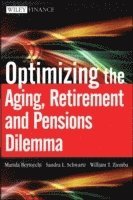
    Optimizing the Aging, Retirement, and Pensions Dilemma

    AvMarida Bertocchi,Sandra L. Schwartz

    Inbunden, Engelska, 2010

    Del 477 i serien Wiley Finance

    785 kr

    Beställningsvara. Skickas inom 3-6 vardagar. Fri frakt över 249 kr.

    Beskrivning

    A straightforward guide focused on life cycle investing-namely aging, retirement, and pensionsLife cycle investing and the implications of aging, retirement, and pensions continues to grow in importance. With people living longer, the relative and absolute number of retirees is growing while the number of workers contributing to pension funds is declining.This reliable resource develops a detailed economic analysis-at the micro (individual) and macro (economy wide) levels-which addresses issues regarding the economics of an aging population. Topics touched upon include retirement and the associated health care funding of the aged as well as social security and the asset classes that are considered asset-liability choices over time. The probability of achieving adequate return patterns from various investment strategies and asset classes is reviewedShares rich insights on the aging, retirement, and pensions dilemmaAn assessment of the resources the real economy will be able to commit to non-workers is providedThe three pillars of retirement are social security, company pensions, and private savings. Each of these pillars is confronted with a variety of asset-liability problems, and this book will addresses them.

    Produktinformation

    • Utgivningsdatum:2010-02-19
    • Mått:160 x 239 x 29 mm
    • Vikt:721 g
    • Format:Inbunden
    • Språk:Engelska
    • Serie:Wiley Finance
    • Antal sidor:432
    • Förlag:John Wiley & Sons Inc
    • ISBN:9780470377345

    Utforska kategorier

    • Finansiering inom Ekonomi och Ledarskap

    Mer om författaren

    MARIDA BERTOCCHI is Professor of Portfolio Theory, University of Bergamo. She taught numerous courses at the Universities of Bergamo, Urbino and Milan, including basic and advanced calculus, mathematical finance, advanced mathematical finance, stochastic optimization, and parallel processing. Bertocchi has been Dean of the Faculty of Economics and Business Administration and is the Director of the Department of Mathematics, Statistics, Computer Science and Applications, University of Bergamo. She is the author of numerous publications on bond portfolio management, asset allocation, quantitative finance, and economic and financial applications. SANDRA L. SCHWARTZ received her interdisciplinary PhD from the University of British Columbia in commerce, economics, and ecology. She has taught business policy, business and society, and topics in research and development and applied economics at Berkeley, UCLA, Tsukuba, UBC, and Simon Fraser. Schwartz designed programs and courses for the Open University of BC. She is the author of a number of books on energy policy, Japanese management and economy, and other topics, as well as numerous articles. WILLIAM T. ZIEMBA is the Alumni Professor of Financial Modeling and Stochastic Optimization (Emeritus), University of British Columbia. He is a well-known academic with books, research articles, and talks on various investment topics and a columnist for Wilmott magazine. Ziemba has visited and lectured at MIT, University of Chicago, Berkeley, UCLA, Cambridge, LSE, Oxford, and the ICMA Centre. He trades through William T. Ziemba Investment Management Inc. He has consulted for various financial institutions including hedge funds, pension, and other investment institutions.

    Innehållsförteckning

    • Acknowledgments xvPreface xviiPart One The Aging Population: Issues for Retirement 1Chapter 1 Issues in Retirement 31.1 Longevity and Changing Demographics across the World 41.2 The Evolution of Retirement 81.2.1 Older Workers as a Growing Share of the Work Force 111.3 Provision for Retirement 111.3.1 The Earliest Pensions 111.3.2 Early Corporate Pensions 121.3.3 Total Assets on Retirement 151.3.4 The Contribution of Various Assets at Retirement 15References 19Chapter 2 The Various Costs of Pensions: Macro and Micro 212.1 Governmental Cost of Retirement 212.2 Pensions and Capital Formation 222.3 Regulating Corporate Pensions 242.3.1 US Regulations 242.3.2 Corporate Bankruptcies Leave a Trail of Broken Promises 302.3.3 Comparing Regulation of Occupational Pension Schemes in the EU and the United States 312.4 DC vs. DB: Shifting the Risks 332.4.1 Pensions, Corporate Earnings, and Tax Deferral 372.5 Freezing Pension Plans 392.6 Where Do We Go from Here? 40References 41Chapter 3 The Various Pillars of Retirement: Social Security, Company Pensions, Supplementary Pensions, and Private Savings 433.1 Pillars of Retirement 433.2 Reforming OECD Pensions 513.3 Changing Role of Private Pensions 513.3.1 Summarizing Pension Reforms in the OECD 553.4 Plans for Reforming Social Pensions 563.4.1 Increase Contributions, Cut Benefits, Extend Working Life 563.4.2 Use the Contributions to Buy Stocks instead of Government Bonds 583.5 Rethinking Pension Promises: Breaking the Fixed Link to a Monetary Value 613.5.1 Feldstein’s PRA with Guarantees 613.5.2 NDC: Notational or Nonfinancial Defined Contributions 623.5.3 The PAAW (Personal Annuitized Average Wage Security), a Variant of the NDC 663.6 Intergenerational Risk-Sharing 673.7 Conclusions 693.8 Case Study: Public Sector vs. Private Pensions 703.8.1 Government Plans Are Different: US 703.8.2 Government Plans Are Different: Canada 723.8.3 What Do We Learn from These Comparisons? 73References 73Chapter 4 Asset Classes: Historical Performance and Risk 774.1 Equities 774.2 ETFs: Exchange-Traded Funds 894.2.1 Levered ETFs 934.3 Bonds and Fixed Income 934.3.1 TIPS 954.4 The Bond-Stock Measure for Medium-Term Large Crash Prediction 954.4.1 The 2000–2003 Crash in the S&P 500 1034.5 Hedge Funds 1124.6 Real Assets 1214.6.1 REITs 1214.7 Housing as an Asset Class 1214.8 Gold and Other Commodities 1254.9 Private Equity and Related Assets 1264.10 Currencies 1264.11 Evaluation of Great Investors 1294.12 Fundamental and Seasonal Anomalies of Asset Returns 135References 141Chapter 5 The Current Economic Crisis and Its Impact on Retirement Decisions 1455.1 Household and Government Debt 1455.2 Were the Crash Models Helpful in Signaling the US and Worldwide 2007–2009 Crash? 1465.3 The Subprime Crisis and How It Evolved 1485.3.1 Favoring the Financial Sector: Evaluating the Policy Responses 1505.4 Impact on Retirement Expectations 1535.4.1 Plan Sponsors in Trouble 1565.5 Pensions in Trouble 1605.6 State Pensions 1615.7 Future ERP 1625.7.1 Companies Freezing Pension Plans 1655.7.2 The Ultimate Strategy: Bankruptcy 1655.8 Future Inflation and Pensions 165References 166Part Two Special Issues and Models 169Chapter 6 The Impact of Population Aging on Household Portfolios and Asset Returns 1716.1 Introduction 1716.2 The Empirical Evidence 1726.2.1 The Empirical Evidence in a Micro-Perspective 1736.2.2 The Empirical Evidence in a Macro-Perspective 1816.3 Models for Portfolio Choices and Life-Cycle Asset Allocations 1936.3.1 The Seminal Models 1946.3.2 More Realistic Portfolio Models 1966.3.3 Life-Cycle Asset Allocation Models with Uninsurable Labor Risk 1986.3.4 Life-Cycle Asset Allocation Models in the Presence of Annuities 2046.4 Conclusions 207References 210Chapter 7 A Continuous Time Approach to Asset-Liability Surplus Management 2177.1 The Rudolf-Ziemba (2004) Intergenerational Surplus Management Model 2187.2 A Case Study Application of the Rudolf-Ziemba Model 222References 226Chapter 8 Should Defined Benefit Pension Schemes Be Career Average or Final Salary? 2278.1 Introduction 2278.2 Career Average Defined Benefit Schemes 2288.3 Cost Neutrality 2298.4 Choosing the Revaluation Rate 2308.5 The Adoption of Career Average Pension Schemes 2328.6 Advantages of a Switch to a Career Average Scheme 2368.6.1 Employer 2368.6.2 Members 2408.7 Disadvantages of a Switch to a Career Average Scheme 2418.7.1 Employer 2418.7.2 Members 2458.8 Redistribution Effects of a Switch to Career Average Pensions 2458.8.1 Compensatory Salary Changes, Pension Contributions, NIC, and Income Tax 2478.8.2 Model of the Redistributive Effects of a Switch to Career Average 2488.8.3 Numerical Example of the Redistributive Effects of a Switch to Career Average 2508.9 Conclusions 253References 254Chapter 9 Applying Stochastic Programming to the US Defined Benefit Pension System 2599.1 Introduction 2609.2 Integrated Corporate/Pension Planning Model 2619.2.1 Multiperiod Stochastic Programming Model 2629.2.2 Alternative Goals 2649.3 Assisting the Defined Benefit Pension System 2659.3.1 Industry Projections 2659.3.2 Applying Stochastic Programs to Industries in Trouble 2709.4 Conclusions 273References 274Chapter 10 Mortality-Linked Securities and Derivatives 27510.1 Introduction 27510.2 Longevity Risk Transfers 27810.2.1 Pension Buy-Outs 27910.2.2 Securitization of Life Insurance Assets and Liabilities 28110.3 Capital Market Solutions and the Development of Mortality-Linked Securities and Derivatives 28210.3.1 The EIB Longevity Bond 28310.3.2 Mortality Catastrophe Bonds 28410.4 Recent Trends in Mortality-Linked Securities 28610.4.1 Mortality Indexes 28610.4.2 Mortality Swaps and Forwards 28710.4.3 Mortality/Longevity Futures and Options 28910.5 Hedging Pension Liabilities with Mortality-Linked Securities and Derivatives 29010.5.1 Cash Flow Hedge Paradigm 29010.5.2 Value Hedge Paradigm 29110.5.3 Longevity Risk Pricing and Optimal Security Design 29210.6 Conclusion 296References 296Chapter 11 Asset Allocation and Governance Issues of Government-Owned Pensions 29911.1 Introduction 29911.2 Types of Sovereign Funds 30111.3 Is There a Common Asset Allocation for Pension Funds? 30311.4 Sovereign Pension Funds and International Capital Markets 30511.5 Governance Issues of Public Pension Funds 30611.5.1 Intergenerational Borrowing 30611.6 Regional Trends 30911.7 Conclusion 313References 314Chapter 12 Issues in Individual Asset-Liability Management for Retirement 31512.1 Own Company Stock 31512.2 The Role of Annuities 31912.3 The Role of Insurance 32112.4 The Role of Managed Withdrawal Plans 32212.4.1 Mandatory Withdrawals 32212.5 Where and How to Retire? 32212.5.1 New Type Retirement Communities 32312.5.2 Assisted Living 32312.5.3 Reverse Mortgages 32312.5.4 Does It Pay to Have Multiple Residences? 32412.5.5 Interest-Free Loan 326References 326Part Three Modeling the Issues 329Chapter 13 Learning from Other Models 33113.1 Preserving Endowment Spending 33113.1.1 Cloning the Yale Approach 33513.1.2 Dealing with Liquidity the Yale Way 33613.1.3 Swensen’s Rule and Others 33613.2 Devising a Rule So That Spending Never Falls 33713.2.1 A Protective Spending Model 341References 343Chapter 14 The Innovest Austrian Pension Fund Financial Planning Model 34514.1 How Should Companies Fund Their Liabilities and Determine Allocations among Asset Classes and Hedging Instruments? 34514.2 Formulating InnoALM as a Multistage Stochastic Linear Programming Model 34914.3 Some Typical Applications 35214.4 Some Test Results 35614.5 Model Tests 35914.5.1 Final Comments 362References 364Chapter 15 An Individual ALM Model for Lifetime Asset-Liability Management 365References 371Chapter 16 Implementation and Numerical Results of Individual ALM Model for Lifetime Asset-Liability Management 375References 392Chapter 17 Conclusions 393Index 397