• Fri frakt över 249 kr
  • •
  • Snabba leveranser
  • •
  • Billiga böcker
Kundservice

Du är på sajten för privatpersoner.

Företag, bibliotek eller offentlig verksamhet?

Du handlar på classic.bokus.com, där alla dina funktioner finns intakta.
Till classic.bokus.com
Bokus logotyp. Gå till startsidan.
  • Erbjudanden
  • Nyheter
  • Student
  • Topplistor
  • Barn & ungdom
  • Bokus Play
  • E-böcker
  • Pocketböcker
  • Spel & pussel

Upp till 20% på populära nyheter →

Sidfot

Mina sidor

    Hjälp

    • Kundservice
    • Vanliga frågor och svar
    • Frakt och leverans
    • Retur vid ångerrätt
    • Reklamera vara
    • Betalning
    • Köpvillkor
    • Allmänna villkor
    • Information om webbplatsens tillgänglighet

    Om Bokus

    • Om oss
    • Pressrum
    • För studenter
    • För företag
    • För bibliotek och offentlig verksamhet
    • För leverantörer
    • Hållbarhet

    Populärt

    • Aktuella erbjudanden
    • Presentkort
    • Studentlitteratur
    • Nya böcker
    • Topplistor
    • Signerade böcker
    • Engelska böcker

    Inspiration

    • Boktips
    • BookTok
    • Populära bokserier
    • Barnbokskaraktärer
    • Populära författare

    Mina sidor

      Hjälp

      • Kundservice
      • Vanliga frågor och svar
      • Frakt och leverans
      • Retur vid ångerrätt
      • Reklamera vara
      • Betalning
      • Köpvillkor
      • Allmänna villkor
      • Information om webbplatsens tillgänglighet

      Om Bokus

      • Om oss
      • Pressrum
      • För studenter
      • För företag
      • För bibliotek och offentlig verksamhet
      • För leverantörer
      • Hållbarhet

      Populärt

      • Aktuella erbjudanden
      • Presentkort
      • Studentlitteratur
      • Nya böcker
      • Topplistor
      • Signerade böcker
      • Engelska böcker

      Inspiration

      • Boktips
      • BookTok
      • Populära bokserier
      • Barnbokskaraktärer
      • Populära författare
      Logotyp för Bokus
      Följ oss på Facebook (extern länk)Följ oss på Instagram (extern länk)Följ oss på YouTube (extern länk)Följ oss på TikTok (extern länk)
      bokus @ CookiesAnpassa cookiesIntegritetspolicyKöpvillkor
      Till Citymail hemsida (extern länk)Till Budbee hemsida (extern länk)Till Postnord hemsida (extern länk)Till Schenker hemsida (extern länk)Till Early Bird hemsida (extern länk)Till Walleys hemsida (extern länk)
      1. Medicin
      2. Klinisk medicin och internmedicin
      3. Audiologi och otologi

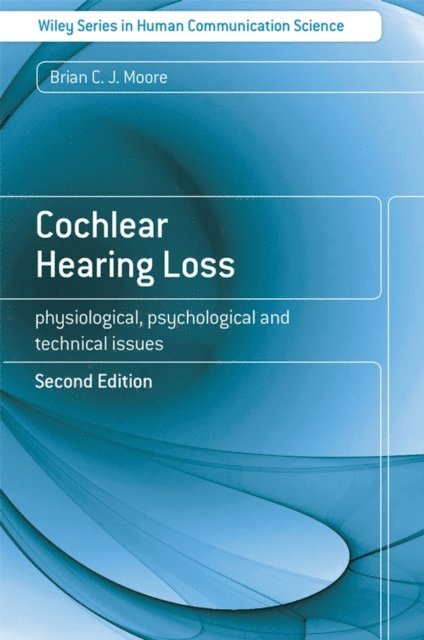
      Cochlear Hearing Loss

      Physiological, Psychological and Technical Issues

      AvBrian C. J. Moore

      Häftad, Engelska, 2007

      1 252 kr

      Beställningsvara. Skickas inom 5-8 vardagar. Fri frakt över 249 kr.

      Fler format och utgåvor

      E-bok

      1 462 kr

      Häftad

      996 kr

      Beskrivning

      Since the first edition was published in 1998, considerable advances have been made in the fields of pitch perception and speech perception. In addition, there have been major changes in the way that hearing aids work, and the features they offer. This book will provide an understanding of the changes in perception that take place when a person has cochlear hearing loss so the reader understands not only what does happen, but why it happens. It interrelates physiological and perceptual data and presents both this and basic concepts in an integrated manner. The goal is to convey an understanding of the perceptual changes associated with cochlear hearing loss, of the difficulties faced by the hearing-impaired person, and the limitations of current hearing aids.

      Produktinformation

      • Utgivningsdatum:2007-10-19
      • Mått:152 x 229 x 20 mm
      • Vikt:508 g
      • Format:Häftad
      • Språk:Engelska
      • Antal sidor:352
      • Upplaga:7002
      • Förlag:John Wiley & Sons Inc
      • ISBN:9780470516331

      Utforska kategorier

      • Audiologi och otologi inom Medicin

      Mer om författaren

      Brian C. J. Moore is the author of Cochlear Hearing Loss: Physiological, Psychological and Technical Issues, 2nd Edition, published by Wiley.

      Innehållsförteckning

      • Preface. Chapter 1. Physiological Aspects of Cochlear Hearing Loss. I. INTRODUCTION. II.LINEAR AND NONLINEAR SYSTEMS. III. STRUCTURE AND FUNCTION OF THE OUTER AND MIDDLE EAR. IV. STRUCTURE AND FUNCTION OF THE NORMAL COCHLEA. 1. The cochlea, the basilar membrane and the organ of Corti.2. Tuning on the basilar membrane.3. The nonlinearity of input-output functions on the BM.4. Two-tone suppression.5. Combination tone generation.6. Responses of the BM to complex sounds.7. Otoacoustic emissions. V. NEURAL RESPONSES IN THE NORMAL AUDITORY NERVE. 1. Spontaneous firing rates and thresholds.2. Tuning curves and iso-rate contours.3. Rate-versus-level functions.4. Two-tone suppression.5. Phase locking. VI. TYPES OF HEARING LOSS. VII. PHYSIOLOGY OF THE DAMAGED COCHLEA.  1. BM responses.2. Neural responses.3. Structure-function correlation.4. Otoacoustic emissions.5. Phase locking. VIII. CONCLUSIONS.Chapter 2. Absolute Thresholds.I.  INTRODUCTION. II. MEASURES OF ABSOLUTE THRESHOLD. 1.  Minimum audible pressure (MAP).2.  Minimum audible field (MAF).3.  Comparison of MAP and MAF.4. The audiogram. III. DESCRIPTIONS OF THE SEVERITY OF HEARING LOSS. IV.  CAUSES OF HEARING LOSS DUE TO COCHLEAR DAMAGE. V. PERCEPTUAL CONSEQUENCES OF ELEVATED ABSOLUTE THRESHOLDS.Chapter 3. Masking, Frequency Selectivity and BM Nonlinearity.I.  INTRODUCTION. II.  THE MEASUREMENT OF FREQUENCY SELECTIVITY USING MASKING.1. Introduction.2. The power spectrum model.3. Estimating the shape of a filter. III.  ESTIMATING FREQUENCY SELECTIVITY FROM MASKING EXPERIMENTS. 1. Psychophysical tuning curves.2. The notched-noise method. IV. CHARACTERISTICS OF THE AUDITORY FILTER IN NORMAL HEARING. 1. Variation with centre frequency.2. Variation with level.3. Summary. V. MASKING PATTERNS AND EXCITATION PATTERNS. 1. Masking patterns.2. Relationship of the auditory filter to the excitation pattern.3. Changes in excitation patterns with level.4. Possible effects of suppression. VI. NON-SIMULTANEOUS MASKING. 1. Basic properties of non-simultaneous masking.2. Evidence for suppression from non-simultaneous masking.3. The enhancement of frequency selectivity revealed in non-simultaneous masking.4. Relation between the growth of forward masking and the BM input-output function. VII. THE AUDIBILITY OF PARTIALS IN COMPLEX TONES. VIII. EFFECTS OF COCHLEAR DAMAGE ON FREQUENCY SELECTIVITY IN SIMULTANEOUS MASKING. 1. Complicating factors.2. Psychophysical tuning curves.3. Auditory filter shapes measured with notched noise. IX. THE USE OF MASKING TO DIAGNOSE DEAD REGIONS.  1. The TEN test.2. The TEN(HL) test.3. Prevalence of dead regions assessed using the TEN(HL) test. X. EFFECTS OF COCHLEAR DAMAGE ON FORWARD MASKING AND SUPPRESSION . XI.  EFFECTS OF COCHLEAR HEARING LOSS ON BM INPUT-OUTPUT FUNCTIONS. XII. PERCEPTUAL CONSEQUENCES OF REDUCED FREQUENCY SELECTIVITY, LOSS OF SUPPRESSION AND STEEPER BM INPUT-OUTPUT FUNCTIONS.  1. Susceptibility to masking.2. Timbre perception.3. Perceptual consequences of dead regions. Chapter 4. Loudness Perception and Intensity Resolution.I. INTRODUCTION. II. LOUDNESS PERCEPTION FOR NORMALLY HEARING PEOPLE. 1. Equal-loudness contours and loudness level.2. The scaling of loudness.3. The detection of intensity changes. III.  EFFECTS OF COCHLEAR HEARING LOSS ON LOUDNESS PERCEPTION. IV.  A MODEL OF NORMAL LOUDNESS PERCEPTION. V.  A MODEL OF LOUDNESS PERCEPTION APPLIED TO COCHLEAR HEARING LOSS. 1. Introduction.2. Elevation of absolute threshold.3. Reduced compressive nonlinearity.4. Reduced IHC/neural function.5. Reduced frequency selectivity.6. Complete loss of functioning IHCs or neurones (dead regions).7. Using the model to account for loudness recruitment. VI. EFFECTS OF BANDWIDTH ON LOUDNESS .  1. Normal hearing.2. Impaired hearing. VII. EFFECTS OF COCHLEAR HEARING LOSS ON INTENSITY RESOLUTION. VIII. PERCEPTUAL CONSEQUENCES OF ALTERED LOUDNESS PERCEPTION.1. Consequences of loudness recruitment and reduced dynamic range.2. Perceptual consequences of reduced loudness summation.3. Perceptual consequences of altered intensity discrimination.Chapter 5. Temporal Resolution and Temporal Integration.I. INTRODUCTION. II. MODELLING WITHIN-CHANNEL TEMPORAL RESOLUTION IN NORMAL HEARING. 1. Bandpass filtering.2. The nonlinearity.3. The sliding temporal integrator.4. The decision device.5. Characterising the nonlinear device and the sliding temporal integrator. III.  TEMPORAL RESOLUTION IN NORMAL HEARING. 1. The effect of centre frequency on gap detection.2.  Temporal modulation transfer functions.3. The rate of recovery from forward masking. IV. TEMPORAL RESOLUTION IN PEOPLE WITH COCHLEAR DAMAGE. 1. The influence of sound level on gap detection and the rate of decay of forward masking.2. The influence of audible bandwidth on TMTFs and gap detection.3. The influence of changes in the compressive nonlinearity. V. TEMPORAL INTEGRATION AT THRESHOLD. 1. Temporal integration in normally hearing people.2. Temporal integration in people with cochlear hearing loss.3. Explanations for reduced temporal integration in people with cochlear hearing loss. VI.  TEMPORAL INTEGRATION AT SUPRATHRESHOLD LEVELS. VII. PERCEPTUAL CONSEQUENCES OF ABNORMAL TEMPORAL PROCESSING IN PEOPLE WITH COCHLEAR HEARING LOSS. 1. Consequences of abnormal temporal resolution.2. Consequences of reduced temporal integration.Chapter 6.  Pitch Perception and Frequency Discrimination.I.  INTRODUCTION. II.  THEORIES OF PITCH PERCEPTION. III.  THE PERCEPTION OF THE PITCH OF PURE TONES BY NORMALLY HEARING PEOPLE.1. The frequency discrimination of pure tones.2. The perception of musical intervals.3. The effect of level on pitch. IV. FREQUENCY DISCRIMINATION OF PURE TONES BY PEOPLE WITH COCHLEAR HEARING LOSS.  1. Difference limens for frequency (DLFs).2. Frequency modulation detection limens (FMDLs). V.  THE PERCEPTION OF PURE-TONE PITCH FOR FREQUENCIES FALLING IN A DEAD REGION. VI. PITCH ANOMALIES IN THE PERCEPTION OF PURE TONES. VII. THE PITCH PERCEPTION OF COMPLEX TONES BY NORMALLY HEARING PEOPLE. 1. The phenomenon of the missing fundamental.2. Discrimination of the repetition rate of complex tones. VIII. THEORIES OF PITCH PERCEPTION FOR COMPLEX TONES.  1. The representation of a complex tone in the peripheral auditory system.2. Spectro-temporal pitch theories.3. The relative importance of envelope and temporal fine structure. IX.  PITCH PERCEPTION OF COMPLEX TONES BY PEOPLE WITH COCHLEAR HEARING LOSS. 1. Theoretical considerations.2. Experimental studies. X. PERCEPTUAL CONSEQUENCES OF ALTERED FREQUENCY DISCRIMINATION AND PITCH PERCEPTION.1. Effects on speech perception.2. Effects on music perception.Chapter 7.  Spatial Hearing and Advantages of Binaural Hearing.I. INTRODUCTION. II. THE LOCALISATION OF SINUSOIDS. 1. Cues for localisation.2. Performance of normally hearing people in localisation and lateralisation.3. Performance of hearing-impaired people in localisation and lateralisation. III. THE LOCALISATION OF COMPLEX SOUNDS. 1. The role of transients and across-frequency comparisons.2.  Performance of normally hearing people.3. Performance of people with cochlear hearing loss.4. Reasons for large ITD and IID thresholds in people with cochlear hearing loss. IV. THE CONE OF CONFUSION, HEAD MOVEMENTS, AND PINNA CUES. 1.  The cone of confusion.2. The role of head movements.3. Information provided by the pinnae.4. Localisation using pinna cues by normal and hearing-impaired people. V. GENERAL CONCLUSIONS ON SOUND LOCALISATION. VI. THE PRECEDENCE EFFECT.  1. The precedence effect for normal hearing.2. The precedence effect for impaired hearing. VII. BINAURAL MASKING LEVEL DIFFERENCES (MLDS). 1. MLDs for normally hearing people.2. Mechanisms underlying MLDs.3. MLDs for people with cochlear hearing loss.4. Possible reasons for smaller MLDs in people with cochlear damage. VIII. HEAD SHADOW EFFECTS. 1. Benefits of head shadow for normally hearing people.2. Benefits of head shadow for hearing-impaired people. IX. RELEASE FROM INFORMATIONAL MASKING. X. DIOTIC ADVANTAGES. XI. PERCEPTUAL CONSEQUENCES OF ABNORMAL BINAURAL AND SPATIAL HEARING IN PEOPLE WITH COCHLEAR DAMAGE.Chapter 8.  Speech Perception.I.  INTRODUCTION. II. THE MAGNITUDE OF THE NOISE PROBLEM. III. THE ROLE OF AUDIBILITY. 1. The Articulation Index and Speech Intelligibility Index.2. Use of the AI or SII to predict speech intelligibility for the hearing impaired.3. The intelligibility of speech in noise at high overall levels.4. Comparison of detection and recognition for speech in noise.5. The intelligibility of speech in quiet at high overall levels.6. Simulation of hearing loss by selective filtering (frequency-dependant attenuation).7. Simulation of hearing loss by masking.8. Comparison of speech intelligibility for conductive and cochlear losses.9. Conclusions on the role of audibility. IV. INFLUENCE OF DEAD REGIONS ON SPEECH PERCEPTION. V. CORRELATION BETWEEN PSYCHOACOUSTIC ABILITIES AND SPEECH PERCEPTION. VI. ASSESSING THE EFFECTS OF FREQUENCY SELECTIVITY ON VOWEL AND CONSONANT PERCEPTION.  1. Consonant perception.2. Vowel perception. VII. INFLUENCE OF LOSS OF SENSITIVITY TO TEMPORAL FINE STRUCTURE. VIII. THE USE OF SIMULATIONS TO ASSESS THE IMPORTANCE OF PSYCHOACOUSTIC FACTORS IN SPEECH PERCEPTION.  1. Simulations of loudness recruitment combined with threshold elevation.2. Simulations of reduced frequency selectivity.3. Simulation of the combined effects of threshold elevation, recruitment and reduced frequency selectivity.4. Simulation of reduced temporal resolution. IX. CONCLUSIONS.Chapter 9.  Hearing Aids.I. INTRODUCTION. II. LINEAR AMPLIFICATION. 1. The difficulty of restoring audibility using linear aids.2. Prescriptive fitting rules for linear hearing aids. III. COMPRESSION AMPLIFICATION.  1. Basic characteristics of AGC systems.2. Varieties of AGC systems.3. Rationales for the use of multi-band compression (and noise reduction).4. Research on the effectiveness of multi-band syllabic compression.5. Methods of initial fitting of hearing aids with multi-band compression.6. Methods for fine tuning hearing aids with multi-band compression.7. Slow-acting AGC systems.8. Comparisons of ssslow-acting and fast-acting systems.9. General conclusions about compression. IV. SOME GENERAL PROBLEMS WITH HEARING AIDS.  1. Inadequate gain at high frequencies.2. Acoustic feedback.3. Peakiness of frequency response.4. The occlusion effect.5. Time delays. V. METHODS FOR IMPROVING THE SPEECH-TO-NOISE RATIO. 1. Multi-channel noise reduction.2. Directional microphones.3. Binaural processing algorithms. VI. TRANSPOSITION AIDS FOR SEVERE AND PROFOUND HEARING LOSS. VII. COCHLEAR IMPLANTS. VIII. CONCLUDING REMARKS. Glossary.References.
      Hoppa över listan

      Mer från samma författare

      Brian C. J. Moore, Brian C.J. Moore - Hearing, Inbunden

      Hearing

      Brian C. J. Moore, Brian C.J. Moore

      Inbunden, 1995

      1 095 kr

      Brian C. J. Moore - Perceptual Consequences of Cochlear Damage, E-bok

      Perceptual Consequences of Cochlear Damage

      Brian C. J. Moore

      E-bok
      1995

      2 586 kr

      Brian C. J. Moore - Perceptual Consequences of Cochlear Damage, Inbunden
      Del 28

      Perceptual Consequences of Cochlear Damage

      Brian C. J. Moore

      Inbunden, 1995

      4 002 kr

      Gerald R. Popelka, Brian C. J. Moore, Richard R. Fay, Arthur N. Popper - Hearing Aids, Inbunden
      Del 56

      Hearing Aids

      Gerald R. Popelka, Brian C. J. Moore, Richard R. Fay, Arthur N. Popper

      Inbunden, 2016

      2 023 kr

      Arthur N. Popper, Richard R. Fay, Brian C. J. Moore, Gerald R. Popelka - Hearing Aids, E-bok

      Hearing Aids

      Arthur N. Popper, Richard R. Fay, Brian C. J. Moore, Gerald R. Popelka

      E-bok
      2016

      2 592 kr

      Gerald R. Popelka, Brian C. J. Moore, Richard R. Fay, Arthur N. Popper - Hearing Aids, Häftad
      Del 56

      Hearing Aids

      Gerald R. Popelka, Brian C. J. Moore, Richard R. Fay, Arthur N. Popper

      Häftad, 2018

      2 023 kr

      Brian C J Moore - AUDITORY PROCESSING OF TEMPORAL FINE STRUCTURE: EFFECTS OF AGE AND HEARING LOSS, Inbunden

      AUDITORY PROCESSING OF TEMPORAL FINE STRUCTURE: EFFECTS OF AGE AND HEARING LOSS

      Brian C J Moore

      Inbunden, 2014

      1 201 kr

      Hoppa över listan

      Du kanske också är intresserad av

      Brian C. J. Moore - Cochlear Hearing Loss, E-bok

      Cochlear Hearing Loss

      Brian C. J. Moore

      E-bok
      2007

      1 462 kr

      Brian C. J. Moore - Cochlear Hearing Loss, Häftad

      Cochlear Hearing Loss

      Brian C. J. Moore

      Häftad, 1998

      996 kr

      Brian C. J. Moore - Perceptual Consequences of Cochlear Damage, E-bok

      Perceptual Consequences of Cochlear Damage

      Brian C. J. Moore

      E-bok
      1995

      2 586 kr

      Gerald R. Popelka, Brian C. J. Moore, Richard R. Fay, Arthur N. Popper - Hearing Aids, Inbunden
      Del 56

      Hearing Aids

      Gerald R. Popelka, Brian C. J. Moore, Richard R. Fay, Arthur N. Popper

      Inbunden, 2016

      2 023 kr

      Brian C. J. Moore - Perceptual Consequences of Cochlear Damage, Inbunden
      Del 28

      Perceptual Consequences of Cochlear Damage

      Brian C. J. Moore

      Inbunden, 1995

      4 002 kr

      Gerald R. Popelka, Brian C. J. Moore, Richard R. Fay, Arthur N. Popper - Hearing Aids, Häftad
      Del 56

      Hearing Aids

      Gerald R. Popelka, Brian C. J. Moore, Richard R. Fay, Arthur N. Popper

      Häftad, 2018

      2 023 kr

      Brian C. J. Moore, Brian C.J. Moore - Hearing, Inbunden

      Hearing

      Brian C. J. Moore, Brian C.J. Moore

      Inbunden, 1995

      1 095 kr

      Arthur N. Popper, Richard R. Fay, Brian C. J. Moore, Gerald R. Popelka - Hearing Aids, E-bok

      Hearing Aids

      Arthur N. Popper, Richard R. Fay, Brian C. J. Moore, Gerald R. Popelka

      E-bok
      2016

      2 592 kr

      Brian C J Moore - AUDITORY PROCESSING OF TEMPORAL FINE STRUCTURE: EFFECTS OF AGE AND HEARING LOSS, Inbunden

      AUDITORY PROCESSING OF TEMPORAL FINE STRUCTURE: EFFECTS OF AGE AND HEARING LOSS

      Brian C J Moore

      Inbunden, 2014

      1 201 kr

      Carola Häggkvist - SIGNERAD - Jag är Carola, Inbunden
      • Signerad!

      SIGNERAD - Jag är Carola

      Carola Häggkvist

      Inbunden, 2026

      269 kr