• Fri frakt över 249 kr
  • •
  • Snabba leveranser
  • •
  • Billiga böcker
Kundservice

Du är på sajten för privatpersoner.

Företag, bibliotek eller offentlig verksamhet?

Du handlar på classic.bokus.com, där alla dina funktioner finns intakta.
Till classic.bokus.com
Bokus logotyp. Gå till startsidan.
  • Erbjudanden
  • Nyheter
  • Student
  • Topplistor
  • Barn & ungdom
  • Bokus Play
  • E-böcker
  • Pocketböcker
  • Spel & pussel

10% rabatt på allt med kod: NYSTART10 →

Sidfot

Mina sidor

    Hjälp

    • Kundservice
    • Vanliga frågor och svar
    • Frakt och leverans
    • Retur vid ångerrätt
    • Reklamera vara
    • Betalning
    • Köpvillkor
    • Allmänna villkor
    • Information om webbplatsens tillgänglighet

    Om Bokus

    • Om oss
    • Pressrum
    • För studenter
    • För företag
    • För bibliotek och offentlig verksamhet
    • För leverantörer
    • Hållbarhet

    Populärt

    • Aktuella erbjudanden
    • Presentkort
    • Studentlitteratur
    • Nya böcker
    • Topplistor
    • Signerade böcker
    • Engelska böcker

    Inspiration

    • Boktips
    • BookTok
    • Populära bokserier
    • Barnbokskaraktärer
    • Populära författare
    Logotyp för Bokus
    Följ oss på Facebook (extern länk)Följ oss på Instagram (extern länk)Följ oss på YouTube (extern länk)Följ oss på TikTok (extern länk)
    bokus @ CookiesAnpassa cookiesIntegritetspolicyKöpvillkor
    Till Citymail hemsida (extern länk)Till Budbee hemsida (extern länk)Till Postnord hemsida (extern länk)Till Schenker hemsida (extern länk)Till Early Bird hemsida (extern länk)Till Walleys hemsida (extern länk)
    1. Medicin
    2. Andra medicinska specialiteter
    3. Behandling och behandlingsmetoder

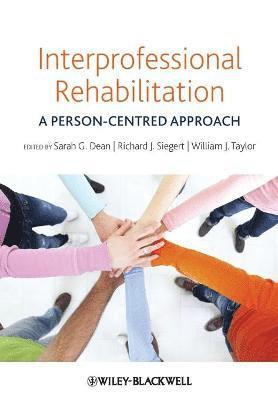
    Interprofessional Rehabilitation

    A Person-Centred Approach

    AvSarah G. Dean,Sarah G. Dean

    Häftad, Engelska, 2012

    541 kr

    Beställningsvara. Skickas inom 5-8 vardagar. Fri frakt över 249 kr.

    Beskrivning

    Interprofessional Rehabilitation: a Person-Centred Approach is a concise and readable introduction to the principles and practice of a person-centred interprofessional approach to rehabilitation, based upon a firm scientific evidence base.Written by a multi-contributor team of specialists in physiotherapy, occupational therapy, nursing, psychology and rehabilitation medicine, this text draws together common themes that cut across the different professional groups and the spectrum of health conditions requiring rehabilitation, and sets out a model of practice that is tailored to the specific needs of the client. Showing interprofessionalism at work in a range of clinical contexts, the book argues that effective rehabilitation is best conducted by well-integrated teams of specialists working in an interdisciplinary way, with the client or patient actively involved in all stages of the process.This book will be essential reading for students preparing for practice in an increasingly interprofessional environment, and will be of interest to any health care practitioner keen to understand how an integrated approach to rehabilitation can benefit their clients.

    Produktinformation

    • Utgivningsdatum:2012-09-07
    • Mått:173 x 244 x 10 mm
    • Vikt:345 g
    • Format:Häftad
    • Språk:Engelska
    • Antal sidor:224
    • Förlag:John Wiley and Sons Ltd
    • ISBN:9780470655962

    Utforska kategorier

    • Behandling och behandlingsmetoder inom Medicin

    Mer om författaren

    About the EditorsSarah G Dean is a senior lecturer in health services research, based at the University of Exeter, UK, with a background in physiotherapy and health psychology. She has a particular interest in the psychology of exercise-based rehabilitation for people with long term conditions.Richard J Siegert has a background in clinical psychology and neuropsychology and a special interest in the application of psychometrics to measurement in rehabilitation settings. A Reader in Rehabilitation at King’s College London, he is soon to take up a Chair in Psychology and Rehabilitation at AUT University in Auckland, New Zealand.William J Taylor is an academic rehabilitation physician and rheumatologist in Wellington, New Zealand, where he teaches a postgraduate interdisciplinary course in rehabilitation and continues to work at the coal-face of clinical practice.

    Recensioner i media

    “The key message of this book is that there is great value in person-centred  rehabilitation.  This book is well laid out, easy to read, and summarizes vast amounts of research and reference material.  Use of case studies helps students and clinicians understand how to incorporate this integrated approach to benefit their clients.  Controversies are also outlined that clearly support the need for additional research in this field.  Overall, the book is considered a thought-provoking read and one that will benefit any clinician with an interest in interprofessional rehabilitation.”  (Canadian Journal of Occupational Therapy, 29 October 2013)

    Innehållsförteckning

    • About the editors ixAbout the contributors xiForeword by Professor Gerold Stucki xvPreface xviiAcknowledgements xix1 Introduction 1Richard J. Siegert, William J. Taylor and Sarah G. Dean1.1 What is rehabilitation? 11.2 Setting boundaries – or what we don’t mean by rehabilitation 21.3 Some defi nitions of rehabilitation 31.4 Some other issues in defi ning rehabilitation 41.5 The core themes 61.6 A word about terminology 71.7 Summary 72 A rehabilitation framework: the International Classification of Functioning, Disability and Health 9William J. Taylor and Szilvia Geyh2.1 There is a need for a common language of functioning 92.2 The ICF is both a model and a classification system 122.3 The origins of the ICF 172.4 Using the ICF in practice – ICF core sets, rehabilitation cycle and ICF tools 192.5 Can the ICF be used to measure functioning – both the ‘what’ and the ‘how’? Controversies – to measure or to classify that is the question 302.6 Controversies – classifi cation of ‘participation restrictions’ versus ‘activity limitations’ 312.7 Controversies – is the ICF a framework for understanding ‘QoL’? 342.8 Future developments of the ICF 363 An interprofessional approach to rehabilitation 45Sarah G. Dean and Claire Ballinger3.1 Introduction and setting the scene 453.2 Terminology and interprofessional working within rehabilitation 463.3 Characteristics of good teamwork 513.4 Team membership and roles 613.5 Processes of teamwork 653.6 The role of interprofessional education in rehabilitation 693.7 Collaborative rehabilitation research 723.8 The future for interprofessional rehabilitation teams 733.9 Conclusion 744 Processes in rehabilitation 79William Levack and Sarah G. Dean4.1 Introduction 794.2 Assessment 804.3 Goal planning 844.4 Interventions 974.5 Evaluation 1024.6 Discharge planning and transitions from hospital to community 1034.7 Conclusion 1035 Outcome measurement in rehabilitation 109Richard J. Siegert and Jo Adams5.1 Introduction 1095.2 Psychometrics – a primer 1185.3 Applying outcome measures in clinical practice 1255.4 Conclusion 1286 The person in context 135Julie Pryor and Sarah G. Dean6.1 Introduction 1356.2 Who are the stakeholders in rehabilitation? 1366.3 Key terms 1376.4 The lived experience of acquired disability 1406.5 Rehabilitation as a personal journey of reconstruction or transformation of the self 1416.6 Understanding rehabilitation as ‘work’ and the role of participation 1466.7 Clinical services guiding and supporting personal rehabilitation journeys 1486.8 Placing the person in their family context and involving families in rehabilitation 1526.9 Ideas for making clinical rehabilitation processes and practices person-centred 1546.10 Can we do person-centred rehabilitation? 1597 Conclusion: rethinking rehabilitation 167Sarah G. Dean, Richard J. Siegert and William J. Taylor7.1 Introduction 1677.2 The ICF as a theoretical framework and language for rehabilitation 1677.3 Interprofessional teamwork in rehabilitation 1687.4 Processes in rehabilitation: goal setting and its mediators 1687.5 Outcome measurement to evaluate rehabilitation and show it makes a difference 1697.6 The importance of the individual person in their context and how to do person-centred rehabilitation 1697.7 Using the ICF as a way to map interprofessional rehabilitation 1707.8 Revisiting the defi nition of rehabilitation 1767.9 Limitations related to the scope of this textbook 1787.10 Future directions of interprofessional rehabilitation 1797.11 Conclusion 183Index 185