• Fri frakt över 249 kr
  • •
  • Snabba leveranser
  • •
  • Billiga böcker
Kundservice

Du är på sajten för privatpersoner.

Företag, bibliotek eller offentlig verksamhet?

Du handlar på classic.bokus.com, där alla dina funktioner finns intakta.
Till classic.bokus.com
Bokus logotyp. Gå till startsidan.
  • Erbjudanden
  • Student
  • Topplistor
  • Barn & ungdom
  • Bokus Play
  • E-böcker
  • Ljudböcker
  • Pocketböcker
  • Spel & pussel

Upp till 25% på utvalda nyheter →

Sidfot

Mina sidor

    Hjälp

    • Kundservice
    • Vanliga frågor och svar
    • Frakt och leverans
    • Retur vid ångerrätt
    • Reklamera vara
    • Betalning
    • Köpvillkor
    • Allmänna villkor
    • Information om webbplatsens tillgänglighet

    Om Bokus

    • Om oss
    • Pressrum
    • För studenter
    • För företag
    • För bibliotek och offentlig verksamhet
    • För leverantörer
    • Hållbarhet

    Populärt

    • Aktuella erbjudanden
    • Presentkort
    • Studentlitteratur
    • Nya böcker
    • Topplistor
    • Signerade böcker
    • Engelska böcker

    Inspiration

    • Boktips
    • BookTok
    • Populära bokserier
    • Barnbokskaraktärer
    • Populära författare
    Logotyp för Bokus
    Följ oss på Facebook (extern länk)Följ oss på Instagram (extern länk)Följ oss på YouTube (extern länk)Följ oss på TikTok (extern länk)
    bokus @ CookiesAnpassa cookiesIntegritetspolicyKöpvillkor
    Till Citymail hemsida (extern länk)Till Budbee hemsida (extern länk)Till Postnord hemsida (extern länk)Till Schenker hemsida (extern länk)Till Early Bird hemsida (extern länk)Till Walleys hemsida (extern länk)
    1. Naturvetenskap och teknik
    2. Teknik och industri
    3. Elektronik och kommunikationer

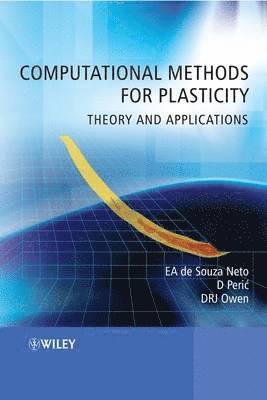
    Computational Methods for Plasticity

    Theory and Applications

    AvEduardo A. de Souza Neto,Djordje Peric

    Inbunden, Engelska, 2008

    1 870 kr

    Skickas . Fri frakt över 249 kr.

    Beskrivning

    The subject of computational plasticity encapsulates the numerical methods used for the finite element simulation of the behaviour of a wide range of engineering materials considered to be plastic – i.e. those that undergo a permanent change of shape in response to an applied force. Computational Methods for Plasticity: Theory and Applications describes the theory of the associated numerical methods for the simulation of a wide range of plastic engineering materials; from the simplest infinitesimal plasticity theory to more complex damage mechanics and finite strain crystal plasticity models. It is split into three parts - basic concepts, small strains and large strains. Beginning with elementary theory and progressing to advanced, complex theory and computer implementation, it is suitable for use at both introductory and advanced levels. The book: Offers a self-contained text that allows the reader to learn computational plasticity theory and its implementation from one volume.Includes many numerical examples that illustrate the application of the methodologies described.Provides introductory material on related disciplines and procedures such as tensor analysis, continuum mechanics and finite elements for non-linear solid mechanics.Is accompanied by purpose-developed finite element software that illustrates many of the techniques discussed in the text, downloadable from the book’s companion website.This comprehensive text will appeal to postgraduate and graduate students of civil, mechanical, aerospace and materials engineering as well as applied mathematics and courses with computational mechanics components. It will also be of interest to research engineers, scientists and software developers working in the field of computational solid mechanics.

    Produktinformation

    • Utgivningsdatum:2008-10-17
    • Mått:178 x 253 x 47 mm
    • Vikt:1 588 g
    • Format:Inbunden
    • Språk:Engelska
    • Antal sidor:816
    • Förlag:John Wiley & Sons Inc
    • ISBN:9780470694527

    Utforska kategorier

    • Elektronik och kommunikationer inom Naturvetenskap och teknik
    • Maskinteknik och material inom Naturvetenskap och teknik

    Mer om författaren

    Eduardo de Souza Neto is a senior lecturer at the School of Engineering, University of Wales, Swansea, where he teaches a postgraduate course on the finite element method, and undergraduate courses on structural mechanics and soil mechanics. He also currently teaches external courses on computational plasticity; and his research interests include, amongst others, damage mechanics, computational plasticity, contact with friction and finite element technology. He is an international advisory board member for the Latin American Journal of Solids and Structures, and has authored 30 papers in refereed research journals as well as many conference papers, and 4 book contributions.David Owen is Professor in Civil Engineering at the University of Wales, Swansea, and chairman of Rockfield Software Ltd. He is an international authority on finite element and discrete element techniques, and is the author of seven textbooks and over three hundred and fifty scientific publications. In addition to being the editor of over thirty monographs and conference proceedings, Professor Owen is also the editor of the International Journal for Engineering Computations and is a member of several Editorial Boards. His involvement in academic research has lead to the supervision of over sixty Ph.D. students. Professor Owen is a fellow of the RAE and ICE.Djordje Peric is Professor in the Department of Civil Engineering, University of Wales, Swansea. He has an established reputation in the field of non-linear computational mechanics and is the author of over 150 research publications. He has also edited two special journal issues, and serves as an editorial board member of five international academic journals. Over the last decade Professor Peric has attracted approximately £2.5 million of research grants and funding from the UK Engineering and Physical Sciences Research Council, and various industries including Unilever, British Steel, Rolls Royce, MIC and Rockfield Software.

    Innehållsförteckning

    • Part One Basic concepts1 Introduction1.1 Aims and scope1.2 Layout1.3 General scheme of notation2 ELEMENTS OF TENSOR ANALYSIS2.1 Vectors2.2 Second-order tensors2.3 Higher-order tensors2.4 Isotropic tensors2.5 Differentiation2.6 Linearisation of nonlinear problems 3 THERMODYNAMICS3.1 Kinematics of deformation3.2 Infinitesimal deformations3.3 Forces. Stress Measures3.4 Fundamental laws of thermodynamics3.5 Constitutive theory3.6 Weak equilibrium. The principle of virtual work3.7 The quasi-static initial boundary value problem 4 The finite element method in quasi-static nonlinear solid mechanics4.1 Displacement-based finite elements4.2 Path-dependent materials. The incremental finite element procedure4.3 Large strain formulation4.4 Unstable equilibrium. The arc-length method 5 Overview of the program structure5.1 Introduction5.2 The main program5.3 Data input and initialisation5.4 The load incrementation loop. Overview5.5 Material and element modularity5.6 Elements. Implementation and management5.7 Material models: implementation and management Part Two Small strains6 The mathematical theory of plasticity6.1 Phenomenological aspects6.2 One-dimensional constitutive model6.3 General elastoplastic constitutive model6.4 Classical yield criteria6.5 Plastic flow rules6.6 Hardening laws 7 Finite elements in small-strain plasticity problems7.1 Preliminary implementation aspects7.2 General numerical integration algorithm for elastoplastic constitutive equations7.3 Application: integration algorithm for the isotropically hardening von Mises model7.4 The consistent tangent modulus7.5 Numerical examples with the von Mises model7.6 Further application: the von Mises model with nonlinear mixed hardening 8 Computations with other basic plasticity models8.1 The Tresca model8.2 The Mohr-Coulomb model8.3 The Drucker-Prager model8.4 Examples 9 Plane stress plasticity9.1 The basic plane stress plasticity problem9.2 Plane stress constraint at the Gauss point level9.3 Plane stress constraint at the structural level9.4 Plane stress-projected plasticity models9.5 Numerical examples9.6 Other stress-constrained states 10 Advanced plasticity models10.1 A modified Cam-Clay model for soils10.2 A capped Drucker-Prager model for geomaterials10.3 Anisotropic plasticity: the Hill, Hoffman and Barlat-Lian models 11 Viscoplasticity11.1 Viscoplasticity: phenomenological aspects11.2 One-dimensional viscoplasticity model11.3 A von Mises-based multidimensional model11.4 General viscoplastic constitutive model11.5 General numerical framework11.6 Application: computational implementation of a von Mises-based model11.7 Examples 12 Damage mechanics12.1 Physical aspects of internal damage in solids12.2 Continuum damage mechanics12.3 Lemaitre's elastoplastic damage theory12.4 A simplified version of Lemaitre's model12.5 Gurson's void growth model12.6 Further issues in damage modelling Part Three Large strains13 Finite strain hyperelasticity13.1 Hyperelasticity: basic concepts13.2 Some particular models13.3 Isotropic finite hyperelasticity in plane stress13.4 Tangent moduli: the elasticity tensors13.5 Application: Ogden material implementation13.6 Numerical examples13.7 Hyperelasticity with damage: the Mullins effect 14 Finite strain elastoplasticity14.1 Finite strain elastoplasticity: a brief review14.2 One-dimensional finite plasticity model14.3 General hyperelastic-based multiplicative plasticity model14.4 The general elastic predictor/return-mapping algorithm14.5 The consistent spatial tangent modulus14.6 Principal stress space-based implementation14.7 Finite plasticity in plane stress14.8 Finite viscoplasticity14.9 Examples14.10 Rate forms: hypoelastic-based plasticity models14.11 Finite plasticity with kinematic hardening 15 Finite elements for large-strain incompressibility15.1 The F-bar methodology15.2 Enhanced assumed strain methods15.3 Mixed u/p formulations 16 Anisotropic finite plasticity: Single crystals16.1 Physical aspects16.2 Plastic slip and the Schmid resolved shear stress16.3 Single crystal simulation: a brief review16.4 A general continuum model of single crystals16.5 A general integration algorithm16.6 An algorithm for a planar double-slip model16.7 The consistent spatial tangent modulus16.8 Numerical examples16.9 Viscoplastic single crystals AppendicesA Isotropic functions of a symmetric tensorA.1 Isotropic scalar-valued functionsA.1.1 RepresentationA.1.2 The derivative of anisotropic scalar functionA.2 Isotropic tensor-valued functionsA.2.1 RepresentationA.2.2 The derivative of anisotropic tensor functionA.3 The two-dimensional caseA.3.1 Tensor function derivativeA.3.2 Plane strain and axisymmetric problemsA.4 The three-dimensional caseA.4.1 Function computationA.4.2 Computation of the function derivativeA.5 A particular class of isotropic tensor functionsA.5.1 Two dimensionsA.5.2 Three dimensionsA.6 Alternative proceduresB The tensor exponentialB.1 The tensor exponential functionB.1.1 Some properties of the tensor exponential functionB.1.2 Computation of the tensor exponential functionB.2 The tensor exponential derivativeB.2.1 Computer implementationB.3 Exponential map integratorsB.3.1 The generalised exponential map midpoint ruleC Linearisation of the virtual workC.1 Infinitesimal deformationsC.2 Finite strains and deformationsC.2.1 Material descriptionC.2.2 Spatial descriptionD Array notation for computations with tensorsD.1 Second-order tensorsD.2 Fourth-order tensorsD.2.1 Operations with non-symmetric tensorsReferencesIndex