• Fri frakt över 249 kr
  • •
  • Snabba leveranser
  • •
  • Billiga böcker
Kundservice

Du är på sajten för privatpersoner.

Företag, bibliotek eller offentlig verksamhet?

Du handlar på classic.bokus.com, där alla dina funktioner finns intakta.
Till classic.bokus.com
Bokus logotyp. Gå till startsidan.
  • Erbjudanden
  • Nyheter
  • Student
  • Topplistor
  • Barn & ungdom
  • Bokus Play
  • E-böcker
  • Pocketböcker
  • Spel & pussel

10% rabatt på allt med kod NYSTART10 →

Sidfot

Mina sidor

    Hjälp

    • Kundservice
    • Vanliga frågor och svar
    • Frakt och leverans
    • Retur vid ångerrätt
    • Reklamera vara
    • Betalning
    • Köpvillkor
    • Allmänna villkor
    • Information om webbplatsens tillgänglighet

    Om Bokus

    • Om oss
    • Pressrum
    • För studenter
    • För företag
    • För bibliotek och offentlig verksamhet
    • För leverantörer
    • Hållbarhet

    Populärt

    • Aktuella erbjudanden
    • Presentkort
    • Studentlitteratur
    • Nya böcker
    • Topplistor
    • Signerade böcker
    • Engelska böcker

    Inspiration

    • Boktips
    • BookTok
    • Populära bokserier
    • Barnbokskaraktärer
    • Populära författare
    Logotyp för Bokus
    Följ oss på Facebook (extern länk)Följ oss på Instagram (extern länk)Följ oss på YouTube (extern länk)Följ oss på TikTok (extern länk)
    bokus @ CookiesAnpassa cookiesIntegritetspolicyKöpvillkor
    Till Citymail hemsida (extern länk)Till Budbee hemsida (extern länk)Till Postnord hemsida (extern länk)Till Schenker hemsida (extern länk)Till Early Bird hemsida (extern länk)Till Walleys hemsida (extern länk)
    1. Naturvetenskap och teknik
    2. Teknik och industri
    3. Elektronik och kommunikationer

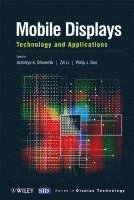
    Mobile Displays

    Technology and Applications

    AvAchintya K. Bhowmik,Zili Li

    Inbunden, Engelska, 2008

    Del 16 i serien Wiley Series in Display Technology

    1 524 kr

    Tillfälligt slut

    Beskrivning

    The mobile display industry has witnessed rapid growth, in both volume and diversification, in recent years. This trend is expected to persist with continued consumer demand for mobile communications and computing applications. Mobile displays are now integral to a wide range of devices such as MP3 players, digital cameras, PDAs, GPS map readers, portable DVD players, and electronic books, as well as the ubiquitous mobile phone and laptop computers.  This proliferation of products has fuelled a significant investment into the research and development of the mobile display, with key research laboratories across the display industry and academia producing many exciting technological advancements. With contributions from well-known experts, in both industry and academia, this book presents a comprehensive coverage of the mobile display in a single volume. Ranging from an in-depth analysis of the requirements that the displays must meet, through current devices, to emerging technologies, the text features: mobile environment and human-factor considerations for the display;advances in the incumbent active matrix liquid crystal display (AMLCD) technologies;backlighting and light manipulation techniques;mobile display driver electronics and interface technologies;emerging technologies including active matrix organic light emitting diode (AMOLED), electronic paper displays, and system-on-glass (SOG) developments;application developments in eyewear, mobile projector, and 3D displays.Mobile Displays: Technology and Applications presents, in addition to the fundamentals, a detailed update on state-of-the-art advancements. It is an invaluable resource for practicing electronics and display engineers working on the development of mobile displays and their applications.  It is also an extensive reference for graduates taking special courses in display technologies. The Society for Information Display (SID) is an international society, which has the aim of encouraging the development of all aspects of the field of information display. Complementary to the aims of the society, the Wiley-SID series is intended to explain the latest developments in information display technology at a professional level. The broad scope of the series addresses all facets of information displays from technical aspects through systems and prototypes to standards and ergonomics

    Produktinformation

    • Utgivningsdatum:2008-05-09
    • Mått:178 x 252 x 41 mm
    • Vikt:1 252 g
    • Format:Inbunden
    • Språk:Engelska
    • Serie:Wiley Series in Display Technology
    • Antal sidor:656
    • Förlag:John Wiley & Sons Inc
    • ISBN:9780470723746

    Utforska kategorier

    • Elektronik och kommunikationer inom Naturvetenskap och teknik

    Mer om författaren

    Achintya K. Bhowmik is a Senior Manager at Intel Corporation, where he leads advanced video and display technology research and development, focusing on power-performance optimized mobile computer architecture. He has been an Adjunct Professor in the department of Information Display at the Kyung Hee University in Seoul, Korea. his prior work includes development of high-definition display systems based on an all-digital Liquid-Crystal on Silicon microdisplay technology, electro-optic modulation in organic molecular crystals, novel light-matter interactions, and integrated optical circuits for high-speed communication networks. he received his PhD and BTech from Auburn University, Alabama, USA, and the Indian Institute of Technology, Kanpur, India, respectively. He has authored more than 70 publications, including 16 issued patents. he is a Program Committee Member for SID and IEEE. he has been a session chair and invited speaker at a number of international conferences. Zili Li is a Distinguished Member of the technical Staff at Motorola Labs, where he leads research groups in developing advanced mobile display technologies ranging from direct-view displays, heads-up displays, and microprojector displays. prior to Motorola, he was with Rockwell International where he developed advanced avionic display and display manufacture process. he received his PhD and BS, both in Physics, from Case Western reserve University in the US and Shandong University in China, respectively. he has more than 35 refereed publications and 17 issued US patents. He has been an invited speaker, seminar lecturer, planer, and chair at major international conferences. he is co-founder of SID Mobile Display conference since 2006 and served as vice-Chair of SID MW Chapter. He is a member of SID,SPIE, and OSA. He also serves as a member for Motorola Science Advisory Board Associates.Philip J. Bos is a Professor of Chemical Physics and Associate Director of the Liquid Crystal Institute at Kent State University. Before joining Kent State in 1994, he was a princip0al scientist in the the Display Research Laboratory of Tektronix Inc. He received his PhD in Physics from Kent State in 1978. He has authored more than 100 papers in the field of liquid crystals and liquid crystal displays, and has over 23 issued patents. His field of interest is applications of liquid crystals, with contributions to fast liquid crystal electro-optical effects including the invention of the pi-cell. He is active in the field of displays and was twice the general chair of the International Display research Conference. he is a Fellow of the SID, and has received the Distinguished Scholar Award from Kent State University.

    Innehållsförteckning

    • About the Editors xvList of Contributors xviiSeries Editor’s Foreword xxiPreface xxiii1 Introduction to Mobile Displays 1Zili Li, Achintya K. Bhowmik, and Philip J. Bos1.1 Introduction 11.2 Advances in Mobile Applications 21.3 Mobile Environment and its Impact on the Display 51.4 Current Mobile Display Technologies 111.5 Emerging Mobile Display Technologies 161.6 Summary 21References 222 Human Factors Considerations: Seeing Information on a Mobile Display 23Jim Larimer2.1 Introduction 232.2 The Perfect Image 272.3 The JND Map and Metric 272.4 Image Bandwidth or Considering a Display or the Eye as an Information Channel 282.5 The Control Signal and Scaling for Rendering 292.6 Jaggies 302.7 Hyperacuity 322.8 Bar Gratings and Spatial Frequency 332.9 Three Measures of Contrast and Weber’s Law 342.10 Contrast Sensitivity Function (csf) 362.11 Veiling Ambient Light: Contrast Reduction from Glare 382.12 Dither: Trade Offs between Spatial Scale and Intensity 392.13 Three Display Screens with Text Imagery 412.14 Color 432.15 Making Color on Displays 472.16 Luminance and Tone Scale 472.17 Concluding Remarks 50References 503 Advanced Mobile Display Technology 53Kee-Han Uh, and Seon-Hong Ahn3.1 Introduction 533.2 Advanced Mobile Display Technology 553.3 Summary 72References 724 In-Plane Switching (IPS) LCD Technology for Mobile Applications 75InJae Chung, and Hyungki Hong4.1 Introduction 754.2 LCD Modes 764.3 Operational Principle of IPS Mode 804.3.1 Voltage Transmittance Relation 804.4 LC Equation of Motion under an Electric Field 824.5 Schematic Diagram of IPS Pixel Structures 854.6 Characteristics of IPS Mode 884.6.1 Response Time Characteristics 884.7 Light Efficiency 894.8 Viewing Angle Characteristics 904.9 Color and Gray Level 914.10 IPS Mode for Outdoor Applications 934.11 Summary 94References 955 Transflective Liquid Crystal Display Technologies 97Xinyu Zhu, Zhibing Ge, and Shin-Tson Wu5.1 Introduction 975.2 Classification of Transflectors 985.3 Classification of Transflective LCDs 1025.4 Discussion 1265.5 Conclusion 127References 1296 Wide Viewing Angle and High Brightness Liquid Crystal Displays Incorporating Birefringent Compensators and Energy-Efficient Backlight 133Claire Gu, Pochi Yeh, Xingpeng Yang, and Guofan Jin6.1 Introduction 1336.2 WVA (Wide-Viewing-Angle) LCDs with Birefringent Compensators 1356.3 High Brightness LCDs with Energy-Efficient Backlights 1886.4 Conclusions 208Acknowledgements 208References 2087 Backlighting of Mobile Displays 211Philip Watson, and Gary T. Boyd7.1 Introduction 2117.2 Edge-lit Backlight Components and Function 2137.3 Light Source 2137.4 Lightguide 2137.5 Back Reflector and Bulb Reflector 2147.6 The Optical Film Stack 2147.7 Prisms-Up Systems 2157.8 Prisms-Down Systems 2167.9 Reflective Polarizers and Polarization Recycling 2177.10 System Efficiencies in Highly Recycling Backlights 2197.11 Trends in Mobile Display Backlighting 223References 2258 LED Backlighting of LCDs in Mobile Appliances 227Josef Hüttner, Gerhard Kuhn, and Matthias Winter8.1 Introduction 2278.2 Basic Physics of LED Technology 2288.3 Basic Physics of Semiconductor Light Emission 2298.4 LED Efficiency and Light Extraction 2318.5 Packaging Technologies and White LED Light 2358.6 Requirements and Designs for LED-based Backlight Solutions 2368.7 LED-Backlighting Products 2398.8 LED Backlighting of Notebook LCDs 2448.9 Summary and Outlook 248References 2499 Advances in Mobile Display Driver Electronics 251James E. Schuessler9.1 Introduction 2519.2 Rapid Evolution 2529.3 Requirements 2539.4 Packaging Techniques 2549.5 Passive Matrix LCD 2559.6 Active Matrix LCD Operation 2569.7 Requirements for Driving Example Emerging Display Technologies 2749.8 Summary 281References 28210 Mobile Display Digital Interface (MDDI) 285George A. Wiley, Brian Steele, Salman Saeed, and Glenn Raskin10.1 Introduction 28510.2 MDDI Advantages 28910.3 Future Generations of MDDI 29410.4 MDDI Roadmap 29610.5 MDDI Technical Overview 29710.6 Conclusion 314References 31411 MIPI High-Speed Serial Interface Standard for Mobile Displays 315Richard Lawrence11.1 Introduction 31511.2 Scope of MIPI DSI Specification 31711.3 DSI Layers 31811.4 DSI Protocol 32011.5 Dual-Display Operation 32411.6 Conclusion 328Notes and Acknowledgements 328About The MIPI Alliance 328About MIPI Specifications 328References 32812 Image Reconstruction on Color Sub-pixelated Displays 329Candice H. Brown Elliott12.1 The Opportunity of Biomimetic Imaging Systems 32912.2 Sub-pixel Image Reconstruction 33212.3 Defining the Limits of Performance: Nyquist, MTF and Moiré Limits 33312.4 Sub-pixel Rendering Algorithm 34212.5 Area Resample Filter Generation 34612.6 RGBW Color Theory 34812.7 RGBW Sub-pixel Rendering 36012.8 RGBW Sub-pixel Rendering Algorithm 36112.9 Gamma Correction and Quantization Error Reduction 36412.10 Conclusion 366References 36613 Recent SOG (System-on-Glass) Development Based on LTPS Technology 369Tohru Nishibe, and Hiroki Nakamura13.1 Introduction 36913.2 Added Value 37013.3 Requirements for TFT Characteristics and Design Rule 37113.4 Display with Fully-integrated Circuit 37213.5 ‘Input Display’ with Scanning Function 37413.6 ‘Input Display’ with Touch-panel Function 37613.7 Future Application of ‘Input Display’ 38013.8 Summary 382References 38214 Advances in AMOLED Technologies 385Y.-M. Alan Tsai, James Chang, D.Z. Peng, Vincent Tseng, Alex Lin,L.J. Chen, and Poyen Lu14.1 Introduction 38514.2 OLED Technology 38614.3 Backplane for AMOLED Display 39714.4 AMOLED Pixel Circuit Design 40414.5 Summary and Outlook 423References 42415 Electronic Paper Displays 427Robert Zehner15.1 Introduction: The Case for Electronic Paper 42715.2 What is Electronic Paper? 42715.3 Particle-based Electro-optic Materials for Electronic Paper 43415.4 Particle-based Electronic Paper Products 44015.5 Conclusion 441References 44216 Reflective Cholesteric Liquid Crystal Displays 443Deng-Ke Yang16.1 Introduction 44316.2 Basics of Ch Liquid Crystals 44416.3 Optics of Ch Liquid Crystals 44516.4 Bistable Reflective Ch Display 45416.5 Drive Schemes of Ch Displays 45816.6 Conclusion 464References 46617 BiNem 1 Displays: From Principles to Applications 469Jacques Angelé, Cécile Joubert, Ivan Dozov, Thierry Emeraud, Stéphane Joly, Philippe Martinot-Lagarde, Jean-Denis Laffitte, François Leblanc, Jesper Osterman, Terry Scheffer, and Daniel Stoenescu17.1 Introduction 46917.2 Liquid Crystal Textures of BiNem 1 Displays 47017.3 Optics of BiNem 1 Displays 47217.4 Physical Mechanisms 47817.5 Specific BiNem 1 Materials 48617.6 BiNem 1 Manufacturing Process 49017.7 Passive Matrix Addressing 49217.8 Performance of BiNem 1 Displays 50017.9 Other Developments 50317.10 Applications of BiNem 1 Displays 50817.11 Conclusion 509References 51018 Electrowetting Displays for Mobile Multimedia Applications 511Johan Feenstra18.1 Introduction 51118.2 Electrowetting: The Technology 51918.3 Electrowetting as a Display Technology 52418.4 Product Platforms 53418.5 Summary 537Acknowledgements 537References 53719 3D Displays for Portable Handheld Devices 539Adrian Travis19.1 Introduction 53919.2 The Perception and Pixelation of 3D Images 54019.3 Stereo Pair 3D 54119.4 Multiview Displays 54319.5 Holographic Displays 54719.6 Future Developments 548References 54920 Eyewear Displays 551Paul Travers20.1 Introduction 55120.2 The Optical Design and Considerations for the Near-Eye Display 55720.3 Summary 563References 56421 Mobile Projectors Using Scanned Beam Displays 565Randy Sprague, Mark Champion, Margaret Brown, Dean Brown, Mark Freeman,and Maarten Niesten21.1 The Need for a Bigger Display in a Smaller Package 56521.2 Principles of Operation 56821.3 Operation of a Bi-Magnetic Scanner 57121.4 Operation of an Electrode Comb Scanner 57721.5 Lasers – New Technology Enabling the Scanned Laser Projector 58021.6 Image Quality Considerations 58521.7 Summary 587References 58822 Plastic Backplane Technology for Mobile Displays 589Cathy J. Curling, and Seamus E. Burns22.1 Introduction 58922.2 Flexible Display Applications and Specifications 59122.3 Active Matrix Backplane Requirements to Drive Bistable Media in E-Paper Applications 59522.4 Review of Flexible Active Matrix Backplane Processes 59922.5 The Plastic Logic Process for Fabricating Flexible Active Matrix Backplanes 60622.6 The Future of E-Paper Display Technologies for Mobile Applications 610Acknowledgements 614Note 614References 614Index 617