• Fri frakt över 249 kr
  • •
  • Snabba leveranser
  • •
  • Billiga böcker
Kundservice

Du är på sajten för privatpersoner.

Företag, bibliotek eller offentlig verksamhet?

Du handlar på classic.bokus.com, där alla dina funktioner finns intakta.
Till classic.bokus.com
Bokus logotyp. Gå till startsidan.
  • Erbjudanden
  • Student
  • Topplistor
  • Barn & ungdom
  • Bokus Play
  • Bokus Play
  • E-böcker
  • Ljudböcker
  • Pocketböcker
  • Spel & pussel

10% rabatt på allt med kod NYSTART10 →

Sidfot

Mina sidor

    Hjälp

    • Kundservice
    • Vanliga frågor och svar
    • Frakt och leverans
    • Retur vid ångerrätt
    • Reklamera vara
    • Betalning
    • Köpvillkor
    • Allmänna villkor
    • Information om webbplatsens tillgänglighet

    Om Bokus

    • Om oss
    • Pressrum
    • För studenter
    • För företag
    • För bibliotek och offentlig verksamhet
    • För leverantörer
    • Hållbarhet

    Populärt

    • Aktuella erbjudanden
    • Presentkort
    • Studentlitteratur
    • Nya böcker
    • Topplistor
    • Signerade böcker
    • Engelska böcker

    Inspiration

    • Boktips
    • BookTok
    • Populära bokserier
    • Barnbokskaraktärer
    • Populära författare
    Logotyp för Bokus
    Följ oss på Facebook (extern länk)Följ oss på Instagram (extern länk)Följ oss på YouTube (extern länk)Följ oss på TikTok (extern länk)
    bokus @ CookiesAnpassa cookiesIntegritetspolicyKöpvillkor
    Till Citymail hemsida (extern länk)Till Budbee hemsida (extern länk)Till Postnord hemsida (extern länk)Till Schenker hemsida (extern länk)Till Early Bird hemsida (extern länk)Till Walleys hemsida (extern länk)
    1. Ekonomi och Ledarskap
    2. Företagsekonomi
    3. Redovisning och finansiering
    4. Finansiering

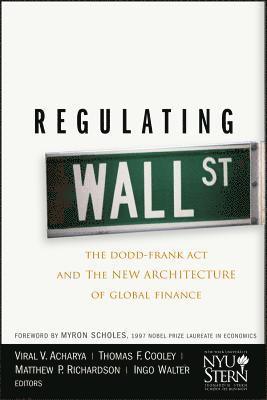
    Regulating Wall Street

    The Dodd-Frank Act and the New Architecture of Global Finance

    AvNew York University Stern School of Business,Viral V. Acharya

    Inbunden, Engelska, 2010

    Del 608 i serien Wiley Finance

    401 kr

    Beställningsvara. Skickas inom 5-8 vardagar. Fri frakt över 249 kr.

    Beskrivning

    Experts from NYU Stern School of Business analyze new financial regulations and what they mean for the economy The NYU Stern School of Business is one of the top business schools in the world thanks to the leading academics, researchers, and provocative thinkers who call it home. In Regulating Wall Street: The New Architecture of Global Finance, an impressive group of the Stern school’s top authorities on finance combine their expertise in capital markets, risk management, banking, and derivatives to assess the strengths and weaknesses of new regulations in response to the recent global financial crisis. Summarizes key issues that regulatory reform should addressEvaluates the key components of regulatory reformProvides analysis of how the reforms will affect financial firms and markets, as well as the real economyThe U.S. Congress is on track to complete the most significant changes in financial regulation since the 1930s. Regulating Wall Street: The New Architecture of Global Finance discusses the impact these news laws will have on the U.S. and global financial architecture.

    Produktinformation

    • Utgivningsdatum:2010-11-19
    • Mått:163 x 236 x 47 mm
    • Vikt:844 g
    • Format:Inbunden
    • Språk:Engelska
    • Serie:Wiley Finance
    • Antal sidor:592
    • Förlag:John Wiley & Sons Inc
    • Medarbetare:Myron Scholes
    • ISBN:9780470768778
    • Utmärkelser:Winner of R.R. Hawkins Award - Business, Finance & Management 2011 (United States)

    Utforska kategorier

    • Finansiering inom Ekonomi och Ledarskap

    Mer om författaren

    VIRAL V. ACHARYA is Professor of Finance at New York University Stern School of Business. THOMAS F. COOLEY is Dean Emeritus and the Paganelli-Bull Professor of Economics at New York University Stern School of Business, as well as a Professor of Economics in the NYU Faculty of Arts and Science. MATTHEW P. RICHARDSON is the Charles E. Simon Professor of Applied Financial Economics at New York University Stern School of Business. INGO WALTER is the Seymour Milstein Professor of Finance, Corporate Governance and Ethics and Vice Dean of Faculty at New York University Stern School of Business.

    Recensioner i media

    "A fascinating, lively, and thoroughly readable guide to the Dodd-Frank Act that pierces the cloud of confusion that hangs over so much of the financial reform debate. It is extremely timely and valuable, and should be required reading for all policymakers, investors, and students of finance. What makes the book so valuable is that it not only analyzes the scope of the Act, in a punchy, lively style, but it also discusses its potential impact. More important, the book analyzes what is not covered in the Act—and where the potential challenges to the financial system still lie."—Gillian Tett, U.S. Managing Editor, Financial Times "The crisis of 2008 confronted even well-educated Americans with a flood of incomprehensible financial vocabulary, describing novel financial institutions and practices most of us had never heard of before. Now we have the 2,300-page Dodd-Frank Act, designed to provide the needed repair. Will it do so? What else will it do? How can we even start to think about these basic questions? Regulating Wall Street addresses these questions in a clear, direct style, taking us through the many parts of the Act one at a time, and providing informed, cogent economic analysis of each. A valuable standard source for future discussion."—Robert E. Lucas, University of Chicago, 1995 Nobel Laureate"Take the faculty of one of the best finance departments in the world. Ask them to analyze the new U.S. legislation on financial regulation, and to think about what the new law gets right, what it gets wrong, and how it is likely to shape the future of the financial system. With a bit of luck, you get this very impressive book. An absolute must-read."—Olivier Blanchard, Chief Economist, International Monetary Fund"Regulating Wall Street goes a long way toward clarifying the intent of the various provisions of the Dodd-Frank Act and evaluating both its effectiveness and limitations. The need for effective implementation by agencies is appropriately emphasized. Not a quick read, a useful reference work on an enormously complex piece of legislation, dealing with an even more complex financial reality."—Paul Volcker, Chairman of the Economic Recovery Advisory Board and former Chairman of the Federal Reserve (1979–1987)“There are many villains in the story of the recent crisis and much written to name them, describe them and even curse them. . .  If you want to know how to fix the problem, I highly recommend ‘Regulating Wall Street,’ from New York University’s Stern School of Business. . .  In the excellent book, ‘Regulating Wall Street,’ several of the studies indicate that there are few synergies among financial activities that could lead to economies of scope. The studies also demonstrate that multiple functions in large, complex firms can actually increase systemic risk. Moreover, they suggest that the spun-off activities could thrive without explicit or implied government support.  The conclusion in this book is that separating activities in this manner, together with stronger resolution processes and better capital standards, would do much to strengthen our financial system, making it more accountable and stronger.”—Thomas M. Hoenig, President, Federal Reserve Bank of Kansas City"Readers should read Regulating Wall Street to understand why, in the face of market failures and copious evidence that Wall Street is unproductive, Congress and regulators labored mightily to resurrect the financial intermediation racket just as it existed on September 12, 2008." (Tax Notes)“If you want to know how to fix the problem, I highly recommend Regulating Wall Street, from New York University’s Stern School of Business.”—Karl Denninger, Seeking Alpha“One refreshing sign of hope for constructive change is that economists, some of whose theories had much to do with a light regulatory approach toward derivatives and the housing bubble, are increasingly producing research calling for stricter guidelines then Dodd-Frank or the Obama administration. Regulating Wall Street presents a wide range of new research supporting stronger regulations than Dodd-Frank recommends, such as . . . tax proposals. . . In the prologue of Regulating Wall Street, the editors, hardly known as progressives, remind financiers how useful strong regulations were in the past. . . We would be better off if the powers on Wall Street would remember. . . “(New York Review)

    Innehållsförteckning

    • Foreword xiPreface xviiPrologue: A Bird’s-Eye ViewThe Dodd-Frank Wall Street Reform and Consumer Protection Act 1 Viral V. Acharya, Thomas Cooley, Matthew Richardson, Richard Sylla, and Ingo WalterPART ONE Financial Architecture 33Chapter 1 The Architecture of Financial Regulation 35 Thomas Cooley and Ingo WalterChapter 2 The Power of Central Banks and the Futureof the Federal Reserve System 51Thomas Cooley, Kermit Schoenholtz, George David Smith, Richard Sylla, and Paul WachtelChapter 3 Consumer Finance Protection 73Thomas Cooley, Xavier Gabaix, Samuel Lee, Thomas Mertens, Vicki Morwitz, Shelle Santana, Anjolein Schmeits, Stijn Van Nieuwerburgh, and Robert WhitelawPART TWO Systemic Risk 85Chapter 4 Measuring Systemic Risk 87Viral V. Acharya, Christian Brownlees, Robert Engle,Farhang Farazmand, and Matthew RichardsonChapter 5 Taxing Systemic Risk 121 Viral V. Acharya, Lasse Pedersen, Thomas Philippon,and Matthew RichardsonChapter 6 Capital, Contingent Capital, and Liquidity Requirements 143Viral V. Acharya, Nirupama Kulkarni, and Matthew RichardsonChapter 7 Large Banks and the Volcker Rule 181 Matthew Richardson, Roy C. Smith, and Ingo WalterChapter 8 Resolution Authority 213Viral V. Acharya, Barry Adler, Matthew Richardson,and Nouriel RoubiniChapter 9 Systemic Risk and the Regulation of Insurance Companies 241Viral V. Acharya, John Biggs, Hanh Le, Matthew Richardson, and Stephen RyanPART THREE Shadow Banking 303Chapter 10 Money Market Funds: How to Avoid Breaking the Buck 305 Marcin Kacperczyk and Philipp SchnablChapter 11 The Repurchase Agreement (Repo) Market 319Viral V. Acharya and T. Sabri O¨ ncu¨Chapter 12 Hedge Funds, Mutual Funds, and ETFs 351Stephen Brown, Anthony Lynch, and Antti PetajistoChapter 13 Regulating OTC Derivatives 367Viral V. Acharya, Or Shachar, and Marti SubrahmanyamPART FOUR Credit Markets 427Chapter 14 The Government-Sponsored Enterprises 429Viral V. Acharya, T. Sabri O¨ ncu¨ , Matthew Richardson, Stijn Van Nieuwerburgh, and Lawrence J. WhiteChapter 15 Regulation of Rating Agencies 443Edward I. Altman, T. Sabri O¨ ncu¨ , Matthew Richardson, Anjolein Schmeits, and Lawrence J. WhiteChapter 16 Securitization Reform 469Matthew Richardson, Joshua Ronen, and Marti SubrahmanyamPART FIVE Corporate Control 491Chapter 17 Reforming Compensation and Corporate Governance 493Jennifer Carpenter, Thomas Cooley, and Ingo WalterChapter 18 Accounting and Financial Reform 511 Joshua Ronen and Stephen RyanEpilogue 527About the Authors 531About the Blog 535Index 537