• Fri frakt över 249 kr
  • •
  • Snabba leveranser
  • •
  • Billiga böcker
Kundservice

Du är på sajten för privatpersoner.

Företag, bibliotek eller offentlig verksamhet?

Du handlar på classic.bokus.com, där alla dina funktioner finns intakta.
Till classic.bokus.com
Bokus logotyp. Gå till startsidan.
  • Erbjudanden
  • Student
  • Topplistor
  • Barn & ungdom
  • Bokus Play
  • E-böcker
  • Ljudböcker
  • Pocketböcker
  • Spel och pussel

Skapa nya rutiner – hälsoböcker upp till 50% →

Sidfot

Mina sidor

    Hjälp

    • Kundservice
    • Vanliga frågor och svar
    • Frakt och leverans
    • Retur vid ångerrätt
    • Reklamera vara
    • Betalning
    • Köpvillkor
    • Allmänna villkor
    • Information om webbplatsens tillgänglighet

    Om Bokus

    • Om oss
    • Pressrum
    • För studenter
    • För företag
    • För bibliotek och offentlig verksamhet
    • För leverantörer
    • Hållbarhet

    Populärt

    • Aktuella erbjudanden
    • Presentkort
    • Studentlitteratur
    • Nya böcker
    • Topplistor
    • Signerade böcker
    • Engelska böcker

    Inspiration

    • Boktips
    • BookTok
    • Barnbokskaraktärer
    • Populära författare
    Logotyp för Bokus
    Följ oss på Facebook (extern länk)Följ oss på Instagram (extern länk)Följ oss på YouTube (extern länk)Följ oss på TikTok (extern länk)
    bokus @ CookiesAnpassa cookiesIntegritetspolicyKöpvillkor
    Till Citymail hemsida (extern länk)Till Budbee hemsida (extern länk)Till Postnord hemsida (extern länk)Till Schenker hemsida (extern länk)Till Early Bird hemsida (extern länk)Till Walleys hemsida (extern länk)
    1. Ekonomi och Ledarskap
    2. Företagsekonomi
    3. Redovisning och finansiering
    4. Finansiering

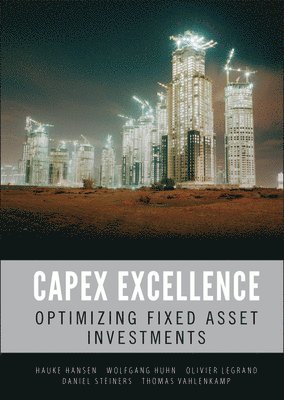
    CAPEX Excellence

    Optimizing Fixed Asset Investments

    AvHauke Hansen,Wolfgang Huhn

    Inbunden, Engelska, 2009

    584 kr

    Beställningsvara. Skickas inom 5-8 vardagar. Fri frakt över 249 kr.

    Beskrivning

    Much of current management literature focuses on a limited set of 'classical' value levers, such as cost reduction, sales optimization or mergers & acquisitions, thus neglecting another core value lever: capital investments. That capital investments receive such limited attention is all the more surprising when one considers how vitally important they are to the economy as a whole as well as individual businesses. There is significant value-creation potential in optimizing capital investments. Investments not only determine the asset structure of a venture. They also enable the introduction of new products structural cost reductions. The book focuses on core questions to be answered in the critical design and realization phase of new investments: Right positioning – does the competitive situation allow the investment to be successfulRight technology – how to optimize timing and risks of technology innovationsRight timing – how to cope with economic cyclesRight size – how to identify the optimum size of an assetRight location – how to find the best location for an assetRight design – how to make investments lean and flexibleRight financing – how to structure the investment financingThe book features an introductory section that provides an overview of investments across the globe, across industries and across time provides practical advice on how to allocate capital to several projects within a company’s investment portfolio.Optimising Fixed Asset Investment is illustrated with real world examples from a range of industries. This book is essential reading for managers faced with challenges of making individual or portfolio capital investment decisions and who are responsible for managing these capital assets over their entire asset lifecycle. The ideas put forward within the book will help to sharpen the focus of management on the impact capital investments have on the well-being and growth of their companies.Optimizing Fixed Asset Investments is a strategic manual for everyone involved or interested in large fixed-capital investments.

    Produktinformation

    • Utgivningsdatum:2009-05-28
    • Mått:173 x 249 x 18 mm
    • Vikt:522 g
    • Format:Inbunden
    • Språk:Engelska
    • Antal sidor:240
    • Förlag:John Wiley & Sons Inc
    • ISBN:9780470779675

    Utforska kategorier

    • Finansiering inom Ekonomi och Ledarskap

    Mer om författaren

    HAUKE HANSEN works as a production manager for ASML in Veldhoven (NL). Prior to his current job he was an Associate Principal in McKinsey’s Düsseldorf office. He served high-tech, logistics and telecom companies and supported several multi-billion dollar investment projects. He holds a PhD in physics from the University of Konstanz and was a Fulbright-scholar at the California Institute of Technology. WOLFGANG HUHN is a Director in McKinsey’s Frankfurt office. He primarily serves clients in the high tech industry as well as in energy. Wolfgang is a member of the Business Technology Office where he leads the industrial sector in Europe. He also leads the European Product Development Practice. Prior to joining McKinsey, Wolfgang studied electrical engineering and physics in Aachen and UK and obtained his PhD in Physics from the RWTH Aachen. From 1998 to 2000, Wolfgang was the CEO of a VC-backed company. OLIVIER LEGRAND is a principal in McKinsey’s Paris office. He serves clients in the transportation, steel and aluminum industries as well as in consumer goods and energy. Olivier co-leads McKinsey’s global capital productivity group. He holds an MBA from Stanford Business School. DANIEL STEINERS is an Associate Principal in McKinsey’s Düsseldorf office. He serves clients in electric power and chemicals across Europe and North America and is a co-leader of McKinsey’s European capital productivity group. Daniel received a diploma in business administration from Münster University and a PhD in management accounting from the European Business School in Oestrich-Winkel. THOMAS VAHLENKAMP is a Director in McKinsey’s Düsseldorf office. He serves clients in the coal, oil, gas, power, and chemicals as well as transportation industries. Thomas is the sector leader of the Energy and Materials Practice in Germany and a member of the leadership group of the European Electric Power and Natural Gas Practice. His educational background is in polymer chemistry. He holds a degree from the Technical University of Aachen (RWTH) and a doctorate from the Max Planck Institute for Polymer Research.

    Innehållsförteckning

    • Acknowledgements ixAbout the Authors xiPart I Why Investments Matter 11 Introduction 31.1 Investments: the forgotten value lever 31.1.1 The early bird catches the worm 41.2 A bird’s-eye view of the book content 61.2.1 Part I: Why investments matter 61.2.2 Part II: Getting investments right 71.2.3 Part III: Right allocation: Managing a company’s investment portfolio 91.3 Why investments matter: the importance and structure of capital investments 101.3.1 The relevance of capital investments 101.3.2 The structure of capital investments 161.3.3 Time dependence of capital investments 211.3.4 The future of capital investments 261.4 Summary 27Appendix 1.1: Wavelet analysis: Extracting frequency information from investment timelines 27References 29Part II Getting Investments Right 312 Right Positioning: Managing an Asset’s Exposure to Economic Risk 332.1 Preface 332.2 Asset exposure determines the achievable return on an investment 332.3 Five levels of protection determine the asset exposure 352.4 A simple scoring metric to measure asset exposure 372.5 Quantitative asset exposure analysis shows high correlation with ROIC at all levels 422.5.1 Using exposure level analysis for benchmarking 452.6 Strategies to reduce asset exposure 472.6.1 Strategy 1: Create public-private, win-win situations in natural monopoly environments 482.6.2 Strategy 2: Foster regulatory conditions that enable sufficient investment levels 492.6.3 Strategy 3: Create the right structural conditions and ensure fair access to scarce resources 492.6.4 Strategy 4: Establish protection for intellectual property 502.6.5 Strategy 5: Achieve a strong commercial position 502.6.6 Strategy 6: Minimize fixed capital costs or outsource asset ownership (go “asset light”) 522.7 Summary 533 Right Technology: How to Optimize Innovation Timing and Risks 553.1 Capital investments in technology innovation 553.1.1 Technology analysis 573.1.2 Assess risks 633.1.3 Mitigating technology risks 673.2 Summary 694 Right Timing: How Cyclicality Affects Return on Investments and What Companies Can Do About It 714.1 How cyclicality destroys value 714.2 Industry drivers of cyclicality 734.2.1 Impact of investment lead times 774.2.2 Slow-to-no market growth 784.2.3 High price sensitivity 784.2.4 Investment timing with respect to the cycle 794.3 Developing an economic model of cyclicality 814.3.1 A fundamental law of economic cycles 814.3.2 Base parameters of simple economic oscillations 834.3.3 Reaction of cyclical systems to external “excitation” 854.3.4 Economic cycles with more than one player present 874.4 Measures to cope with cyclicality 904.4.1 Reaction delay 914.4.2 Reaction strength 924.4.3 “Jokers” that can help beat the cycle 924.4.4 Where no joker is available 954.5 Summary 98Appendix 4A: A differential equation for economic cyclicality 98Reference 1005 Right Size: Balancing Economies and Diseconomies of Scale 1015.1 Introduction: The role of scale in determining profitability 1015.2 Assessing economies of scale 1035.2.1 Fixed cost leverage 1045.2.2 Decreasing unit costs 1055.2.3 Equipment utilization/chunkiness of capacity 1065.2.4 Critical size 1075.3 Determining diseconomies of scale 1075.3.1 Cost elements 1095.4 Risk elements 1115.4.1 Utilization risks 1135.4.2 Market reaction risks 1155.4.3 Technology risks 1165.4.4 Timing risks 1165.5 An approach for finding the “sweet spot” 1175.5.1 Scale effect model 1175.6 Real-life examples 1185.6.1 Automotive industry case example 1185.6.2 Base chemicals case example 1195.7 Summary 120Reference 1216 Right Location: Getting the Most from Government Incentives 1236.1 Government incentives: An overview 1246.1.1 Creating public-private, win-win situations 1256.2 Common types of incentive instruments 1276.2.1 Subsidies 1316.2.2 Financing support 1316.2.3 Tax relief 1336.2.4 Other types of government incentives 1346.3 The financial impact of incentives: A modeling approach 1366.3.1 General impact of subsidies 1376.3.2 General impact of financing support 1386.3.3 General impact of tax relief 1386.3.4 Specific impact of incentives on different industries 1396.4 Geographical differences in incentive structures 1406.5 Managing government incentives 1416.6 Summary 142References 1427 Right Design: How to Make Investments Lean and Flexible 1437.1 Lean design as a competitive advantage 1437.1.1 The lean way: Moving from capital investment projects to a lean design system 1437.2 The three dimensions of a lean capital investment system 1467.3 Dimension 1: The technical system 1477.3.1 Start with project objectives, design princisples, and target setting 1477.3.2 Value engineering and lean tools 1497.3.3 Design optimization 1527.3.4 From the basic design to start of production 1537.3.5 Anchoring tools and practices to formal standards 1557.4 Dimensions 2 & 3: Management infrastructure, mindset and behavior 1557.4.1 Project organization and performance management 1557.4.2 Institutionalization and learning 1567.4.3 Adapting the system to local specifics: Project design cannot be “one size fits all” 1567.4.4 Getting started 1577.5 Flexibility: Just what customers and the company need and no more 1587.5.1 Macro-level flexibility: modularity in plant design to ensure flexible, cost-efficient assets 1587.5.2 Midi-level flexibility in plant design: cater for product portfolio diversity 1597.5.3 Micro-level flexibility in plant design: design for iso-productivity 1607.6 How to avoid creating a front-page disaster: Anticipating what can go wrong 1627.6.1 Performance management and decision making 1637.6.2 Tools which every company and project team need to master 1647.6.3 Cross-functional coordination 1657.7 Summary 166References 1668 Right Financing: Shaping the Optimal Finance Portfolio 1678.1 Why Financing Matters 1678.2 Three-Step Financing Approach 1708.2.1 Step 1: Evaluating the investment’s cash flow parameters 1708.2.2 Step 2: Assessing investment risks 1728.2.3 Step 3: Composing the financing portfolio 1808.3 Summary 183References 183Part III 1859 Right Allocation: How to Allocate Money Within the Company 1879.1 Key requirements for capital allocation 1889.2 Four models of the corporate center role in shaping the investment portfolio 1929.3 Capital allocation approach for operators and strategic controllers 1959.3.1 Step 1: Treat special projects as high priority 1969.3.2 Step 2: Allocate remaining capital to business units 1979.3.3 Step 3: Business units distribute capital to individual investments 1999.3.4 Step 4: Implement a capital assurance process 2019.3.5 Improving the “capital allocation key” 2039.3.6 Capital allocation backbone 2049.4 Capital allocation approach for strategic architects and financial holding structures 2109.5 Summary 213References 213Index 215
    Hoppa över listan

    Mer från samma författare

    Thomas Vahlenkamp, Daniel Steiners, Olivier Legrand, Wolfgang Huhn, Hauke Hansen - CAPEX Excellence, E-bok

    CAPEX Excellence

    Thomas Vahlenkamp, Daniel Steiners, Olivier Legrand, Wolfgang Huhn, Hauke Hansen

    E-bok
    2011

    683 kr

    Thomas Vahlenkamp, Daniel Steiners, Olivier Legrand, Wolfgang Huhn, Hauke Hansen - CAPEX Excellence, E-bok

    CAPEX Excellence

    Thomas Vahlenkamp, Daniel Steiners, Olivier Legrand, Wolfgang Huhn, Hauke Hansen

    E-bok
    2009

    683 kr

    Hoppa över listan

    Du kanske också är intresserad av

    Thomas Vahlenkamp, Daniel Steiners, Olivier Legrand, Wolfgang Huhn, Hauke Hansen - CAPEX Excellence, E-bok

    CAPEX Excellence

    Thomas Vahlenkamp, Daniel Steiners, Olivier Legrand, Wolfgang Huhn, Hauke Hansen

    E-bok
    2011

    683 kr

    Thomas Vahlenkamp, Daniel Steiners, Olivier Legrand, Wolfgang Huhn, Hauke Hansen - CAPEX Excellence, E-bok

    CAPEX Excellence

    Thomas Vahlenkamp, Daniel Steiners, Olivier Legrand, Wolfgang Huhn, Hauke Hansen

    E-bok
    2009

    683 kr

    Daniel Steiners - Lernen mit Controllinginformationen, E-bok

    Lernen mit Controllinginformationen

    Daniel Steiners

    E-bok
    2015

    813 kr

    Daniel Steiners - Lernen mit Controllinginformationen, Häftad

    Lernen mit Controllinginformationen

    Daniel Steiners

    Häftad, 2005

    829 kr

    Olivier Legrand, J.B. Djian - Baker Street Four, Vol. 1, Häftad

    Baker Street Four, Vol. 1

    Olivier Legrand, J.B. Djian

    Häftad, 2017

    152 kr

    Jean-Blaise Djian, Olivier Legrand - Die Vier von der Baker Street. Band 9, Inbunden
    Del 9

    Die Vier von der Baker Street. Band 9

    Jean-Blaise Djian, Olivier Legrand

    Inbunden, 2021

    197 kr

    Jean-Blaise Djian, Olivier Legrand, David Etien - Die Vier von der Baker Street 03. Die Nachtigall von Stepney, Inbunden
    Del 3

    Die Vier von der Baker Street 03. Die Nachtigall von Stepney

    Jean-Blaise Djian, Olivier Legrand, David Etien

    Inbunden

    170 kr

    Jean-Blaise Djian, Olivier Legrand - Die Vier von der Baker Street 07, Inbunden
    Del 7

    Die Vier von der Baker Street 07

    Jean-Blaise Djian, Olivier Legrand

    Inbunden

    181 kr

    Jean-Blaise Djian, Olivier Legrand - Die Vier von der Baker Street. Band 10, Inbunden
    Del 10

    Die Vier von der Baker Street. Band 10

    Jean-Blaise Djian, Olivier Legrand

    Inbunden

    220 kr

    Olivier Legrand, Jean-Blaise Djian - Thorgal Saga: Frost und Feuer, Inbunden
    Del 4

    Thorgal Saga: Frost und Feuer

    Olivier Legrand, Jean-Blaise Djian

    Inbunden, 2026

    284 kr