• Fri frakt över 249 kr
  • •
  • Snabba leveranser
  • •
  • Billiga böcker
Kundservice

Du är på sajten för privatpersoner.

Företag, bibliotek eller offentlig verksamhet?

Du handlar på classic.bokus.com, där alla dina funktioner finns intakta.
Till classic.bokus.com
Bokus logotyp. Gå till startsidan.
  • Erbjudanden
  • Student
  • Topplistor
  • Barn & ungdom
  • Bokus Play
  • E-böcker
  • Ljudböcker
  • Pocketböcker
  • Spel och pussel

Pocketfynda! Hundratals böcker för 49 kr/st →

Sidfot

Mina sidor

    Hjälp

    • Kundservice
    • Vanliga frågor och svar
    • Frakt och leverans
    • Retur vid ångerrätt
    • Reklamera vara
    • Betalning
    • Köpvillkor
    • Allmänna villkor
    • Information om webbplatsens tillgänglighet

    Om Bokus

    • Om oss
    • Pressrum
    • För studenter
    • För företag
    • För bibliotek och offentlig verksamhet
    • För leverantörer
    • Hållbarhet

    Populärt

    • Aktuella erbjudanden
    • Presentkort
    • Studentlitteratur
    • Nya böcker
    • Topplistor
    • Signerade böcker
    • Engelska böcker

    Inspiration

    • Boktips
    • BookTok
    • Barnbokskaraktärer
    • Populära författare
    Logotyp för Bokus
    Följ oss på Facebook (extern länk)Följ oss på Instagram (extern länk)Följ oss på YouTube (extern länk)Följ oss på TikTok (extern länk)
    bokus @ CookiesAnpassa cookiesIntegritetspolicyKöpvillkor
    Till Citymail hemsida (extern länk)Till Budbee hemsida (extern länk)Till Postnord hemsida (extern länk)Till Schenker hemsida (extern länk)Till Early Bird hemsida (extern länk)Till Walleys hemsida (extern länk)
    1. Naturvetenskap och teknik
    2. Teknik och industri
    3. Elektronik och kommunikationer

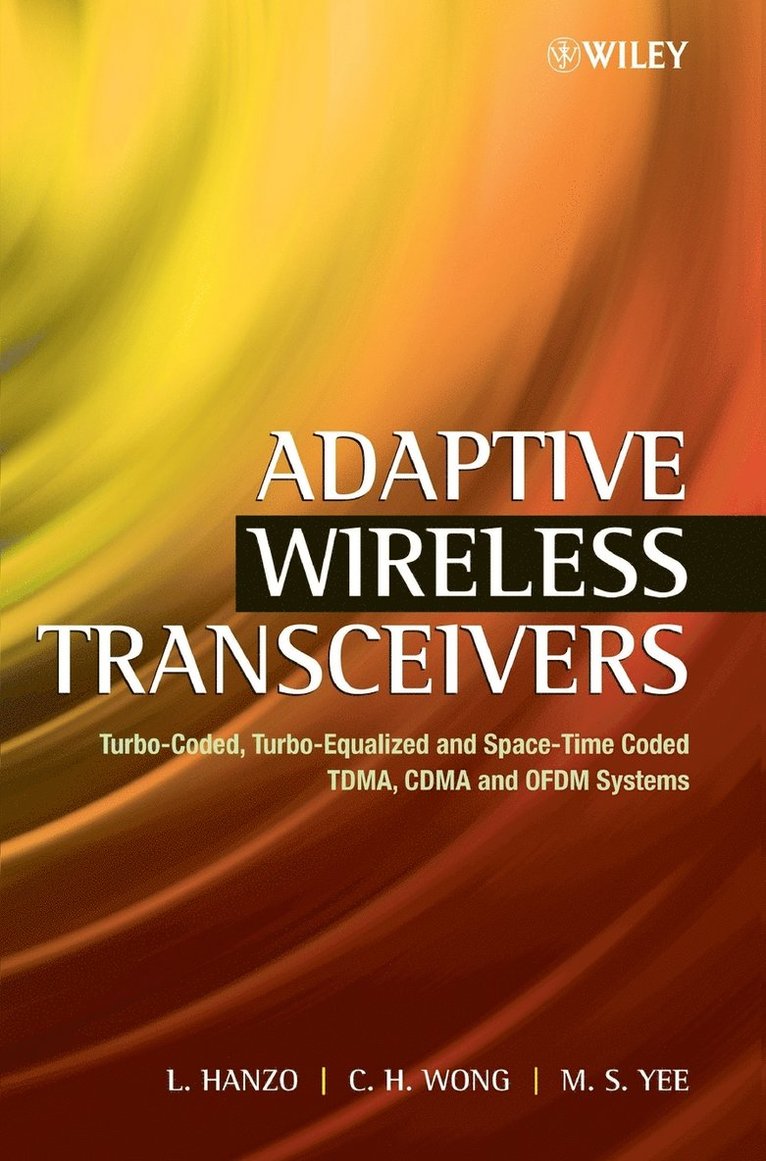
    Adaptive Wireless Transceivers

    Turbo-Coded, Turbo-Equalized and Space-Time Coded TDMA, CDMA and OFDM Systems

    AvLajos Hanzo,C. H. Wong

    Inbunden, Engelska, 2002

    Del i serien IEEE Press

    2 803 kr

    Beställningsvara. Skickas inom 5-8 vardagar. Fri frakt över 249 kr.

    Beskrivning

    Adaptive Wireless Transceivers provides the reader with abroad overview of near-instantaneously adaptive transceivers in thecontext of TDMA, CDMA and OFDM systems. The adaptive transceiversexamined employ powerful turbo codecs, turbo equalisers andspace-time codecs, equipping the reader with a future-prooftechnological road map. It demonstrates that adaptive transceiversare capable of mitigating the channel quality fluctuations of thewireless channel as a lower-complexity alternative to space-timecoding. By contrast, if the higher complexity of multipletransmitters and multiple receiver-assisted systems is deemedacceptable, the advantages of adaptability erode.* Provides an in-depth introduction to channel equalisers andKalman filtering and discusses the associated complexity versusperformance trade-offs* Introduces wideband near-instantaneously adaptive transceiversand studies their performance both with and without turbo channelcoding* Describes how to optimise adaptive modulation mode switchingand highlights a range of practical considerations* Introduces neural network based channel equalisers anddiscusses Radial Basis Function (RBF) assisted equalisers embeddedinto adaptive modems supported by turbo channel coding and turbochannel equalisation* Employs the above adaptive principles also in the context ofCDMA and OFDM transceivers and discusses the pros and cons ofspace-time coding versus adaptive modulationResearchers, advanced students and practising development engineersworking in wireless communications will all find this valuable textan informative read.

    Produktinformation

    • Utgivningsdatum:2002-02-26
    • Mått:182 x 250 x 52 mm
    • Vikt:1 474 g
    • Format:Inbunden
    • Språk:Engelska
    • Serie:IEEE Press
    • Antal sidor:752
    • Förlag:John Wiley & Sons Inc
    • ISBN:9780470846896

    Utforska kategorier

    • Elektronik och kommunikationer inom Naturvetenskap och teknik

    Mer om författaren

    Lajos Hanzo received his degree in electronics in 1976 and his doctorate in 1983. During his 25-year career in telecommunications he has held various research and academic posts in Hungary, Germany and the UK. Since 1986 he has been with the Department of Electronics and Computer Science, University of Southampton, UK, where he holds the chair in telecommunications. He has co-authored eight books on mobile radio communications, published over 300 research papers, organised and chaired conference sessions, presented overview lectures and been awarded a number of distinctions. Currently he is managing an academic research team, working on a range of research projects in the field of wireless multimedia communications sponsored by industry, the Engineering and Physical Sciences Research Council UK, the European IST Programme and the Mobile Virtual Centre of Excellence, UK. He is an enthusiastic supporter of industrial and academic liaison and he offers a range of industrial courses. He is also an IEEE Distinguished Lecturer. For further information on research in progress and associated publications please refer to http://www-mobile.ecs.soton.ac.uk.

    Recensioner i media

    "...provides an overview of near-instantaneously adaptive transceivers." (SciTech Book News, Vol. 26, No. 2, June 2002)

    Innehållsförteckning

    • 1 Prologue 11.1 Motivation of the Book 11.2 Adaptation Principles 41.3 Channel Quality Metrics 51.4 Transceiver Parameter Adaptation 51.5 Milestones in Adaptive Modulation History 71 .5 . 1 Adaptive Single- and Multi-carrier Modulation 71.6 Outline of the book 14I Near-instantaneously Adaptive Modulation and Filtering Based Equalisation 192 Introduction To Equalizers 212.1 Coherent Demodulation of Square-QAM 232.2 Intersymbol Interference 292.3 Basic Equalizer Theory 292.4 Signal to Noise Ratio Loss of the DFE 402.5 Equalization in Multi-level Modems 412.6 Review and Discussion 423 Adaptive Equalization 453.1 Derivation of the Recursive Kalman Algorithm 463.2 Application of the Kalman Algorithm 543.3 Complexity Study 713.4 Adaptive Equalization in Multilevel Modems 723.5 Review and Discussion 774 Adaptive Modulation 814.1 Adaptive Modulation for Narrow-band Fading Channels 814.2 Power Control Assisted Adaptive Modulation 864.3 Adaptive Modulation and Equalization in a Wideband Environment 994.4 Review and Discussion 1195 Turbo-Coded and Turbo-Equalised Adaptive Modulation 1235.1 Turbo Coding 1245.2 System Parameters 1275.3 Turbo Block Coding Performance of the Fixed QAM Modes 1285.4 Fixed Coding Rate, Fixed Interleaver Size Turbo Coded AQAM 1315.5 Fixed Coding Rate. Variable Interleaver Size Turbo Coded AQAM 1355.6 Blind Modulation Detection 1395.7 Variable Coding Rate Turbo Block Coded Adaptive Modulation 1465.8 Comparisons of the Turbo Block Coded AQAM Schemes 1525.9 Turbo Convolutional Coded AQAM Schemes 1615.10 Turbo Equalization 1655.11 Burst-by-Burst Adaptive Wideband Coded Modulation 1735.12 Review and Discussion 1866 Adaptive Modulation Mode Switching Optimization 1916 .l Introduction 1916.2 Increasing the Average Transmit Power as a Fading Counter-Measure 1926.3 System Description 1966.4 Optimum Switching Levels 2036.5 Results and Discussions 2216.6 Review and Discussion 2547 Practical Considerations of Wideband AQAM 2577.1 Impact of Error Propagation 2577.2 Channel Quality Estimation Latency 2597.3 Effect of CO-channel Interference on AQAM 2717.4 Review and Discussion 292I1 Near-instantaneously Adaptive Modulation and Neural Network Based Equalisation 2978 Neural Network Based Equalization 2998 .l Discrete Time Model for Channels Exhibiting Intersymbol Interference 2998.2 Equalization as a Classification Problem 3008.3 Introduction to Neural Networks 3058.4 Equalization Using Neural Networks 3118.5 Multilayer Perceptron Based Equaliser 3118.6 Polynomial Perceptron Based Equaliser 3148.7 Radial Basis Function Networks 3168.8 K-means Clustering Algorithm 3298.9 Radial Basis Function Network Based Equalisers 3308.10 Scalar Noise-free Channel Output States 3408.1 l Decision Feedback Assisted Radial Basis Function Network Equaliser 3428.12 Simulation Results 3548.13 Review and Discussion 3829 RBF-Equalized Adaptive Modulation 3859 .l Background to Adaptive Modulation in a Narrowband Fading Channel 3869.2 Background on Adaptive Modulation in a Wideband Fading Channel 3899.3 Brief Overview of Part I of the Book 3909.4 Joint Adaptive Modulation and RBF Based Equalization 3959.5 Performance of the AQAM RBF DFE Scheme 4 109.6 Review and Discussion 4149.4.4 Simulation Model for Best-case Performance 39910 RBF Equalization Using nrbo Codes 41710.1 Introduction to Turbo Codes 41710.2 Jacobian Logarithmic RBF Equalizer 41910.3 System Overview 42310.4 Turbo-coded RBF-equalized M-QAM Performance 42710.5 Channel Quality Measure 43210.6 Turbo Coding and RBF Equalizer Assisted AQAM 43310.7 Review and Discussion 45211 RBF Turbo Equalization 4531 1 . 1 Introduction to Turbo equalization 45311.2 RBF Assisted Turbo equalization 45511.3 Comparison of the RBF and MAP Equaliser 45711.4 Comparison of the Jacobian RBF and Log-MAP Equaliser 4601 1.5 RBF Turbo Equaliser Performance 4631 1.6 Reduced-complexity RBF Assisted Turbo equalization 47111.7 In-phase/Quadrature-phase Turbo equalization 47611.8 Turbo Equalized Convolutional and Space Time Trellis Coding 48511.9 Review and Discussion 493III Near-Instantaneously Adaptive CDMA and Adaptive Space-Time Coded OFDM 49512 Burst-by-Burst Adaptive Multiuser Detection CDMA 49712.1 Motivation 49712.2 Multiuser Detection 49812.3 Multiuser Equaliser Concepts 50112.4 Adaptive CDMA Schemes 51812.5 Burst-by-Burst AQAM/CDMA 52112.6 Review and Discussion 53313 Adaptive Multicarrier Modulation 53513.1 Introduction 53513.2 Orthogonal Frequency Division Multiplexing 53613.3 OFDM Transmission over Frequency Selective Channels 54313.4 OFDM Performance with Frequency Errors and Timing Errors 54713.5 Synchronization Algorithms 55613.6 Adaptive OFDM 56313.7 Pre-Equalization 57913.8 Review and Discussion 58414 Space-Time Coding versus Adaptive Modulation 58914.1 Introduction 58914.2 Space-Time Trellis Codes 59014.3 Space-Time Coded Transmission Over Wideband channels 59414.4 Simulation Results 60314.5 Space-Time Coded Adaptive Modulation for OFDM 62614.6 Review and Discussion 63515 Conclusions and Suggestions for Further Research 63915.1 Book Summary and Conclusions 63915.2 Suggestions for Future Research 64915.3 Closing Remarks 651A Appendices 653Bibliography 687Index 713Author Index 723