• Fri frakt över 249 kr
  • •
  • Snabba leveranser
  • •
  • Billiga böcker
Kundservice

Du är på sajten för privatpersoner.

Företag, bibliotek eller offentlig verksamhet?

Du handlar på classic.bokus.com, där alla dina funktioner finns intakta.
Till classic.bokus.com
Bokus logotyp. Gå till startsidan.
  • Erbjudanden
  • Nyheter
  • Student
  • Topplistor
  • Barn & ungdom
  • Bokus Play
  • E-böcker
  • Pocketböcker
  • Spel & pussel

10% rabatt på allt med kod NYSTART10 →

Sidfot

Mina sidor

    Hjälp

    • Kundservice
    • Vanliga frågor och svar
    • Frakt och leverans
    • Retur vid ångerrätt
    • Reklamera vara
    • Betalning
    • Köpvillkor
    • Allmänna villkor
    • Information om webbplatsens tillgänglighet

    Om Bokus

    • Om oss
    • Pressrum
    • För studenter
    • För företag
    • För bibliotek och offentlig verksamhet
    • För leverantörer
    • Hållbarhet

    Populärt

    • Aktuella erbjudanden
    • Presentkort
    • Studentlitteratur
    • Nya böcker
    • Topplistor
    • Signerade böcker
    • Engelska böcker

    Inspiration

    • Boktips
    • BookTok
    • Populära bokserier
    • Barnbokskaraktärer
    • Populära författare
    Logotyp för Bokus
    Följ oss på Facebook (extern länk)Följ oss på Instagram (extern länk)Följ oss på YouTube (extern länk)Följ oss på TikTok (extern länk)
    bokus @ CookiesAnpassa cookiesIntegritetspolicyKöpvillkor
    Till Citymail hemsida (extern länk)Till Budbee hemsida (extern länk)Till Postnord hemsida (extern länk)Till Schenker hemsida (extern länk)Till Early Bird hemsida (extern länk)Till Walleys hemsida (extern länk)
    1. Naturvetenskap och teknik
    2. Teknik och industri
    3. Elektronik och kommunikationer

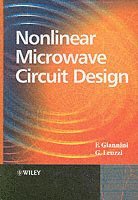
    Nonlinear Microwave Circuit Design

    AvFranco Giannini,Giorgio Leuzzi

    Inbunden, Engelska, 2004

    1 870 kr

    Beställningsvara. Skickas inom 11-20 vardagar. Fri frakt över 249 kr.

    Fler format och utgåvor

    Övrigt

    Tillf. slut

    Beskrivning

    Design techniques for nonlinear microwave circuits are much less developed than for linear microwave circuits. Until now there has been no up-to-date text available in this area. Current titles in this field are considered outdated and tend to focus on analysis, failing to adequately address design and measurement aspects. Giannini and Leuzzi provide the theoretical background to non-linear microwave circuits before going on to discuss the practical design and measurement of non-linear circuits and components. Non-linear Microwave Circuit Design reviews all of the established analysis and characterisation techniques available and provides detailed coverage of key modelling methods. Practical examples are used throughout the text to emphasise the design and application focus of the book.* Provides a unique, design-focused, coverage of non-linear microwave circuits* Covers the fundamental properties of nonlinear circuits and methods for device modelling* Outlines non-linear measurement techniques and characterisation of active devices* Reviews available design methodologies for non-linear power amplifiers and details advanced software modelling tools* Provides the first detailed treatment of non-linear frequency multipliers, mixers and oscillators* Focuses on the application potential of non-linear components Practicing engineers and circuit designers working in microwave and communications engineering and designing new applications, as well as senior undergraduates, graduate students and researchers in microwave and communications engineering and their libraries will find this a highly rewarding read.

    Produktinformation

    • Utgivningsdatum:2004-04-23
    • Mått:175 x 252 x 28 mm
    • Vikt:912 g
    • Format:Inbunden
    • Språk:Engelska
    • Antal sidor:424
    • Förlag:John Wiley & Sons Inc
    • ISBN:9780470847015

    Utforska kategorier

    • Elektronik och kommunikationer inom Naturvetenskap och teknik

    Mer om författaren

    Franco Giannini was born in Galatina, in 1944 and graduated in Electronics Engineering, summa cum laude in 1968, before getting the chair of Full Professor of Applied Electronics in 1980. In 2008, he was awarded the Laurea Honoris Causa Scientiarum Technicarum degree by the Warsaw University of Technology, Poland. Since 1981 he has been at the University of Roma Tor Vergata, where he has served as Head of Department, Vice President for International Affairs, Pro-Rector, and Dean of the Faculty of Electronics Engineering. He has chaired the Microwave Engineering Centre for Space Applications. He has been working on modeling, characterization and design methodologies of active and passive microwave components and circuits, including MICs and MMICs for telecommunication and space applications, authoring or co-authoring more than 400 scientific contributions. He chaired the theme MMICs of the national project MADESS I of the CNR and was a member of the Management Board of MADESS II, chairman of the theme MMICs of the National Project MICROELECTRONICS, and member of the Board of Directors of the Italian Space Agency. He has also been active in European Projects and was the Italian representative in the European Working Group for GaAs Microelectronics. He has been a consultant for various national and international organizations, including the ITU for the United Nations Development Program, and the European Union for ESPRIT, LTR, ISTC projects. In 1996 Professor Giannini was awarded the Irena Galewska Kielbasinski Prize by the Technical University of Darmstadt, Germany, and an Honorary Professorship by WUT, Poland, in 2001.Giorgio Leuzzi received a degree in electronic engineering from the University of Roma, Italy, in 1982. In 1983; he served in the Italian Army as an officer in the Technical Corps. In 1984 he became research assistant at the University of Roma Tor Vergata and taught Microwave Electronics there. He worked in the field of microwave integrated transmission lines and is now involved in the study of nonlinear microwave circuits.

    Recensioner i media

    "…any reader of 'Nonlinear Microwave Circuit Design' will gain insight into the many issues that are blissfully disregarded when using only linear techniques." (IEEE Microwave Magazine, December 2004)

    Innehållsförteckning

    • Preface. Chapter 1. Nonlinear Analysis Methods. 1.1 Introduction. 1.2 Time-Domain Solution. 1.3 Solution Through Series Expansion 1.4 The Conversion Matrix. 1.5 Bibliography. Chapter 2. Nonlinear Measurements. 2.1 Introduction. 2.2 Load/Source-Pull. 2.3 The Vector Nonlinear Network Analyser. 2.4 Pulsed Measurements. 2.5 Bibliography. Chapter 3. Nonlinear Models. 3.1 Introduction. 3.2 Physical Models. 3.3 Equivalent-Circuit Models. 3.4 Black-Box Models. 3.5 Simplified Models. 3.6 Bibliography. Chapter 4. Power Amplifiers. 4.1 Introduction. 4.2 Classes of Operation. 4.3 Simplified Class-A Fundamental-Frequency Design For High Efficiency. 4.4 Multi-Harmonic Design For High Power And Efficiency. 4.5 Bibliography. Chapter 5. Oscillators. 5.1 Introduction. 5.2 Linear Stability and Oscillation Conditions. 5.3 From Linear To Nonlinear: Quasi-Large-Signal Oscillation And Stability Conditions. 5.4 Design Methods. 5.5 Nonlinear Analysis Methods For Oscillators. 5.6 Noise. 5.7 Bibliography. Chapter 6. Frequency Multipliers and Dividers. 6.1 Introduction. 6.2 Passive Multipliers. 6.3 Active Multipliers. 6.4 Frequency Dividers-The Rigenerative (Passive) Approach. 6.5 Bibliography. Chapter 7. Mixers. 7.1 Introduction. 7.2 Mixer Configurations. 7.3 Mixer Design. 7.4 Nonlinear Analysis. 7.5 Noise. 7.6 Bibliography. Chapter 8. Stability and Injection-locked Circuits. 8.1 Introduction. 8.2 Local Stability Of Nonlinear Circuits In Large-Signal Regime. 8.3 Nonlinear Analysis, Stability And Bifurcations. 8.4 Injection Locking. 8.5 Bibliography. Appendix. A.1. Transformation in the Fourier Domain of the Linear Differential Equation. A.2. Time-Frequency Transformations. A.3 Generalized Fourier Transformation for the Volterra Series Expansion. A.4 Discrete Fourier Transform and Inverse Discrete Fourier Transform for Periodic Signals. A.5 The Harmonic Balance System of Equations for the Example Circuit with N=3. A.6 The Jacobian Matrix A.7 Multi-dimensional Discrete Fourier Transform and Inverse Discrete Fourier Transform for quasi-periodic signals. A.8 Oversampled Discrete Fourier Transform and Inverse Discrete Fourier Transform for Quasi-Periodic Signals. A.9 Derivation of Simplified Transport Equations. A.10 Determination of the Stability of a Linear Network. A.11 Determination of the Locking Range of an Injection-Locked Oscillator. Index.