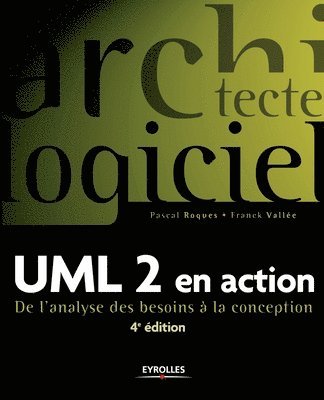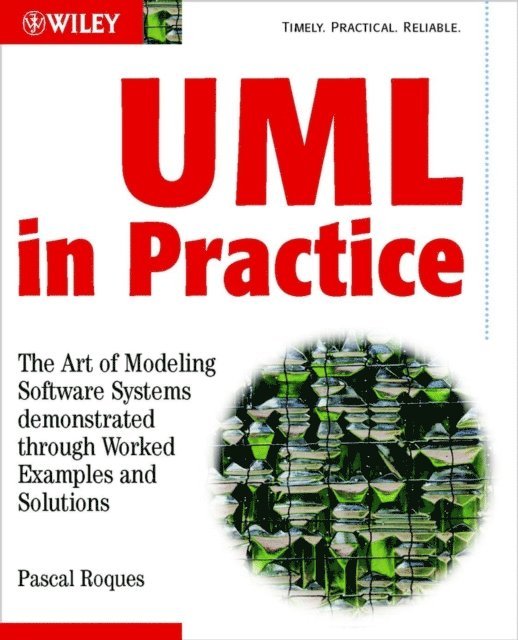
Offers comprehensive coverage of all major modeling viewpointsProvides details of collaboration and class diagrams for filling in the design-level models
Pascal Roques is a senior trainer and consultant running courses on UML. He has led training in modeling techniques and tools at Verilog (now Telelogic) and since 1995 at Valtech.
Innehållsförteckning
Foreword ixIntroduction xiAcknowledgements xvPART 1 FUNCTIONAL VIEW 11 Case study: automatic teller machine 31.1 Step 1 – Identifying the actors of the ATM 51.2 Step 2 – Identifying use cases 81.3 Step 3 – Creating use case diagrams 101.4 Step 4 – Textual description of use cases 141.5 Step 5 – Graphical description of use cases 201.6 Step 6 – Organising the use cases 262 Complementary exercises 372.1 Step 1 – Business modelling 532.2 Step 2 – Defining system requirements 57Appendix A: Glossary & tips 65PART 2 STATIC VIEW 713 Case study: flight booking system 733.1 753.2 Step 2 – Modelling sentences 6, 7 and 10 773.3 Step 3 – Modelling sentences 8 and 9 823.4 Step 4 – Modelling sentences 3, 4 and 5 863.5 Step 5 – Adding attributes, constraints and qualifiers 893.6 Step 6 – Using analysis patterns 943.7 Step 7 – Structuring into packages 983.8 Step 8 – Generalisation and re-use 1054 Complementary exercises 113Appendix B: Glossary & tips 149Step 1– Modelling sentences 1 and 2PART 3 DYNAMIC VIEW 1575 Case study: coin-operated pay phone 1595.1 Step 1 – Identifying the actors and use cases 1615.2 Step 2 – Realising the system sequence diagram 1645.3 Step 3 – Representing the dynamic context 1665.4 Step 4 – In-depth description using a state diagram 1686 Complementary exercises 185Apendix C: Glossary & tips 207PART 4 DESIGN 2137 Case study: training request 2157.1 Step 1 – Defining iterations 2177.2 Step 2 – Defining the system architecture 2197.3 Step 3 – Defining system operations (iteration 1) 2247.4 Step 4 – Operation contracts (iteration 1) 2257.5 Step 5 – Interaction diagrams (iteration 1) 2287.6 Step 6 – Design class diagrams (iteration 1) 2377.7 Step 7 – Defining the system operations (iteration 2) 2457.8 Step 8 – Operation contracts (iteration 2) 2477.9 Step 9 – Interaction diagrams (iteration 2) 2507.10 Step 10 – Design class diagrams (iteration 2) 2527.11 Step 11 – Back to architecture 2537.12 Step 12 – Transition to Java code 2547.13 Step 13 – Putting the application into action 2628 Complementary exercises 267Appendix D: Glossary & tips 283Index 293