• Fri frakt över 249 kr
  • •
  • Snabba leveranser
  • •
  • Billiga böcker
Kundservice

Du är på sajten för privatpersoner.

Företag, bibliotek eller offentlig verksamhet?

Du handlar på classic.bokus.com, där alla dina funktioner finns intakta.
Till classic.bokus.com
Bokus logotyp. Gå till startsidan.
  • Erbjudanden
  • Nyheter
  • Student
  • Topplistor
  • Barn & ungdom
  • Bokus Play
  • E-böcker
  • Pocketböcker
  • Spel & pussel

10% rabatt på allt med kod NYSTART10 →

Sidfot

Mina sidor

    Hjälp

    • Kundservice
    • Vanliga frågor och svar
    • Frakt och leverans
    • Retur vid ångerrätt
    • Reklamera vara
    • Betalning
    • Köpvillkor
    • Allmänna villkor
    • Information om webbplatsens tillgänglighet

    Om Bokus

    • Om oss
    • Pressrum
    • För studenter
    • För företag
    • För bibliotek och offentlig verksamhet
    • För leverantörer
    • Hållbarhet

    Populärt

    • Aktuella erbjudanden
    • Presentkort
    • Studentlitteratur
    • Nya böcker
    • Topplistor
    • Signerade böcker
    • Engelska böcker

    Inspiration

    • Boktips
    • BookTok
    • Populära bokserier
    • Barnbokskaraktärer
    • Populära författare
    Logotyp för Bokus
    Följ oss på Facebook (extern länk)Följ oss på Instagram (extern länk)Följ oss på YouTube (extern länk)Följ oss på TikTok (extern länk)
    bokus @ CookiesAnpassa cookiesIntegritetspolicyKöpvillkor
    Till Citymail hemsida (extern länk)Till Budbee hemsida (extern länk)Till Postnord hemsida (extern länk)Till Schenker hemsida (extern länk)Till Early Bird hemsida (extern länk)Till Walleys hemsida (extern länk)
    1. Naturvetenskap och teknik
    2. Teknik och industri
    3. Elektronik och kommunikationer

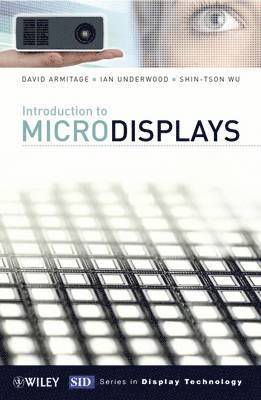
    Introduction to Microdisplays

    AvDavid Armitage,Ian Underwood

    Inbunden, Engelska, 2006

    Del i serien Wiley Series in Display Technology

    1 754 kr

    Beställningsvara. Skickas inom 5-8 vardagar. Fri frakt över 249 kr.

    Beskrivning

    Microdisplays are tiny, high-resolution electronic displays, designed for use in magnifying optical systems such as HDTV projectors and near-eye personal viewers. As a result of research and development into this field, Microdisplays are   incorporated in a variety of visual electronics, notably new 3G portable communications devices, digital camera technologies, wireless internet applications, portable DVD viewers and wearable PCs.  Introduction to Microdisplays encapsulates this market through describing in detail the theory, structure, fabrication and applications of Microdisplays. In particular this book: Provides excellent reference material for the Microdisplay industry through including an overview of current applications alongside a guide to future developments in the fieldCovers all current technologies and devices such as Silicon Wafer Backplane Technology, Liquid Crystal Devices, Micromechanical Devices, and the emerging area of Organic Light Emitting DiodesPresents guidance on the design of applications of Microdisplays, including Microdisplays for defence and telecoms, from basic principles through to their performance limitations Introduction to Microdisplays is a thorough and comprehensive reference on this emerging topic. It is essential reading for display technology manufacturers, developers, and system integrators, as well as practising electrical engineers, physicists, chemists and specialists in the display field. Graduate students, researchers, and developers working in optics, material science, and telecommunications will also find this a valuable resource. The Society for Information Display (SID) is an international society, which has the aim of encouraging the development of all aspects of the field of information display. Complementary to the aims of the society, the Wiley-SID series is intended to explain the latest developments in information display technology at a professional level. The broad scope of the series addresses all facets of information displays from technical aspects through systems and prototypes to standards and ergonomics

    Produktinformation

    • Utgivningsdatum:2006-09-15
    • Mått:175 x 252 x 28 mm
    • Vikt:889 g
    • Format:Inbunden
    • Språk:Engelska
    • Serie:Wiley Series in Display Technology
    • Antal sidor:400
    • Förlag:John Wiley & Sons Inc
    • ISBN:9780470852811

    Utforska kategorier

    • Elektronik och kommunikationer inom Naturvetenskap och teknik
    • Fysik inom Naturvetenskap och teknik

    Mer om författaren

    David Armitage, Consultant, Los Altos, CA94024, USA Dr Ian Underwood, Reader, Dept of Electrical Engineering, The University of Edinburgh, King's Buildings, Mayfield Road, Edinburgh EH9 3JL, ScotlandDr Shin-Tson Wu, Provost Professor of Optics, University of Central Florida, School of Optics – CREOL, 4000 Central Florida Boulevard PO Box 162700, Orlando, Florida 32816-2700, USA

    Innehållsförteckning

    • Series Editor’s Foreword. Preface.1. Introduction.1.1 Microdisplays.1.2 Human Factors.1.3 Display Specifications.1.4 Displays in General.1.5 Microdisplay Evolution.1.6 Microdisplay Applications.2 Electronic Addressing.2.1 Introduction.2.2 MOS Transistor.2.3 LCOS System Electronics Architecture.2.4 Analogue Pixel Drive Schemes for Analogue Electro-Optic Response.2.5 Digital Electronic Drive Schemes for Analog Electro-Optical Response.2.6 Digital Pixel Drive Schemes for Binary Electro-Optical Response.2.7 DMD Microdisplay Circuit.2.8 OLED Microdisplay Circuits.2.9 Photo-Addressing.3 Silicon Backplane Technology.3.1 Introduction.3.2 CMOS Technology.3.3 CMOS for microdisplays.3.4 Wafer and die bow.3.5 Surface planarization.3.6 Pixel storage.3.7 Light blocking.3.8 Mirror quality.3.9 Pixel gap fill.3.10 LC Cell gap.3.11 LCoS CMOS summary.3.12 Backplane technology for other microdisplays.3.13 Silicon Technology Roadmap.3.14 Cost of silicon.3.15 Summary.4 Transmission Microdisplays Structure.4.1 Background.4.2 Thin film transistors.4.3 Polysilicon.4.4 Polysilicon microdisplay.4.5 Transferred silicon.4.6 Silicon-on-sapphire.5 Transmission Liquid Crystal Microdisplays.5.1 Introduction.5.2 TFT-LCD.5.3 Projection System.5.4 Twisted-Nematic Cells.5.5 Vertically-Aligned Nematic (VAN) Cells.5.6 Fringing Field Effect.5.7 Liquid crystal ionic effects.6 Reflective Liquid Crystal Microdisplays.6.1 Introduction.6.2 Normally Black Homeotropic Cell.6.3 Normally White Homogenous Cell.6.4 Reflective TN Cells.6.5 Normally White 90o MTN Cell.6.6 Normally White 63.6o MTN Cell.6.7 Normally Black 63.6o TN Cell.6.8 Normally White 60o MTN Cell.6.9 Normally White 45o MTN Cell.6.10 Normally Black 45o TN.6.11 Finger-On-Plane Structure.6.12 Scattering and Diffractive Microdisplays.6.13 Ferroelectric Liquid Crystals.7 LCD Assembly and Test.7.1 Background.7.2 Back end processing.7.3 Assembly components.7.4 Assembly methods.7.5 Test.8 Micromechanical Devices.8.1 Background.8.2 Digital Mirror Device.8.3 Piezoelectric Micromirror.8.4 Grating Light Valve.8.5 Interference modulation.8.6 Further development.9 Emissive Microdisplays.9.1 Introduction.9.2 Organic Emissive Materials.9.3 Device Construction & Manufacture.9.4 Device Characteristics.9.5 Color.9.6 OLED Microdisplays.9.7 Other Emissive Microdisplays.9.8 Summary.10 Projection Displays.10.1 Background.10.2 Throughput.10.3 Laser and LED sources.10.4 Arc Lamps.10.5 Polarizing Optics.10.6 Color management.10.7 Schlieren projector.10.8 Laser scanning.10.9 Projector Performance.11 Near-Eye Systems.11.1 Background.11.2 Magnification.11.3 Field of View.11.4 Microdisplay Factors.11.5 Magnifiers.11.6 Camera Viewfinder.11.7 Head mounted displays.11.8 Free-surface prisms.11.9 Eyewear-based displays.11.10 Light-guide System.11.11 Wide field of view.11.12 Portable Equipment.Table of Symbols.