• Fri frakt över 249 kr
  • •
  • Snabba leveranser
  • •
  • Billiga böcker
Kundservice

Du är på sajten för privatpersoner.

Företag, bibliotek eller offentlig verksamhet?

Du handlar på classic.bokus.com, där alla dina funktioner finns intakta.
Till classic.bokus.com
Bokus logotyp. Gå till startsidan.
  • Erbjudanden
  • Nyheter
  • Student
  • Topplistor
  • Barn & ungdom
  • Bokus Play
  • E-böcker
  • Pocketböcker
  • Spel & pussel

10% rabatt på allt med kod NYSTART10 →

Sidfot

Mina sidor

    Hjälp

    • Kundservice
    • Vanliga frågor och svar
    • Frakt och leverans
    • Retur vid ångerrätt
    • Reklamera vara
    • Betalning
    • Köpvillkor
    • Allmänna villkor
    • Information om webbplatsens tillgänglighet

    Om Bokus

    • Om oss
    • Pressrum
    • För studenter
    • För företag
    • För bibliotek och offentlig verksamhet
    • För leverantörer
    • Hållbarhet

    Populärt

    • Aktuella erbjudanden
    • Presentkort
    • Studentlitteratur
    • Nya böcker
    • Topplistor
    • Signerade böcker
    • Engelska böcker

    Inspiration

    • Boktips
    • BookTok
    • Populära bokserier
    • Barnbokskaraktärer
    • Populära författare
    Logotyp för Bokus
    Följ oss på Facebook (extern länk)Följ oss på Instagram (extern länk)Följ oss på YouTube (extern länk)Följ oss på TikTok (extern länk)
    bokus @ CookiesAnpassa cookiesIntegritetspolicyKöpvillkor
    Till Citymail hemsida (extern länk)Till Budbee hemsida (extern länk)Till Postnord hemsida (extern länk)Till Schenker hemsida (extern länk)Till Early Bird hemsida (extern länk)Till Walleys hemsida (extern länk)
    1. Psykologi och pedagogik
    2. Psykologi

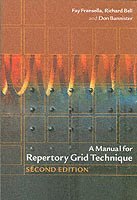
    Manual for Repertory Grid Technique

    AvFay Fransella,Richard Bell

    Häftad, Engelska, 2003

    741 kr

    Beställningsvara. Skickas inom 5-8 vardagar. Fri frakt över 249 kr.

    Fler format och utgåvor

    Inbunden

    2 327 kr

    Beskrivning

    First published in 1977, this now classic manual has been completely revised and updated to reflect the enormous changes that have taken place both in the popularity of repertory grid methods and in the study of the methods themselves. Aimed at novices as well as those already knowledgeable about grid usage, this manual provides an overview of George Kelly’s personal construct theory, which underpins repertory grid methods. The reader will learn how to design a grid, with guidance on how to choose elements and ways of eliciting personal constructs that can influence the results obtained.The second edition includes multiple examples of grids, as well as: New chapters on the main computer methods of analysis availableSupporting website with grid analysis programs available to downloadExtended annotated bibliography of the many examples of grid usageThis book will appeal to psychology students, practitioners and academics. Other professionals who will find this an invaluable guide include managers, teachers and educationalists, speech and language therapists, nurses, probation officers and psychiatrists.

    Produktinformation

    • Utgivningsdatum:2003-10-24
    • Mått:171 x 246 x 17 mm
    • Vikt:510 g
    • Format:Häftad
    • Språk:Engelska
    • Antal sidor:280
    • Upplaga:2
    • Förlag:John Wiley & Sons Inc
    • ISBN:9780470854907

    Utforska kategorier

    • Psykologi inom Psykologi och pedagogik

    Mer om författaren

    Fay Fransella is Founder and Director of the Center for Personal Construct Psychology, Emeritus Reader in Clinical Psychology, University of London and Visiting Professor of Personal Construct Psychology at the University of Hertfordshire. She has written 11 books, eight of them specifically relating to personal construct psychology and the use of repertory grids, and she has published over 150 journal papers and book chapters. She wrote the first edition of A Manual for Repertory Grid Technique with Don Bannister for Academic Press in 1977.She trained and worked as an occupational therapist for 10 years before taking a degree in psychology and a postgraduate diploma in clinical psychology in 1962. It was during her first job as a lecturer at the Institute of Psychiatry, London, that she was introduced to George Kelly’s personal construct psychology and his repertory grid method. Both were revolutionary alternatives to the dominant behaviorism of the time. She found the view that we are all free agents responsible for what we make of the events which continually confront us particularly liberating. Since that time she has conducted research, together with teaching and writing, within the framework of Kelly’s ideas. Her main area of research has been stuttering, for which she used a form of repertory grid. She has also conducted research on weight disorders and various psychological problems. Richard Bell is an Associate Professor of Psychology at the University of Melbourne. He is interested practical problems of measurement in clinical, organizational and educational settings. He has written extensively on the analysis of repertory grid data and has authored widely used software for the analysis of such data.The influence of Don Bannister in arousing interest in George Kelly’s theory and methods of assessment has been profound. Even after his untimely death in 1986 his influence continues, through those he inspired, through his professional research and writings, and also through his four novels. In the year in which this second edition of the Manual for Repertory Grid Techniques is published the 15th International Congress in Personal Construct Psychology was held in Huddersfield, UK, focusing on that outstanding influence. He spent much of his professional life carrying out research for the UK Medical Research Council, which included a year working with George Kelly at Ohio State University in 1965. He saw the psychology of personal constructs as an approach to the person that was empowering, democratic and, above all, valuable in helping people understand themselves and others. He was insistent that psychologists should use what power and influence they have to make a difference in the lives of people. He would have taken great interest in the vast amount of new work that has been carried out with and into that tool which is detailed in this second edition of the book that he co-authored in 1977.

    Recensioner i media

    "...integrity and up-to-date scholarship demands our attention..." (Constructive Interventionist Newsletter, August 2004)

    Innehållsförteckning

    • About the Authors ixPreface xiAcknowledgements xiii1 The Basis of Repertory Grid Technique 1Grids: What Are They? 1The Grid as Part of Personal Construct Theory 5Grids: a Measure of What? 5Grids are about Constructs 7Some Personal Construct Theory Corollaries 9Different Kinds of Construct 12Constructs in Transition 12Conclusions 122 Constructs And Elements 15What is an Element? 15What is a Construct? 15Elements in a Grid 18The Nature and Types of Constructs in a Grid 23Ways of Eliciting Personal Constructs from ’Elements’ 27Eliciting Personal Constructs in Ways other than from ’Elements’ 30Eliciting Constructs from Constructs 39To Elicit or to Supply Constructs? 46Classification of Constructs 49Which are more Important in a Grid – Elements or Constructs? 50Constructs and Elements: the Debate 50Comment 523 Varieties Of Grid In Use Today 54The Grid Form of the Role Construct Repertory Test 54The Split-Half Method of Allocating Elements 56A Grid Using Rankings 56A Grid Using Ratings 59Implications and Resistance-to-Change Grids 65Resistance-to-Change Grid 70A Bipolar Implications Grid 73Dependency Grid 76A Textual Grid 78A Qualitative Grid 79Comment 804 Analyzing Grid Data 82Repertory Grids 82Analyzing Constructs 83Analyzing Elements 91Joint Representations of Constructs and Elements 93Representations of Multiple Repertory Grid Data 98Dependency Grids 101Implications Grids 104Comments 1085 Some Summary Measures Of Structure 113Cognitive Complexity 114Extremity and Ordination 121Conflict 122Element Indices 124Measures of Superordinacy 126Measures of Intransitivity 127Implications Grids 128Dependency Grids 129Comment 1306 Reliability and Validity 132Reliability 132Conclusions 143Validity 143Conclusions 1517 Specific Ways Of Using Grids 153The Individual and the Grid 154A Decision-Making Grid 162Wholly or Partially Standardized Grid Formats 163Conclusions 1678 Some Uses To Which Grids Have Been Put 168Grids in General 169In the Clinical Setting 170Working with Children 188Teachers and Teaching 192The Construing of Professionals 195Those With Learning Difficulties 196Social Relationships 199Language 204Dependency 210The Use and Abuse of Drugs 211The Family 212Forensic Work 213Maps, Planning and Environment 215Market Research 217Politics 218Careers 219Sport 220Organizational and Business Applications 220More Unusual Uses of Grids 226Appendix Computer Programs and Websites 230References 232Author Index 258Subject Index 262