• Fri frakt över 249 kr
  • •
  • Snabba leveranser
  • •
  • Billiga böcker
Kundservice

Du är på sajten för privatpersoner.

Företag, bibliotek eller offentlig verksamhet?

Du handlar på classic.bokus.com, där alla dina funktioner finns intakta.
Till classic.bokus.com
Bokus logotyp. Gå till startsidan.
  • Erbjudanden
  • Nyheter
  • Student
  • Topplistor
  • Barn & ungdom
  • Bokus Play
  • E-böcker
  • Pocketböcker
  • Spel & pussel

10% rabatt på allt med kod: NYSTART10 →

Sidfot

Mina sidor

    Hjälp

    • Kundservice
    • Vanliga frågor och svar
    • Frakt och leverans
    • Retur vid ångerrätt
    • Reklamera vara
    • Betalning
    • Köpvillkor
    • Allmänna villkor
    • Information om webbplatsens tillgänglighet

    Om Bokus

    • Om oss
    • Pressrum
    • För studenter
    • För företag
    • För bibliotek och offentlig verksamhet
    • För leverantörer
    • Hållbarhet

    Populärt

    • Aktuella erbjudanden
    • Presentkort
    • Studentlitteratur
    • Nya böcker
    • Topplistor
    • Signerade böcker
    • Engelska böcker

    Inspiration

    • Boktips
    • BookTok
    • Populära bokserier
    • Barnbokskaraktärer
    • Populära författare
    Logotyp för Bokus
    Följ oss på Facebook (extern länk)Följ oss på Instagram (extern länk)Följ oss på YouTube (extern länk)Följ oss på TikTok (extern länk)
    bokus @ CookiesAnpassa cookiesIntegritetspolicyKöpvillkor
    Till Citymail hemsida (extern länk)Till Budbee hemsida (extern länk)Till Postnord hemsida (extern länk)Till Schenker hemsida (extern länk)Till Early Bird hemsida (extern länk)Till Walleys hemsida (extern länk)
    1. Psykologi och pedagogik
    2. Pedagogik
    3. Undervisning i specifika ämnen

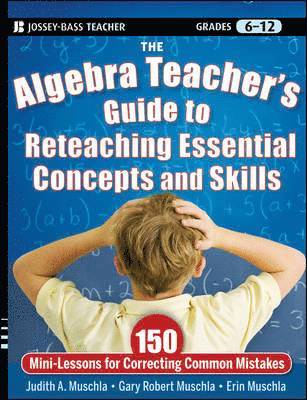
    Algebra Teacher's Guide to Reteaching Essential Concepts and Skills

    150 Mini-Lessons for Correcting Common Mistakes

    AvJudith A. Muschla,Gary R. Muschla

    Häftad, Engelska, 2011

    351 kr

    Beställningsvara. Skickas inom 3-6 vardagar. Fri frakt över 249 kr.

    Beskrivning

    Easy to apply lessons for reteaching difficult algebra concepts Many students have trouble grasping algebra. In this book, bestselling authors Judith, Gary, and Erin Muschla offer help for math teachers who must instruct their students (even those who are struggling) about the complexities of algebra. In simple terms, the authors outline 150 classroom-tested lessons, focused on those concepts often most difficult to understand, in terms that are designed to help all students unravel the mysteries of algebra. Also included are reproducible worksheets that will assist teachers in reviewing and reinforcing algebra concepts and key skills. Filled with classroom-ready algebra lessons designed for students at all levelsThe 150 mini-lessons can be tailored to a whole class, small groups, or individual students who are having troubleThis practical, hands-on resource will help ensure that students really get the algebra they are learning

    Produktinformation

    • Utgivningsdatum:2011-12-20
    • Mått:216 x 279 x 18 mm
    • Vikt:785 g
    • Format:Häftad
    • Språk:Engelska
    • Antal sidor:336
    • Förlag:John Wiley & Sons Inc
    • ISBN:9780470872826

    Utforska kategorier

    • Undervisning i specifika ämnen inom Psykologi och pedagogik

    Mer om författaren

    Judith A. Muschla (Jackson, NJ) taught mathematics in South River, New Jersey, at the middle school and high school for over twenty-five years. At South River Middle School she helped revise the mathematics curriculum to reflect the Standards of the National Council of Teachers of Mathematics (NCTM), coordinated interdisciplinary units, and conducted mathematics workshops for teachers and parents.Gary Robert Muschla (Jackson, NJ) taught at Appleby School in Spotswood, New Jersey, for more than twenty-five years. Judith and Gary have coauthored several very successful math activity books, including The Algebra Teacher's Activities Kit and Hands-On Math Projects with Real Life Applications.Erin Muschla (Freehold, NJ) teaches middle school math and algebra at Monroe Township Middle School in Monroe, New Jersey. She is also a coauthor with Judith and Gary of The Math Teacher's Survival Guide, and The Elementary Teacher's Book of Lists.

    Innehållsförteckning

    • About This Book iii About the Authors vAcknowledgments viiSECTION 1: INTEGERS, VARIABLES, AND EXPRESSIONS 11.1: Using the Order of Operations  21.2: Simplifying Expressions That Have Grouping Symbols  41.3: Simplifying Expressions with Nested Grouping Symbols  61.4: Using Positive Exponents and Bases Correctly  81.5: Simplifying Expressions with Grouping Symbols and Exponents  101.6: Evaluating Expressions  121.7: Writing Expressions  141.8: Writing Expressions Involving Grouping Symbols  161.9: Identifying Patterns by Considering All of the Numbers  181.10: Writing Prime Factorization  201.11: Finding the Greatest Common Factor  221.12: Finding the Least CommonMultiple 241.13: Classifying Counting Numbers, Whole Numbers, and Integers  261.14: Finding Absolute Values and Opposites 281.15: Adding Integers with Different Signs  301.16: Subtracting Integers 321.17: Multiplying Two Integers 341.18: MultiplyingMore Than Two Integers  361.19: Using Integers as Bases  381.20: Dividing Integers  401.21: Finding Absolute Values of Expressions 421.22: Finding Square Roots of Square Numbers  44SECTION 2: RATIONAL NUMBERS 472.1: Classifying Counting Numbers, Whole Numbers, Integers, and Rational Numbers  482.2: Simplifying Fractions 502.3: RewritingMixed Numbers as Improper Fractions  522.4: Comparing Rational Numbers 542.5: Expressing Rational Numbers as Decimals  562.6: Expressing Terminating Decimals as Fractions or Mixed Numbers 582.7: Expressing Repeating Decimals as Fractions or Mixed Numbers  602.8: Adding Rational Numbers 622.9: Subtracting Rational Numbers  642.10: Multiplying and Dividing Rational Numbers 662.11: Expressing Large Numbers in Scientific Notation  682.12: Evaluating Rational Expressions  702.13: Writing Ratios Correctly  722.14: Writing and Solving Proportions 742.15: Expressing Fractions as Percents  762.16: Expressing Percents as Fractions 782.17: Solving Percent Problems  802.18: Finding the Percent of Increase or Decrease  822.19: Converting from One Unit of Measurement to Another Using theMultiplication Property of One  84SECTION 3: EQUATIONS AND INEQUALITIES 873.1: Writing Equations  883.2: Solving Equations by Adding or Subtracting  903.3: Solving Equations byMultiplying or Dividing  923.4: Solving Two-Step Equations with the Variable on One Side 943.5: Solving Equations Using the Distributive Property 963.6: Solving Equations with Variables on Both Sides  983.7: Solving Equations with Variables on Both Sides, Including Identities and Equations That Have No Solution 1003.8: Solving Absolute Value Equations 1023.9: Solving Absolute Value Equations That Have Two Solutions, One Solution, or No Solution  1043.10: Classifying Inequalities as True or False 1063.11: Writing Inequalities  1083.12: Solving Inequalities with Variables on One Side 1103.13: Rewriting Combined Inequalities as One Inequality 1123.14: Solving Combined Inequalities—Conjunctions  1143.15: Solving Combined Inequalities—Disjunctions  1163.16: Solving Absolute Value Inequalities  1183.17: Solving Systems of Equations Using the Substitution Method  1203.18: Solving Systems of Equations Using the Addition-or-SubtractionMethod 1223.19: Solving Systems of Equations Using Multiplication with the Addition-or-SubtractionMethod  1243.20: Solving Systems of Equations Using a Variety of Methods 1263.21: Solving Systems of Equations That Have One Solution, No Solution, or an Infinite Number of Solutions 1283.22: Using Matrices—Addition, Subtraction, and Scalar Multiplication 1303.23: Identifying Conditions forMultiplying TwoMatrices  1323.24: Multiplying TwoMatrices 134SECTION 4: GRAPHS OF POINTS AND LINES 1374.1: Graphing on a Number Line  1384.2: Graphing Conjunctions  1404.3: Graphing Disjunctions  1424.4: Graphing Ordered Pairs on the Coordinate Plane  1444.5: Completing T-Tables  1464.6: Finding the Slope of a Line, Given Two Points on the Line 1484.7: Identifying the Slope and Y-Intercept from an Equation . . 1504.8: Using Equations to Find the Slopes of Lines  1524.9: Identifying Parallel and Perpendicular Lines, Given an Equation  1544.10: Using the X-Intercept and the Y-Intercept to Graph a Linear Equation  1564.11: Using Slope-Intercept Form to Graph the Equation of a Line  1584.12: Graphing Linear Inequalities in the Coordinate Plane 1604.13: Writing a Linear Equation, Given Two Points 1624.14: Finding the Equation of the Line of Best Fit  1644.15: Using theMidpoint Formula  1664.16: Using the Distance Formula to Find the Distance Between Two Points  1684.17: Graphing Systems of Linear Equations When Lines Intersect 1704.18: Graphing Systems of Linear Equations if Lines Intersect, Are Parallel, or Coincide 172SECTION 5: MONOMIALS AND POLYNOMIALS 1755.1: ApplyingMonomial Vocabulary Accurately  1765.2: Identifying Similar Terms  1785.3: Adding Polynomials  1805.4: Subtracting Polynomials  1825.5: MultiplyingMonomials  1845.6: Using Powers ofMonomials  1865.7: Multiplying a Polynomial by aMonomial  1885.8: Multiplying Two Binomials  1905.9: Multiplying Two Polynomials  1925.10: DividingMonomials  1945.11: Dividing Polynomials  1965.12: Finding the Greatest Common Factor of Two or More Monomials 1985.13: Factoring Polynomials by Finding the Greatest Monomial Factor 2005.14: Factoring the Difference of Squares  2025.15: Factoring Trinomials if the Last TermIs Positive 2045.16: Factoring Trinomials if the Last TermIs Negative  2065.17: Factoring by Grouping 2085.18: Factoring Trinomials if the Leading Coefficient Is an Integer Greater Than 1 2105.19: Factoring the Sums and Differences of Cubes  2125.20: Solving Quadratic Equations by Factoring 2145.21: Solving Quadratic Equations by Finding Square Roots  2165.22: Solving Quadratic Equations Using the Quadratic Formula  2185.23: Using the Discriminant  220SECTION 6: RATIONAL EXPRESSIONS 2236.1: Using Zero and Negative Numbers as Exponents 2246.2: Using the Properties of Exponents That Apply to Division 2266.3: Using the Properties of Exponents That Apply to Multiplication and Division 2286.4: Identifying Restrictions on the Variable 2306.5: Simplifying Algebraic Fractions  2326.6: Adding and Subtracting Algebraic Fractions with Like Denominators 2346.7: Finding the Least CommonMultiple of Polynomials 2366.8: Writing Equivalent Algebraic Fractions  2386.9: Adding and Subtracting Algebraic Fractions with Unlike Denominators  2406.10: Multiplying and Dividing Algebraic Fractions  2426.11: Solving Proportions  2446.12: Solving Equations That Have Fractional Coefficients  2466.13: Solving Fractional Equations 248SECTION 7: IRRATIONAL AND COMPLEX NUMBERS 2517.1: Simplifying Radicals  2527.2: Multiplying Radicals  2547.3: Rationalizing the Denominator  2567.4: Dividing Radicals  2587.5: Adding and Subtracting Radicals  2607.6: Multiplying Two Binomials Containing Radicals  2627.7: Using Conjugates to Simplify Radical Expressions  2647.8: Simplifying Square Roots of Negative Numbers  2667.9: Multiplying Imaginary Numbers 2687.10: Simplifying ComplexNumbers  270SECTION 8: FUNCTIONS 2738.1: Determining if a Relation Is a Function  2748.2: Finding the Domain of a Function 2768.3: Finding the Range of a Function  2788.4: Using the Vertical Line Test  2808.5: Describing Reflections of the Graph of a Function  2828.6: Describing Vertical Shifts of the Graph of a Function  2848.7: Describing Horizontal and Vertical Shifts of the Graph of a Function  2868.8: Describing Dilations of the Graph of a Function  2888.9: Finding the Composite of Two Functions  2908.10: Finding the Inverse of a Function 2928.11: Evaluating the Greatest Integer Function 2948.12: Identifying Direct and Indirect Variation 2968.13: Describing the Graph of the Quadratic Function 2988.14: Using Rational Numbers as Exponents  3008.15: Using Irrational Numbers as Exponents  3028.16: Solving Exponential Equations 3048.17: Using the Compound Interest Formula  3068.18: Solving Radical Equations  3088.19: Writing Logarithmic Equations as Exponential Equations  3108.20: Solving Logarithmic Equations  3128.21: Using the Properties of Logarithms 314Common Core State Standards for Mathematics 316