• Fri frakt över 249 kr
  • •
  • Snabba leveranser
  • •
  • Billiga böcker
Kundservice

Du är på sajten för privatpersoner.

Företag, bibliotek eller offentlig verksamhet?

Du handlar på classic.bokus.com, där alla dina funktioner finns intakta.
Till classic.bokus.com
Bokus logotyp. Gå till startsidan.
  • Erbjudanden
  • Nyheter
  • Student
  • Topplistor
  • Barn & ungdom
  • Bokus Play
  • E-böcker
  • Pocketböcker
  • Spel & pussel

10% rabatt på allt med kod: NYSTART10 →

Sidfot

Mina sidor

    Hjälp

    • Kundservice
    • Vanliga frågor och svar
    • Frakt och leverans
    • Retur vid ångerrätt
    • Reklamera vara
    • Betalning
    • Köpvillkor
    • Allmänna villkor
    • Information om webbplatsens tillgänglighet

    Om Bokus

    • Om oss
    • Pressrum
    • För studenter
    • För företag
    • För bibliotek och offentlig verksamhet
    • För leverantörer
    • Hållbarhet

    Populärt

    • Aktuella erbjudanden
    • Presentkort
    • Studentlitteratur
    • Nya böcker
    • Topplistor
    • Signerade böcker
    • Engelska böcker

    Inspiration

    • Boktips
    • BookTok
    • Populära bokserier
    • Barnbokskaraktärer
    • Populära författare
    Logotyp för Bokus
    Följ oss på Facebook (extern länk)Följ oss på Instagram (extern länk)Följ oss på YouTube (extern länk)Följ oss på TikTok (extern länk)
    bokus @ CookiesAnpassa cookiesIntegritetspolicyKöpvillkor
    Till Citymail hemsida (extern länk)Till Budbee hemsida (extern länk)Till Postnord hemsida (extern länk)Till Schenker hemsida (extern länk)Till Early Bird hemsida (extern länk)Till Walleys hemsida (extern länk)
    1. Naturvetenskap och teknik
    2. Teknik och industri
    3. Agronomi och lantbruk

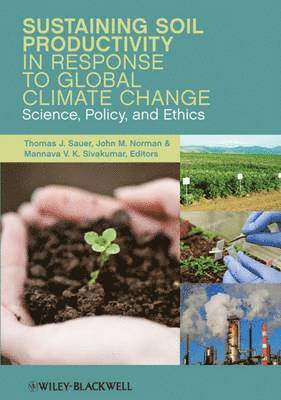
    Sustaining Soil Productivity in Response to Global Climate Change

    Science, Policy, and Ethics

    AvThomas J. Sauer,John Norman

    Inbunden, Engelska, 2011

    2 781 kr

    Beställningsvara. Skickas inom 11-20 vardagar. Fri frakt över 249 kr.

    Beskrivning

    Sustaining Soil Productivity in Response to Global Climate Change: Science, Policy, and Ethics is a multi-disciplinary volume exploring the ethical, political and social issues surrounding the stewardship of our vital soil resources. Based on topics presented by an international group of experts at a conference convened through support of the Organization for Economic Co-operation and Development, chapters include scientific studies on carbon sequestration, ecosystem services, maintaining soil fertility, and the effects of greenhouse gas emissions, as well as ethical issues ranging from allocation of land use to policies needed for climate change adaptation and mitigation.Bringing together the latest research in soil science and climatology, Sustaining Soil Productivity in Response to Global Climate Change is a valuable resource for soil and plant scientists, agronomists and environmental scientists, as well as agricultural and natural resources engineers and economists, environmental policy makers and conservationists.Key Features: Written by an international group of authors representing a cross-section of scientists, thought leaders, and policy-makersIncludes chapters on the potential effects of climate change on forest soil carbon, microbial function, and the role of soils and biogeochemistry in the climate and earth systemExplores historical development of land use ethics and stewardship

    Produktinformation

    • Utgivningsdatum:2011-10-25
    • Mått:178 x 254 x 19 mm
    • Vikt:671 g
    • Format:Inbunden
    • Språk:Engelska
    • Antal sidor:264
    • Förlag:John Wiley & Sons Inc
    • ISBN:9780470958575

    Utforska kategorier

    • Agronomi och lantbruk inom Naturvetenskap och teknik

    Mer om författaren

    Thomas J. Sauer is a Research Soil Scientist for the USDA Agricultural Research Service in Ames, Iowa.John M. Norman is Emeritus Professor of Soil Science at the University of Wisconsin-Madison.Mannava V. K. Sivakumar is Director of the Climate Prediction and Adaptation Branch of the World Meteorological Organization in Geneva, Switzerland.

    Recensioner i media

    “This book provides a useful primer in ethics and the philosophy of science in the context of soils. I enjoyed reading it and it is refreshing to see the attention given to the interaction between science and policy.”  (European Journal of Soil Science, 1 August 2012“There is also a useful body of information that provides a basic summary of the state of knowledge and thought about climate change in 2009. For both aspects, it is worth adding to one’s library.”  (Canadian Journal of Soil Science, 11 July 2013)"This is one of those rare books - a conference publication that is full of pleasant surprises ... In summary, this is a thought-provoking publication, which reinforces the notion that soils confer real biophysical limits to the expansion of the market economy." (Expl Agric, 2012)

    Innehållsförteckning

    • Contributors xiForeword by Sally Collins xvIntroduction xviiChapter 1 Science, Ethics, and the Historical Roots of Our Ecological Crisis: Was White Right? 3Thomas J. Sauer and Michael P. Nelson1.1 Introduction 31.2 Historical Perspective on Soil Degradation 41.3 The New Challenge of Global Climate Change 51.4 White 81.5 Other Views on the Ethics of Land Use: Leopold et al. 91.6 Ethical Considerations of Strategies for Climate Change Mitigation: An Example 111.7 Conclusions 13Acknowledgements 14Chapter 2 Intellectual Inertia: An Uneasy Tension between Collective Validation of the Known and Encouraging Exploration of the Unknown 17John M. Norman2.1 Introduction 172.2 Defining Intellectual Inertia 172.3 Examples of Intellectual Inertia 182.4 Intellectual Inertia is Unavoidable But Requires Vigilance 212.5 Intellectual Inertia and Climate Change Science 232.6 Optimizing Intellectual Inertia 26Chapter 3 The Ethics of Soil: Stewardship, Motivation, and Moral Framing 31Paul B. Thompson3.1 Introduction 313.2 Private Property and Personal Ethics 323.3 Common Pool Resources 333.4 Public Policy 353.5 Instrumental Values of Soil 363.6 Beyond Instrumental Value 383.7 Conclusion and Next Steps 40Chapter 4 Aldo Leopold and the Land Ethic: An Argument for Sustaining Soils 43Susan L. Flader4.1 Introduction 434.2 The Shaping of a Progressive 434.3 Erosion as a Menace 454.4 Standards of Conservation 464.5 Conservation as a Moral Issue 474.6 Wildlife and Soils 494.7 The Conservation Ethic 504.8 An Adventure in Cooperative Conservation 524.9 Land Pathology 554.10 Land Health 564.11 The Land Ethic 594.12 Epilogue 61Chapter 5 Rural Response to Climate Change in Poor Countries: Ethics, Policies, and Scientific Support Systems in Their Agricultural Environment 67C. J. (Kees) Stigter5.1 Introduction 675.2 Ethics 685.3 Policies 695.4 Scientific Support Systems 715.5 Conclusions 75Chapter 6 Soil and Human Health 79Eiliv Steinnes6.1 Introduction 796.2 Essential Trace Elements 806.3 Concerns for the Future 84Chapter 7 Agroecological Approaches to Help “Climate Proof ” Agriculture While Raising Productivity in the Twenty-First Century 87Norman Uphoff7.1 Introduction 877.2 Agroecological Approaches 887.3 The System of Rice Intensification 907.4 Effects of SRI Practices on Agriculture Affected by Climate Change 937.5 Applications to Crops Other than Rice 977.6 Climate-Proofing Agriculture 98Chapter 8 Ecological Integrity and Biological Integrity: The Right to Food 103Laura Westra8.1 Introduction 1038.2 Ecological Integrity and Food Production Today 1048.3 The Legal Status of Genetically Modified Organisms 1108.4 Western Diets and Lifestyle Preferences: Vegan versus Carnivore 1128.5 Conclusion 113Chapter 9 Soil Ecosystem Services: Sustaining Returns on Investment into Natural Capital 117Brent E. Clothier, Alistair J. Hall, Markus Deurer, Steven R. Green, and Alec D. Mackay9.1 Introduction 1179.2 F. H. King—“Farmers of Forty Centuries” 1189.3 Soil: Valuable Natural Capital 1209.4 Valuing Ecosystem Services 1239.5 Valuing Carbon and Soil Ecosystem Services 1259.6 Valuing Terroir 1299.7 Land-Use Policy, Nutrient Management, and Natural Capital 1339.8 Conclusion 136Chapter 10 Climate and Land Degradation 141Mannava V. K. Sivakumar10.1 Introduction 14110.2 Influence of Land Surface Changes on Climate 14210.3 Climate Change and Land Degradation 14210.4 Climate Variability and Impacts on Land Degradation 14510.5 Technologies, Policies, and Measures to Address the Linkages between Climate and Land Degradation 15110.6 Future Perspectives 151Chapter 11 The Role of Soils and Biogeochemistry in the Climate and Earth System 155Elisabeth A. Holland11.1 Introduction 15511.2 Lessons Learned from the Intergovernmental Panel on Climate Change 15511.3 The Carbon Cycle 15911.4 The Nitrogen Cycle 16311.5 Future of Earth System Models 165Chapter 12 Net Agricultural Greenhouse Gases: Mitigation Strategies and Implications 169Claudia Wagner-Riddle and Alfons Weersink12.1 Introduction 16912.2 Mitigation Practices for Reduction of Net GHG Emissions 17012.3 Net GHG Reduction 17212.4 Case Study 1: GHG Emission Mitigation through Composting of Liquid Swine Manure 17212.5 Case Study 2: Direct and Indirect N2O Emission Reduction through Soil Tillage and Nitrogen Fertilizer Management Practices 17412.6 Designing Policies for Reduced Nitrogen Fertilizer Use 17512.7 Conclusion 180Chapter 13 Overview on Response of Global Soil Carbon Pools to Climate and Land-Use Changes 183Thomas Eglin, Philippe Ciais, Shi Long Piao, Pierre Barré, Valentin Belassen, Patricia Cadule, Claire Chenu, Thomas Gasser, Markus Reichstein, and Pete Smith13.1 Introduction 18313.2 Global Distribution of SOC 18313.3 Global Vulnerability of SOC to Climate and Land-Use Change 18513.4 Historical Land Cover, Agricultural Management, and Climate Change Effects on SOC 18613.5 Future Changes in Climate and Land Use and the SOC Balance 19013.6 Discussion: Uncertainties and Future Directions 19213.7 Conclusions 19313.8 Methods 194Acknowledgement 195Chapter 14 Potential Impacts of Climate Change on Microbial Function in Soil: The Effect of Elevated CO2 Concentration 201Paolo Nannipieri14.1 Introduction 20114.2 Effect of CO2 Concentration on Plant C Inputs including Rhizodeposition to Soil 20214.3 Effects of Elevated CO2 Concentration on Activity, Size, and Composition of Soil Microbiota 20314.4 Effects of Elevated CO2 Concentration on Mycorrhizal Infections of Plants 20514.5 Effect of Elevated CO2 Concentration on Biotic Interactions and on the Rhizosphere Microfauna 20514.6 Effects of Increased CO2 Concentration, Global Warming, and Changes in Soil Moisture on Microbial Functions Related to C Sequestration in Soil 20614.7 Conclusions 208Chapter 15 Impacts of Climate Change on Forest Soil Carbon: Uncertainties and Lessons from Afforestation Case Studies 213Philip J. Polglase and Keryn I. Paul15.1 Introduction 21315.2 Afforestation Overview 21515.3 Implications for Predicting Climate Change Impacts 21815.4 Modeling the Impacts of Climate Change on Soil Carbon 21915.5 Conclusion 222Acknowledgments 222Chapter 16 The Effect of Forest Management on Soil Organic Carbon 225Giustino Tonon, Silvia Dezi, Maurizio Ventura, and Francesca Scandellari16.1 Forest Ecosystems and Global Carbon Cycle 22516.2 Effect of Forest Management on Soil Organic Carbon Sequestration 22716.3 Forest Management Strategies and Forest Structures Improving Carbon Storage 23416.4 Conclusions 235Index 239