• Fri frakt över 249 kr
  • •
  • Snabba leveranser
  • •
  • Billiga böcker
Kundservice

Du är på sajten för privatpersoner.

Företag, bibliotek eller offentlig verksamhet?

Du handlar på classic.bokus.com, där alla dina funktioner finns intakta.
Till classic.bokus.com
Bokus logotyp. Gå till startsidan.
  • Erbjudanden
  • Nyheter
  • Student
  • Topplistor
  • Barn & ungdom
  • Bokus Play
  • E-böcker
  • Pocketböcker
  • Spel & pussel

10% rabatt på allt med kod: NYSTART10 →

Sidfot

Mina sidor

    Hjälp

    • Kundservice
    • Vanliga frågor och svar
    • Frakt och leverans
    • Retur vid ångerrätt
    • Reklamera vara
    • Betalning
    • Köpvillkor
    • Allmänna villkor
    • Information om webbplatsens tillgänglighet

    Om Bokus

    • Om oss
    • Pressrum
    • För studenter
    • För företag
    • För bibliotek och offentlig verksamhet
    • För leverantörer
    • Hållbarhet

    Populärt

    • Aktuella erbjudanden
    • Presentkort
    • Studentlitteratur
    • Nya böcker
    • Topplistor
    • Signerade böcker
    • Engelska böcker

    Inspiration

    • Boktips
    • BookTok
    • Populära bokserier
    • Barnbokskaraktärer
    • Populära författare
    Logotyp för Bokus
    Följ oss på Facebook (extern länk)Följ oss på Instagram (extern länk)Följ oss på YouTube (extern länk)Följ oss på TikTok (extern länk)
    bokus @ CookiesAnpassa cookiesIntegritetspolicyKöpvillkor
    Till Citymail hemsida (extern länk)Till Budbee hemsida (extern länk)Till Postnord hemsida (extern länk)Till Schenker hemsida (extern länk)Till Early Bird hemsida (extern länk)Till Walleys hemsida (extern länk)
    1. Naturvetenskap och teknik
    2. Teknik och industri
    3. Övrig teknik och tillämpad vetenskap
    4. Militärteknik

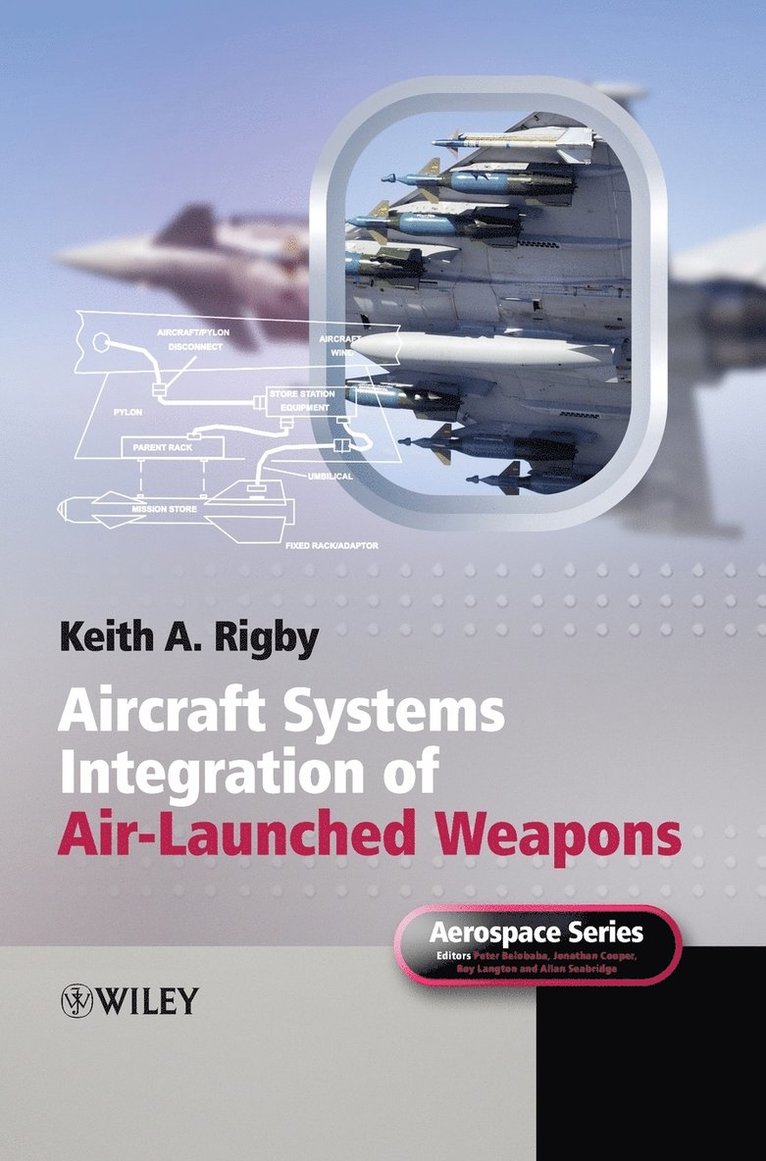
    Aircraft Systems Integration of Air-Launched Weapons

    AvKeith A. Rigby,Peter Belobaba

    Inbunden, Engelska, 2013

    Del i serien Aerospace Series

    1 359 kr

    Skickas . Fri frakt över 249 kr.

    Beskrivning

    From the earliest days of aviation where the pilot would drop simple bombs by hand, to the highly agile, stealthy aircraft of today that can deliver smart ordnance with extreme accuracy, engineers have striven to develop the capability to deliver weapons against targets reliably, safely and with precision. Aircraft Systems Integration of Air-Launched Weapons introduces the various aspects of weapons integration, primarily from the aircraft systems integration viewpoint, but also considers key parts of the weapon and the desired interactions with the aircraft required for successful target engagement. Key features: Addresses the broad range of subjects that relate directly to the systems integration of air-launched weapons with aircraft, such as the integration process, system and subsystem architectures, the essential contribution that open, international standards have on improving interoperability and reducing integration costs and timescalesDescribes the recent history of how industry and bodies such as NATO have driven the need for greater interoperability between weapons and aircraft and worked to reduce the cost and timescales associated with the systems integration of complex air-launched weapons with aircraftExplores future initiatives and technologies relating to the reduction of systems integration costs and timescalesThe systems integration of air-launched weapons with aircraft requires a multi-disciplinary set of engineering capabilities.  As a typical weapons integration life-cycle spans several years, new engineers have to learn the skills required by on-the-job training and working with experienced weapons integrators.  Aircraft Systems Integration of Air-Launched Weapons augments hands-on experience, thereby enabling the development of subject matter expertise more quickly and in a broader context than would be achieved by working through the life-cycle on one specific project.  This book also serves as a useful revision source for experienced engineers in the field.

    Produktinformation

    • Utgivningsdatum:2013-04-12
    • Mått:175 x 252 x 18 mm
    • Vikt:567 g
    • Format:Inbunden
    • Språk:Engelska
    • Serie:Aerospace Series
    • Antal sidor:272
    • Förlag:John Wiley & Sons Inc
    • ISBN:9780470971185

    Utforska kategorier

    • Militärteknik inom Naturvetenskap och teknik

    Mer om författaren

    Keith Rigby, Autonomous Systems, BAE Systems Military Air Solutions, UKKeith Rigby is Chief Weapons Engineer – Autonomous Systems, BAE Systems Military Air Solutions. He has spent his entire career with BAE Systems, starting as a graduate in 1984 within Armament Control Systems & progressing to a senior management position on the Tornado GR4 engineering team. He then becoming Head of Weapons Control & Integration within the Air Systems business before assuming his current position in November 2008. During the last 25 years he has been involved in all aspects of the design, development and certification of armament systems and has been a key player in a number of weapon integration programmes including the weaponisation of unmanned systems. He is the author of the Weapons Integration chapter in the Encyclopaedia of Aerospace Engineering.

    Innehållsförteckning

    • Series Preface xiPreface xiiiAcknowledgments xvList of Abbreviations xvii1 Introduction to Weapons Integration 11.1 Introduction 11.2 Chapter Summaries 21.2.1 The Systems Integration Process 21.2.2 Stores Management System Design 21.2.3 The Global Positioning System 31.2.4 Weapon Initialisation and Targeting 31.2.5 The Role of Standardisation in Weapons Integration 31.2.6 Interface Management 41.2.7 A Weapons Integration Scenario 41.2.8 ‘Plug and Play’ Weapons Integration 51.2.9 Weaponised Unmanned Air Systems 51.2.10 Reducing the Cost of Weapons Integration 61.3 Weapons 61.3.1 Types of Weapon 61.3.2 Targets 61.3.3 Weapon Requirements 71.3.4 Lethality 71.3.5 Precision 81.3.6 Stand-Off Range 101.3.7 Typical Weapon Configurations 111.3.8 Implications for the Launch Aircraft 111.4 Carriage Systems 141.4.1 Mechanical Attachments 141.4.2 Downward Ejection 141.4.3 Forward Firing 151.4.4 Multi-weapon Carriage Systems 15Further Reading 162 An Introduction to the Integration Process 172.1 Chapter Summary 172.2 Introduction 172.3 The V-Diagram 182.4 Responsibilities 182.5 Safety 202.6 The Use of Requirements Management Tools in the Systems Engineering Process 242.7 Weapons Integration Requirements Capture 242.8 The Need for Unambiguous, Clear and Appropriate Requirements 262.9 Minimising Requirements 29Further Reading 303 Requirements Analysis, Partitioning, Implementation in Aircraft Subsystems 313.1 Chapter Summary 313.2 Introduction 313.3 System Architecture 333.4 Requirements Decomposition 343.5 Requirements Partitioning 353.6 Subsystem Implementation 363.7 Maturity Reviews 373.8 Right-Hand Side of the V-Diagram 383.9 Proving Methods 383.10 Integration 413.11 Verification 423.12 Validation 423.13 The Safety Case and Certification 42Further Reading 454 Armament Control System and Global Positioning System Design Issues 474.1 Chapter Summary 474.2 Stores Management System Design 484.2.1 SMS Design Requirements 484.2.2 Other System Components 504.2.3 Typical System Architectures 534.2.4 Training System 554.3 GPS: Aircraft System Design Issues 594.3.1 GPS Overview 594.3.2 Satellite Acquisition Concepts 644.3.3 Acquisition Strategies 654.3.4 GPS Signal Distribution 654.3.5 Aircraft Requirements 674.3.6 Aircraft Implementation Concepts 684.3.7 Cost of Complexity 70Further Reading 705 Weapon Initialisation and Targeting 715.1 Chapter Summary 715.2 Targeting 715.3 Aiming of Ballistic Bombs 725.4 Aircraft/Weapon Alignment 735.5 Aiming of Smart Air-to-Ground Weapons 745.6 Air-to-Air Missiles 765.6.1 Sensors 765.6.2 Engagement Modes 775.6.3 Air-to-Air Weapons Training 78Further Reading 796 Weapon Interface Standards 816.1 Chapter Summary 816.2 Benefits of Standardisation 816.3 MIL-STD-1760 AEIS 826.3.1 MIL-STD-1760 Interface Points 836.3.2 Connectors 836.3.3 Signal Sets 856.3.4 GPS RF Signal Distribution 856.3.5 Data Protocols 906.3.6 Data Entities 946.3.7 Time Tagging 946.3.8 Mass Data Transfer 956.3.9 High-Speed 1760 966.4 Standardisation Conclusions 96Further Reading 977 Other Weapons Integration Standards 997.1 Chapter Summary 997.2 AS5725 Miniature Mission Store Interface 997.2.1 Interface Points 997.2.2 Connector 1017.2.3 Signal Set 1017.3 AS5726 Interface for Micro Munitions 1037.3.1 Interface Points 1037.3.2 Connectors 1047.3.3 Signal Set 1047.4 Other Weapons Integration Standards 1067.4.1 Generic Aircraft–Store Interface Framework 1067.4.2 Mission Data Exchange Format 1087.4.3 Common Launch Acceptability Region Approach 109Further Reading 1108 Interface Management 1118.1 Chapter Summary 1118.2 Introduction 1118.3 Management of the Aircraft/Store Interface 1128.4 Approaches to Interface Documentation 1148.5 Interfaces Documented in the ICD 1158.6 Controlling the Interface of Store Variants 1198.7 Information Exchange between Design Organisations 1208.8 Process for Managing Integration Risk 120Further Reading 1249 A Weapons Integration Scenario 1259.1 Chapter Summary 1259.2 Introduction 1259.3 The Weapons Integration Scenario 1269.4 The V-Diagram Revisited 1299.5 Systems Integration Activities 1309.6 Safety 1329.6.1 Aircraft/System Hazards 1369.6.2 Weapon Hazards 1399.7 Systems Requirements Decomposition, Design and Implementation 1409.7.1 Weapon System Integration Requirement 1409.7.2 Functional Definition and Development/Interface Definition 1409.7.3 Weapon Interfacing 1419.7.4 Data Flows between Aircraft Subsystems 1439.8 Loading to Dispersion Sequence 1439.8.1 Weapon Loading 1459.8.2 System Power-Up/Store Discovery 1459.8.3 Build Inventory 1469.8.4 Weapon BIT/System Power-Down 1479.8.5 Download Target Data/Power-Down Weapons 1489.8.6 Taxi/Take-Off/On-Route Phase 1499.8.7 Weapon Selection and Priming 1499.8.8 Update Target Data 1509.8.9 Steer to Target LAR/Confirm in LAR 1519.8.10 Initiate Release Sequence 1519.8.11 Weapon Release Phase 1539.8.12 Selective/Emergency Jettison 1549.8.13 Carriage Store Control 1559.8.14 Training Capability 1569.8.15 Implications of Aeromechanical Aspects – Weapon Physical Alignment 156Further Reading 15810 A Weapons Integration Scenario: System Proving and Certification 15910.1 Chapter Summary 15910.2 Introduction 15910.3 Simulators and Emulators 16010.4 Avionic Weapons 16010.5 Interface Proving 16010.6 Rig Trials 16110.7 Avionic Trials 16210.8 Electromagnetic Compatibility 16210.9 Airworthiness and Certification 16310.10 Declaration of Design and Performance/Statement of Design 16410.11 Certificate of Design 16410.12 Safety Case 16510.13 Airworthiness Flight Limitations 16510.14 Release to Service 16510.15 User Documentation 16510.16 Weapon System Evaluation 16610.17 Conclusion 167Further Reading 16711 Introduction to ‘Plug and Play’ Weapons Integration 16911.1 Chapter Summary 16911.2 Systems Integration Considerations 16911.3 The Journey to ‘Plug and Play’ Weapons Integration 17111.4 ‘Plug and Play’ Technologies 17211.5 Adoption of ‘Plug and Play’ Technology 17211.6 Introduction to Aircraft, Launcher and Weapons Interoperability 17311.7 ALWI Study 17411.8 ALWI-2 Study 17611.9 ALWI Common Interface Study 17911.9.1 Technical Architecture 18011.9.2 Greater Interoperability through a Common ICD Approach 18111.9.3 Common Store Control Service 18111.9.4 Model-Driven Architecture Approach 18311.9.5 Implementation Considerations 18511.10 ALWI Conclusions 186Further Reading 18712 Open Systems 18912.1 Chapter Summary 18912.2 Introduction 18912.3 The Contracting and Industry Environment 19012.4 Current Systems 19112.5 A Typical Mission Systems Upgrade Programme 19212.6 ASAAC Architecture 19312.7 ASAAC and ‘Plug and Play’ 19512.8 Certification Issues 19812.9 Easing the Upgrade Programme 200Further Reading 20113 The Universal Armament Interface 20313.1 Chapter Summary 20313.2 Introduction 20313.3 Objectives of UAI 20413.4 Fundamental Principles of UAI 20713.5 Platform/Store Interface 20913.6 Mission Planning 21013.7 Launch Acceptability Region 21113.8 Integration Work Flow 21113.9 UAI Interface Management 21313.10 Certification Tools 21413.11 Benefits 21513.12 NATO UAI 21613.13 ‘Plug and Play’ Conclusions 216Further Reading 21714 Weaponised Unmanned Air Systems 21914.1 Chapter Summary 21914.2 Introduction 21914.3 Distributed Weapon System 22014.4 System Architecture Partitioning 22214.5 Conclusions 226Further Reading 22615 Reducing the Cost of Weapons Integration 22715.1 Chapter Summary 22715.2 Introduction 22715.3 The Cost Landscape 22915.4 Reducing the Cost of Weapons Integration – Other Initiatives 23115.4.1 Streamlined Integration Processes 23215.4.2 Common Goals for the ADO and WDO 23215.4.3 Employment of New Technology Which Eases Integration 23315.4.4 The Need for Exports 23315.4.5 Spiral Introduction of Capability 23415.4.6 Organisational Re-structuring 23415.4.7 Adoption of International Standards 23415.5 Conclusions 23415.6 The Future 236Further Reading 237Index 239