• Fri frakt över 249 kr
  • •
  • Snabba leveranser
  • •
  • Billiga böcker
Kundservice

Du är på sajten för privatpersoner.

Företag, bibliotek eller offentlig verksamhet?

Du handlar på classic.bokus.com, där alla dina funktioner finns intakta.
Till classic.bokus.com
Bokus logotyp. Gå till startsidan.
  • Erbjudanden
  • Nyheter
  • Student
  • Topplistor
  • Barn & ungdom
  • Bokus Play
  • E-böcker
  • Pocketböcker
  • Spel & pussel

10% rabatt på allt med kod: NYSTART10 →

Sidfot

Mina sidor

    Hjälp

    • Kundservice
    • Vanliga frågor och svar
    • Frakt och leverans
    • Retur vid ångerrätt
    • Reklamera vara
    • Betalning
    • Köpvillkor
    • Allmänna villkor
    • Information om webbplatsens tillgänglighet

    Om Bokus

    • Om oss
    • Pressrum
    • För studenter
    • För företag
    • För bibliotek och offentlig verksamhet
    • För leverantörer
    • Hållbarhet

    Populärt

    • Aktuella erbjudanden
    • Presentkort
    • Studentlitteratur
    • Nya böcker
    • Topplistor
    • Signerade böcker
    • Engelska böcker

    Inspiration

    • Boktips
    • BookTok
    • Populära bokserier
    • Barnbokskaraktärer
    • Populära författare
    Logotyp för Bokus
    Följ oss på Facebook (extern länk)Följ oss på Instagram (extern länk)Följ oss på YouTube (extern länk)Följ oss på TikTok (extern länk)
    bokus @ CookiesAnpassa cookiesIntegritetspolicyKöpvillkor
    Till Citymail hemsida (extern länk)Till Budbee hemsida (extern länk)Till Postnord hemsida (extern länk)Till Schenker hemsida (extern länk)Till Early Bird hemsida (extern länk)Till Walleys hemsida (extern länk)
    1. Medicin
    2. Andra medicinska specialiteter
    3. Farmakologi

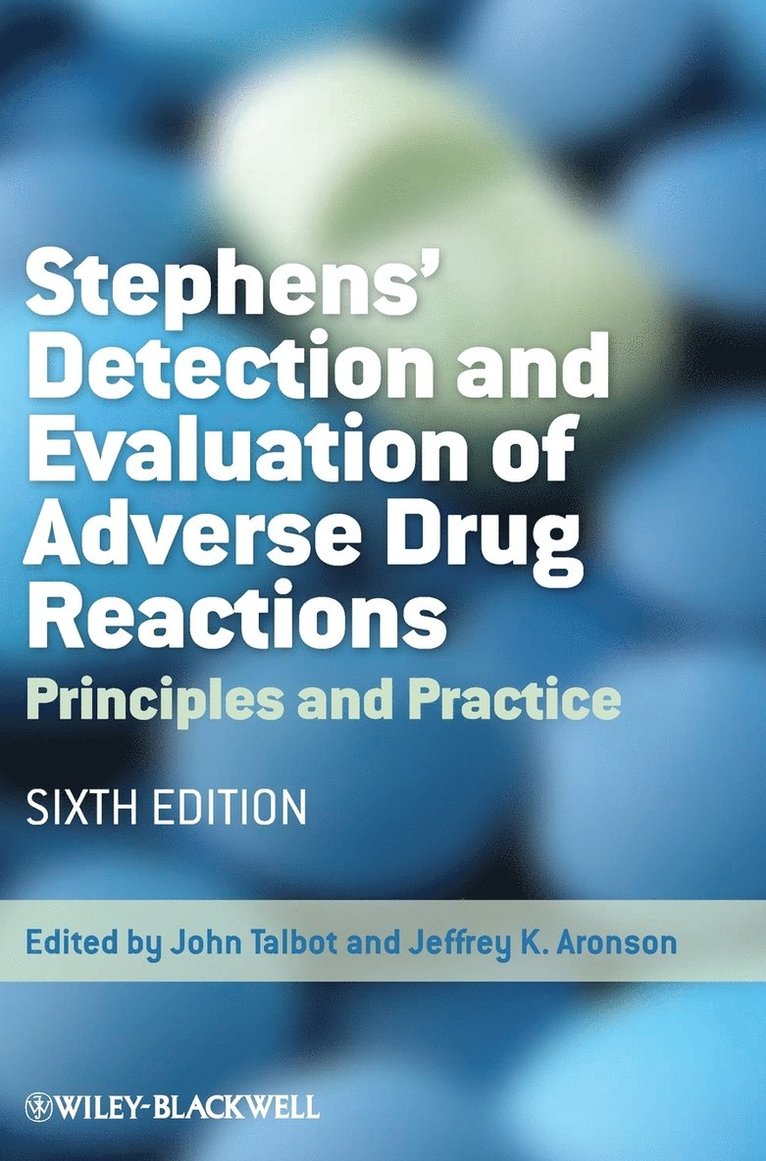
    Stephens' Detection and Evaluation of Adverse Drug Reactions

    Principles and Practice

    AvTalbot,John Talbot

    Inbunden, Engelska, 2011

    3 811 kr

    Beställningsvara. Skickas inom 5-8 vardagar. Fri frakt över 249 kr.

    Beskrivning

    The detection and evaluation of adverse drug reactions is crucial for understanding the safety of medicines and for preventing harm in patients. Not only is it necessary to detect new adverse drug reactions, but the principles and practice of pharmacovigilance apply to the surveillance of a wide range of medicinal products. Stephens' Detection and Evaluation of Adverse Drug Reactions provides a comprehensive review of all aspects of adverse drug reactions throughout the life cycle of a medicine, from toxicology and clinical trials through to pharmacovigilance, risk management, and legal and regulatory requirements. It also covers the safety of biotherapeutics and vaccines and includes new chapters on pharmacogenetics, proactive risk management, societal considerations, and the safety of drugs used in oncology and herbal medicines.This sixth edition of the classic text on drug safety is an authoritative reference text for all those who work in pharmacovigilance or have an interest in adverse drug reactions, whether in regulatory authorities, pharmaceutical companies, or academia.Praise for previous editions"This book presents a comprehensive and wide-ranging overview of the science of pharmacovigilance. For those entering or already experienced in the pharmaceutical sciences, this is an essential work.” - from a review in E-STREAMS"...a key text in the area of pharmacovigilance...extensively referenced and well-written...a valuable resource..." - from a review in The Pharmaceutical Journal

    Produktinformation

    • Utgivningsdatum:2011-12-09
    • Mått:168 x 244 x 38 mm
    • Vikt:1 098 g
    • Format:Inbunden
    • Språk:Engelska
    • Antal sidor:752
    • Upplaga:6
    • Förlag:John Wiley and Sons Ltd
    • ISBN:9780470986349

    Utforska kategorier

    • Farmakologi inom Medicin

    Mer om författaren

    John Talbot, Senior Lecturer, University of Hertfordshire, UK. Formerly Director, Global Drug Safety, AstraZeneca R&D Charnwood, Loughborough, Leicestershire, UK Jeffrey Aronson, Reader in Clinical Pharmacology, University of Oxford, Oxford, UK and President Emeritus of the British Pharmacological Society

    Recensioner i media

    “A vast array of experts in the science of pharmacovigilance contribute to this book, but the editors have maintained a clarity of presentation, keeping in mind that communication is a key factor in pharmacovigilance.”  (Doody’s, 27 July 2012)

    Innehållsförteckning

    • Foreword xi Preface to the Sixth Edition xiiiList of Contributors xvAcknowledgements xvii1 Adverse Drug Reactions: History, Terminology, Classification, Causality, Frequency, Preventability 1Jeffrey K. Aronson1.1 Introduction 11.2 Defining pharmacovigilance 11.3 The modern history of pharmacovigilance 31.4 Terminology and definitions in pharmacovigilance 61.5 Medication errors 251.6 Pharmacological classification of adverse drug reactions 321.7 Drug interactions 531.8 Reporting suspected adverse drug reactions 591.9 Causality assessment 641.10 Frequencies of adverse drug reactions 691.11 Risk perception and adverse drug reactions 771.12 Class effects of drugs 781.13 Unlicensed indications, off-label uses, and orphan drugs 801.14 Preventing adverse drug reactions 841.15 Publishing accounts of adverse drug reactions 95References 1012 Pharmacogenetics of Adverse Drug Reactions 121Sudeep P. Pushpakom and Munir Pirmohamed2.1 Introduction 1212.2 Historical review 1212.3 Sources of genetic variability 1222.4 Role of pharmacogenetic factors in drug pharmacokinetics 1232.5 Role of pharmacogenetic factors in drug pharmacodynamics 1332.6 The role of pharmacogenetics in pharmaceutical companies 1392.7 The impact of pharmacogenetics on regulatory agencies 1412.8 The impact of pharmacogenetics on clinical practice 1432.9 Conclusions 145References 1453 Toxicology and Adverse Drug Reactions 157D. J. Snodin and A. Suitters3.1 Introduction 1573.2 Toxicity testing 1573.3 Drug discovery and development 1683.4 Data interpretation and risk assessment 1743.5 Adverse drug reactions detected after marketing authorization 1863.6 Examples of toxicological investigation of ADRs 1993.7 Conclusions 200Acknowledgements 201References 2014 Clinical Trials—Collecting Safety Data and Establishing the Adverse Drug Reactions Profile 215John Talbot, Marianne Keisu, and Lars St°ahle4.1 Introduction 2154.2 Adverse events 2164.3 Clinical studies and safety 2364.4 The emerging safety profile 2674.5 Presentation of safety data 2714.6 Conclusions 280References 2815 Clinical Laboratory Safety Data 291Alan Craig5.1 Introduction 2915.2 Factors that influence the interpretation of clinical laboratory data 2945.3 Sample collection procedure 3005.4 Analytical variation 3015.5 Reference ranges 3045.6 Intra-individual biological variation 3075.7 Detecting adverse events during drug development 3095.8 Test selection 3335.9 Exclusion criteria and “panic levels” 3355.10 Harmonization of data from different laboratories 3375.11 Data analysis and presentation 3395.12 Conclusions 3445.13 Appendix 345References 3466 Statistics: Analysis and Presentation of Safety Data 349Stephen J. W. Evans and Dorothea Nitsch6.1 Introduction and background 3496.2 Problems with efficacy trials for detecting adverse drug reactions 3526.3 Analysis and presentation of data from trials 3556.4 Statistical measures of the occurrence of adverse events 3566.5 Combining data from several trials—meta-analysis 3646.6 Use of statistical methods for signal detection from spontaneous reports 3656.7 Analysis and presentation of data from observational studies 3736.8 Summary and conclusions 384Acknowledgements 385References 3867 Proactive Pharmacovigilance and Risk Management 389June Raine, Lesley Wise, John Talbot, and Jeffrey K. Aronson7.1 Introduction 3897.2 Risk management—definition and general principles 3907.3 Defining the knowledge base—the safety specification 3917.4 Extending the knowledge of safety and characterizing risk—the pharmacovigilance plan 3947.5 Minimizing risks 3957.6 Special challenges for risk management 3977.7 Experience with risk evaluation and mitigation strategies (REMS) in the USA 3987.8 A possible method for risk management when a new adverse reaction is discovered after marketing 3997.9 Future challenges for risk management 4057.10 Conclusions 406References 4078 Regulatory Aspects of Pharmacovigilance 411Kristina Leila Strutt and Barry David Charles Arnold8.1 Introduction 4118.2 The standardization and harmonization of safety data collection and reporting: CIOMS and ICH 4128.3 The European Union 4478.4 The UK 4818.5 France 4838.6 Germany 4858.7 USA 4878.8 Japan 500Acknowledgements 505References 506Useful web sites 5099 Legal Aspects of Pharmacovigilance in the European Union 511Christine H. Bendall9.1 Introduction 5119.2 Application of EU legislation in Member States 5119.3 Interpretation of EU law 5149.4 Relationship between law and guidelines 5159.5 Issues in interpreting EU pharmacovigilance legislation 5179.6 Legal responsibility for pharmacovigilance activities 5199.7 Failures to meet pharmacovigilance requirements 5229.8 Enforcement and sanctions 5249.9 European powers and procedures in the event of a product safety issue 5289.10 Civil liability 5349.11 Personal data privacy 5379.12 Safety in research products 538References 54110 Dictionaries and Coding in Pharmacovigilance 545E. G. Brown and J. E. Harrison10.1 Introduction 54510.2 Scope of this chapter 54610.3 What is a dictionary? 54610.4 Drug dictionaries 54710.5 Disease classifications 55410.6 Medical Dictionary for Regulatory Activities, MedDRA R55710.7 Common Terminology Criteria for Adverse Events (CTCAE) 56710.8 Definition of adverse reaction terms 56710.9 Dictionaries used in electronic health records 56810.10 Use of dictionaries in standard product information 57010.11 Conclusions 571Acknowledgements 571References 57111 Adverse Drug Reactions: Societal Considerations 573Nicky Britten11.1 Introduction 57311.2 Adverse drug reactions at the population level 57411.3 The social production of ADRs 57611.4 Trust 57911.5 Information about ADRs 58111.6 Conclusions 583References 58312 Safety of Biotherapeutics 585Andrew Erdman, James Nickas, and Benton Brown12.1 Introduction 58512.2 Properties of proteins 58612.3 Classification of biotherapeutics 58712.4 Monitoring for adverse events due to biotherapeutics 58912.5 Conclusions 598References 59813 Vaccine Safety Surveillance 603E. Miller and J. Stowe13.1 Introduction 60313.2 What is special about vaccine safety compared with other drugs? 60413.3 Pathogenesis of vaccine reactions 60513.4 Criteria for establishing causality after vaccine-related adverse events 60813.5 Pre-licensing evaluation of vaccine safety 61013.6 Objectives of an ideal post-licensing vaccine safety surveillance system 61113.7 Conclusions 620References 62014 Assessing the Safety of Drugs Used in Oncology 625Anne Kehely14.1 Introduction 62514.2 Factors to consider when assessing the safety of drugs used in oncology 62714.3 Sources of adverse effect data 63214.4 Nature of the data 63414.5 Assessment of adverse effects data in oncology 63514.6 Conclusions 641References 64215 Adverse Drug Reactions and Pharmacovigilance of Herbal Medicines 645Joanne Barnes15.1 Introduction 64515.2 Herbal medicines: definitions and descriptions 64615.3 Characteristics of herbal medicines 64715.4 Regulation of herbal medicines and pharmacovigilance requirements 64815.5 Access to and use of herbal medicines 65515.6 Adverse reactions associated with herbal medicines 65615.7 Methods for pharmacovigilance of herbal medicines 66615.8 Responding to safety concerns associated with herbal medicines 67315.9 The future for pharmacovigilance of herbal medicines 67415.10 Conclusions 675References 676Appendix 1 Web Sites Relevant to Pharmacovigilance—An Analysis of Contents 685Charlotte I. S. Barker, John Talbot, and Jeffrey K. AronsonA1.1 Introduction 685A1.2 Ten national pharmacovigilance web sites 685A1.3 Twelve institutional web sites 689Acknowledgements 697References 697Appendix 2 Guidelines and a Checklist for Reporting Suspected Adverse Drug Reactions Anecdotally in Journals 699Jeffrey K. AronsonA2.1 Introduction 699A2.2 Notes on the checklist 700A2.3 Conclusions 706Note 706References 706Index 709