• Fri frakt över 249 kr
  • •
  • Snabba leveranser
  • •
  • Billiga böcker
Kundservice

Du är på sajten för privatpersoner.

Företag, bibliotek eller offentlig verksamhet?

Du handlar på classic.bokus.com, där alla dina funktioner finns intakta.
Till classic.bokus.com
Bokus logotyp. Gå till startsidan.
  • Erbjudanden
  • Nyheter
  • Student
  • Topplistor
  • Barn & ungdom
  • Bokus Play
  • E-böcker
  • Pocketböcker
  • Spel & pussel

10% rabatt på allt med kod NYSTART10 →

Sidfot

Mina sidor

    Hjälp

    • Kundservice
    • Vanliga frågor och svar
    • Frakt och leverans
    • Retur vid ångerrätt
    • Reklamera vara
    • Betalning
    • Köpvillkor
    • Allmänna villkor
    • Information om webbplatsens tillgänglighet

    Om Bokus

    • Om oss
    • Pressrum
    • För studenter
    • För företag
    • För bibliotek och offentlig verksamhet
    • För leverantörer
    • Hållbarhet

    Populärt

    • Aktuella erbjudanden
    • Presentkort
    • Studentlitteratur
    • Nya böcker
    • Topplistor
    • Signerade böcker
    • Engelska böcker

    Inspiration

    • Boktips
    • BookTok
    • Populära bokserier
    • Barnbokskaraktärer
    • Populära författare
    Logotyp för Bokus
    Följ oss på Facebook (extern länk)Följ oss på Instagram (extern länk)Följ oss på YouTube (extern länk)Följ oss på TikTok (extern länk)
    bokus @ CookiesAnpassa cookiesIntegritetspolicyKöpvillkor
    Till Citymail hemsida (extern länk)Till Budbee hemsida (extern länk)Till Postnord hemsida (extern länk)Till Schenker hemsida (extern länk)Till Early Bird hemsida (extern länk)Till Walleys hemsida (extern länk)
    1. Naturvetenskap och teknik
    2. Matematik och naturvetenskap
    3. Kemi
    4. Organisk kemi

    NMR Spectroscopy and Polymer Microstructure

    The Conformational Connection

    AvAlan E. Tonelli

    Inbunden, Engelska, 1989

    Del 9 i serien Methods in Stereochemical Analysis

    3 051 kr

    Beställningsvara. Skickas inom 5-8 vardagar. Fri frakt över 249 kr.

    Beskrivning

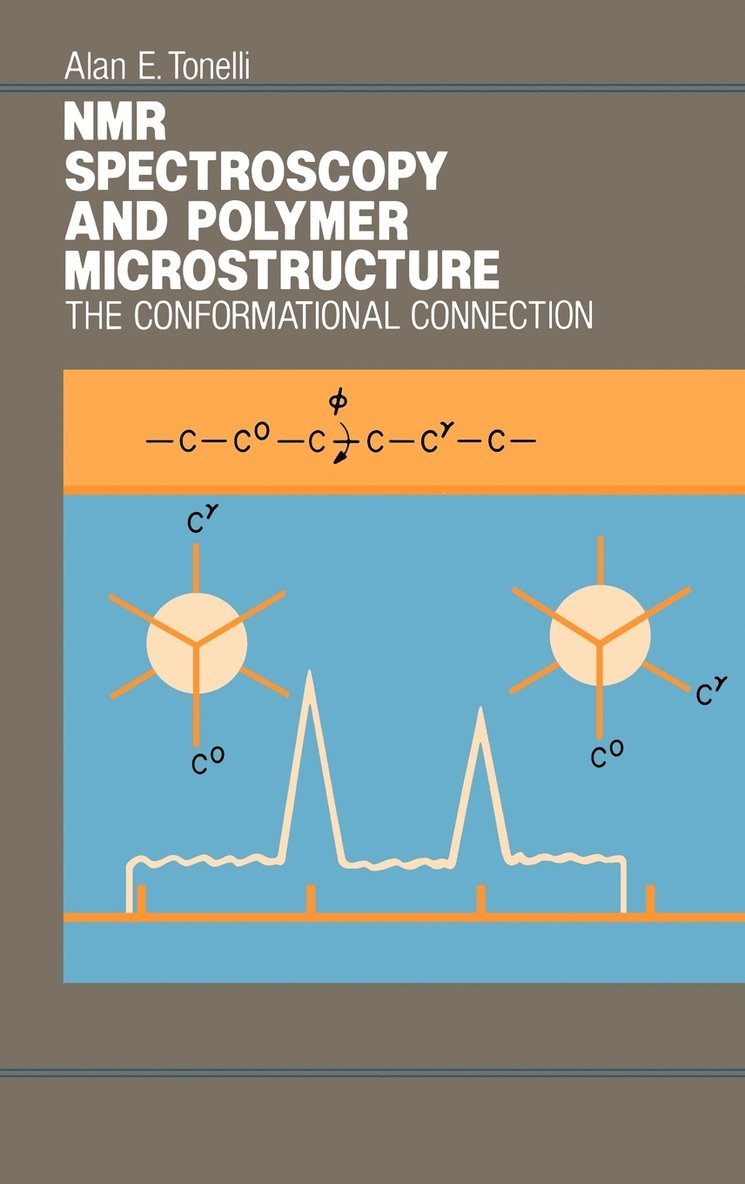
    The various techniques used to analyze the microstructures of polymers are presented in this book. High resolution and solid state techniques are described, and applications to both synthetic and biological polymers are discussed in detail. Particular emphasis is placed on the determination of polymer microstructure by NMR spectroscopy. Here attention is drawn to the connection between the microstructures and NMR spectra of polymers, and it is demonstrated that the local polymer conformation provides this link. The numerous examples illustrating this connection are a special feature of the book.

    Produktinformation

    • Utgivningsdatum:1989-09-06
    • Mått:158 x 234 x 24 mm
    • Vikt:494 g
    • Format:Inbunden
    • Språk:Engelska
    • Serie:Methods in Stereochemical Analysis
    • Antal sidor:264
    • Förlag:John Wiley & Sons Inc
    • ISBN:9780471187486

    Utforska kategorier

    • Organisk kemi inom Naturvetenskap och teknik
    • Tillverkningsteknik inom Naturvetenskap och teknik

    Mer om författaren

    Alan Tonelli received a B.S. in Chemical Engineering from the University of Kansas in 1964 and a Ph.D. in Polymer Chemistry from Stanford in 1968, where he was associated with the late Professor Paul J. Flory. He was a member of the Polymer Chemistry Research Department at AT&T-Bell Laboratories, Murray Hill, NJ, for 23 years and in 1991 joined the Fiber & Polymer Science Program in the College of Textiles at North Carolina State University in Raleigh, NC, where he is currently the INVISTA Professor of Fiber and Polymer Chemistry. His research interests include the configurations, conformations, and structures of synthetic and biological polymers, their determination, principally by NMR and Kerr effect observations, and establishing their effects on the physical properties of polymer materials. Most recently, the formation of and coalescence from noncovalent crystalline inclusion compounds (ICs) formed between cyclodextrin (CD) hosts and polymer guests have been used to nanostructure bulk polymers, including homopolymers and their blends, and block copolymers. In addition, small-molecule guest-CD-ICs (crystalline) and -rotaxanes (soluble), and the covalent incorporation of CDs into polymers both during and subsequent to their syntheses, have been used to improve the delivery of additives to polymer materials.

    Innehållsförteckning

    • Preface 1. The Microstructure of Polymer Chains 1.1 Introduction 1.2 Polymers Are Macromolecules 1.3 Polymer Microstructures from Polymerization of Monomers 1.3.1 Directional Isomerism 1.3.2 Stereochemical Isomerism 1.3.3 Geometrical Isomerism 1.3.4 Truly Asymmetric Polymers 1.3.5 Copolymer Sequences 1.4 Organization of Polymer Chains 1.5 Polymer Properties and Their Relation to Microstructure 2. Nuclear Magnetic Resonance 2.1 Introduction 2.2 The NMR Phenomenon 2.2.1 Resonance 2.2.2 Interactions and Relaxations of Nuclear Spins 2.2.3 Chemical Shift 2.2.4 Spin-Spin Coupling 2.3 Experimental Observation of NMR 3. High-Resolution NMR of Polymers 3.1 Introduction 3.2 ¯1H NMR 3.3 ¯13C NMR 3.4 High-Resolution ¯13C NMR in the Solid State 3.4.1 Dipolar Broadening 3.4.2 Chemical-Shift Anisotropy 3.4.3 Cross-Polarization 3.5 Two-Dimensional NMR 3.6 Other Nuclei-¯15N, ¯19F, ¯29Si, and ¯31p 4. ¯13C NMR of Polymers 4.1 Introduction 4.2 ¯13C Chemical Shifts and Their Dependence on Microstructure 4.2.1 ¯13C Nuclear Shielding 4.2.2 Substituent Effects on ¯13C Chemical Shifts 4.2.3 The -Substituent Effect in ¯13C NMR 4.2.4 -gauche Effects in ¯13C NMR 5. -gauche Effect Method of Predicting ¯13C NMR Chemical Shifts 5.1 Introduction 5.2 Polymer Conformations 5.2.1 Rotational Isomeric-State Model of Polymers 5.2.2 Average Bond Conformations 5.3 -gauche Effect Calculation of ¯13C NMR Chemical Shifts 5.3.1 Small-Molecule Example 5.3.2 Macromolecular Example 6. Determination of Stereosequences in Vinyl Polymers 6.1 Introduction 6.2 Traditional Methods 6.2.1 Stereoregular Polymers 6.2.2 Epimerization of Stereoregular Polymers 6.2.3 Model Compounds 6.2.4 Assumed Polymerization Mechanism 6.3 2D NMR Determination of Vinyl Polymer Stereosequence 6.4 Application of -gauche Effect Method 6.5 Establishing Vinyl Polymerization Mechanisms from Stereosequence Analysis 7. Microstructural Defects in Polymers 7.1 Introduction 7.2 Determining the Regiosequence of PVF_2 7.2.1 ¯13C NMR 7.2.2 ¯19F NMR 7.2.3 2D ¯19F NMR 7.3 Regiosequence Defects in PPO 8. Copolymer Microstructure 8.1 Introduction 8.2 Comonomer Sequences 8.3 Copolymer Stereosequences 8.4 Copolymer Conformations 8.5 Copolymerization Mechanisms 9. Chemically Modified Polymers 9.1 Introduction 9.2 Transformation of PVC to Ethylene-Vinyl Chloride Copolymers 9.2.1 Tri-n-butyltin Hydride Reduction of PVC 9.2.2 Microstructures of E-V Copolymers 9.2.3 (n-Bu)_3SnH Reduction of PVC Model Compounds 9.2.4 Computer Simulation of TCH and PVC Reduction 9.3 Modification of 1,4-Poly(butadienes) with Dihalocarbenes 9.3.1 Possible Microstructures in the Dihalocarbene Adducts of PBD 9.3.2 NMR of Dihalocarbene Adducts of PBD 10. Biopolymers 10.1 Introduction 10.2 Polypeptides 10.2.1 2D NMR Assignment of ¯1H Resonances 10.2.2 Determination of Polypeptide Conformation by 2D NMR 10.3 Polynucleotides 10.4 Polysaccharides 11. Solid Polymers 11.1 Introduction 11.2 Solid-State Polymer Conformation 11.3 Interchain Packing in Solid Polymers 11.4 Molecular Motion in Solid Polymers 11.5 Application of CPMAS/DD ¯13C NMR to Solid Polymers 11.5.1 Morphology and Motion in Polymer Crystals 11.5.2 Solid-Solid Polymer Phase Transitions 11.6 Other Nuclei Observed In Solid-State Polymer Spectra 11.6.1 CPMAS/DD ¯29Si NMR 11.6.2 MAS/DD ¯31p NMR 11.6.3 CPMAS/DD ¯15N NMR 11.7 Concluding Remarks