• Fri frakt över 249 kr
  • •
  • Snabba leveranser
  • •
  • Billiga böcker
Kundservice

Du är på sajten för privatpersoner.

Företag, bibliotek eller offentlig verksamhet?

Du handlar på classic.bokus.com, där alla dina funktioner finns intakta.
Till classic.bokus.com
Bokus logotyp. Gå till startsidan.
  • Erbjudanden
  • Nyheter
  • Student
  • Topplistor
  • Barn & ungdom
  • Bokus Play
  • E-böcker
  • Pocketböcker
  • Spel & pussel

10% rabatt på allt med kod: NYSTART10 →

Sidfot

Mina sidor

    Hjälp

    • Kundservice
    • Vanliga frågor och svar
    • Frakt och leverans
    • Retur vid ångerrätt
    • Reklamera vara
    • Betalning
    • Köpvillkor
    • Allmänna villkor
    • Information om webbplatsens tillgänglighet

    Om Bokus

    • Om oss
    • Pressrum
    • För studenter
    • För företag
    • För bibliotek och offentlig verksamhet
    • För leverantörer
    • Hållbarhet

    Populärt

    • Aktuella erbjudanden
    • Presentkort
    • Studentlitteratur
    • Nya böcker
    • Topplistor
    • Signerade böcker
    • Engelska böcker

    Inspiration

    • Boktips
    • BookTok
    • Populära bokserier
    • Barnbokskaraktärer
    • Populära författare
    Logotyp för Bokus
    Följ oss på Facebook (extern länk)Följ oss på Instagram (extern länk)Följ oss på YouTube (extern länk)Följ oss på TikTok (extern länk)
    bokus @ CookiesAnpassa cookiesIntegritetspolicyKöpvillkor
    Till Citymail hemsida (extern länk)Till Budbee hemsida (extern länk)Till Postnord hemsida (extern länk)Till Schenker hemsida (extern länk)Till Early Bird hemsida (extern länk)Till Walleys hemsida (extern länk)
    1. Naturvetenskap och teknik
    2. Teknik och industri
    3. Elektronik och kommunikationer

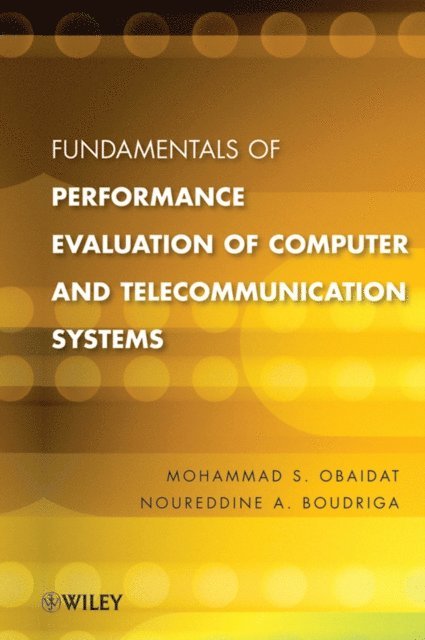
    Fundamentals of Performance Evaluation of Computer and Telecommunication Systems

    AvMohammed S. Obaidat,Noureddine A. Boudriga

    Inbunden, Engelska, 2010

    1 648 kr

    Beställningsvara. Skickas inom 5-8 vardagar. Fri frakt över 249 kr.

    Beskrivning

    The only singular, all-encompassing textbook on state-of-the-art technical performance evaluationFundamentals of Performance Evaluation of Computer and Telecommunication Systems uniquely presents all techniques of performance evaluation of computers systems, communication networks, and telecommunications in a balanced manner. Written by the renowned Professor Mohammad S. Obaidat and his coauthor Professor Noureddine Boudriga, it is also the only resource to treat computer and telecommunication systems as inseparable issues. The authors explain the basic concepts of performance evaluation, applications, performance evaluation metrics, workload types, benchmarking, and characterization of workload. This is followed by a review of the basics of probability theory, and then, the main techniques for performance evaluation—namely measurement, simulation, and analytic modeling—with case studies and examples. Contains the practical and applicable knowledge necessary for a successful performance evaluation in a balanced approachReviews measurement tools, benchmark programs, design of experiments, traffic models, basics of queueing theory, and operational and mean value analysisCovers the techniques for validation and verification of simulation as well as random number generation, random variate generation, and testing with examplesFeatures numerous examples and case studies, as well as exercises and problems for use as homework or programming assignmentsFundamentals of Performance Evaluation of Computer and Telecommunication Systems is an ideal textbook for graduate students in computer science, electrical engineering, computer engineering, and information sciences, technology, and systems. It is also an excellent reference for practicing engineers and scientists.

    Produktinformation

    • Utgivningsdatum:2010-02-09
    • Mått:163 x 165 x 31 mm
    • Vikt:816 g
    • Format:Inbunden
    • Språk:Engelska
    • Antal sidor:480
    • Förlag:John Wiley & Sons Inc
    • ISBN:9780471269830

    Utforska kategorier

    • Elektronik och kommunikationer inom Naturvetenskap och teknik
    • Systemvetenskap och AI inom Data och IT

    Mer om författaren

    Professor Mohammad S. Obaidat is an internationally well-known academic/researcher/scientist. He received his Ph.D. and M. S. degrees in Computer Engineering with a minor in Computer Science from the Ohio State University, Columbus, Ohio, USA. Dr. Obaidat is currently a tenured full Professor of Computer Science at Monmouth University, NJ, USA. Among his previous positions are Chair of the Department of Computer Science and Director of the Graduate Program at Monmouth University and a faculty member at the City University of New York. He has received extensive research funding and has published over two hundred and ten (210) refereed technical articles in refereed scholarly journals and proceedings of refereed international conferences. He is the co-author of the book entitled, "Wireless Networks" to be published by Wiley in August 2002.Noureddine Boudriga is a professor at the School of Telecommunications at Catharge University in Tunis, Tunisia.

    Innehållsförteckning

    • PREFACE xiii1 INTRODUCTION AND BASIC CONCEPTS 11.1 Background 21.2 Performance Evaluation Viewpoints and Concepts 31.3 Goals of Performance Evaluation 51.4 Applications of Performance Evaluation 61.5 Techniques 71.6 Metrics of Performance 81.7 Workload Characterization and Benchmarking 101.8 Summary 182 PROBABILITY THEORY REVIEW 212.1 Basic Concepts on Probability Theory 222.2 Elementary Sampling 262.3 Random Variables 292.4 Sums of Variables 382.5 Regression Models 402.6 Important Density and Distribution Functions 472.7 Markov Processes 502.8 Limits 542.9 Comparing Systems using Sample Data 572.10 Summary 623 MEASUREMENT/TESTING TECHNIQUE 663.1 Measurement Strategies 663.2 Event Tracing 673.3 Monitors 703.4 Program Optimizers 733.5 Accounting Logs 743.6 Summary 754 BENCHMARKING AND CAPACITY PLANNING 784.1 Introduction 794.2 Types of Benchmark Programs 804.3 Benchmark Examples 834.4 Frequent Mistakes and Games in Benchmarking 964.5 Procedures of Capacity Planning and Related Main Problems 1004.6 Capacity Planning for Web Services 1024.7 Summary 1085 DATA REPRESENTATION AND ADVANCED TOPICS ON VALIDATION MODELING 1135.1 Data Representation 1145.2 Measurements 1185.3 Program Profiling and Outlining 1235.4 State Machine Models 1275.5 Petri Net-Based Modeling 1355.6 Protocol Validation 1435.7 Summary 1476 BASICS OF QUEUEING THEORY 1526.1 Queue Models 1526.2 Queue Parameters 1576.3 Little's Law 1626.4 Priority Management 1676.5 Analysis of M/M/1 Systems 1706.6 The M/M/M Queue 1766.7 Other Queues 1776.8 Queueing Models with Insensitive Length Distribution 1846.9 Summary 1867 QUEUEING NETWORKS 1907.1 Fundamentals of Queueing Networks 190\7.2 Model Inputs and Outputs in Queueing Networks 1957.3 Open Networks 1987.4 Closed Queueing Networks 2047.5 Product Form Networks 2097.6 Mean Value Analysis 2157.7 Analysis Using Flow Equivalent Servers 2187.8 Summary 2208 OPERATIONAL AND MEAN VALUE ANALYSIS 2268.1 Operational Laws 2268.2 Little's Formula 2318.3 Bottleneck Analysis 2368.4 Standard MVA 2398.5 Approximation of MVA 2448.6 Bounding Analysis 2488.7 Case Study: A Circuit Switching System 2558.8 Summary 2599 INTRODUCTION TO SIMULATION TECHNIQUE 2659.1 Introduction 2659.2 Types of Simulation 2759.3 Some Terminology 2799.4 Random-Number-Generation Techniques 2809.5 Survey of Commonly Used Random Number Generators 2919.6 Seed Selection 2929.7 Random Variate Generation 2949.8 Testing of Random Number Sequences 2999.9 Summary 30710 COMMONLY USED DISTRIBUTIONS IN SIMULATION AND THEIR APPLICATIONS 31210.1 Exponential Distribution 31310.2 Poisson Distribution 31510.3 Uniform Distribution 31810.4 Normal Distribution 31910.5 Weibull Distribution 32610.6 Pareto Distribution 32710.7 Geometric Distribution 33010.8 Gamma distribution 33110.9 Erlang Distribution 33410.10 Beta Distribution 33710.11 Binomial Distribution 33810.12 Chi-Square Distribution 34210.13 Student's t Distribution 34510.14 Examples of Applications 34610.15 Summary 34911 ANALYSIS OF SIMULATION RESULTS 35311.1 Introduction 35311.2 Fundamental Approaches 35511.3 Verification Techniques 35811.4 Validation Techniques 36211.5 Verification and Validation in Distributed Environments 36511.6 Transient Elimination 36911.7 Stopping Principles for Simulations 37211.8 Accreditation 37311.9 Summary 37412 SIMULATION SOFTWARE AND CASE STUDIES 37712.1 Introduction 37812.2 Selection of Simulation Software 37812.3 General-Purpose Programming Languages 37912.4 Simulation Languages 38112.5 Simulation Software Packages 39812.6 Comparing Simulation Tools and Languages 41712.7 Case Studies on Simulation of Computer and Telecommunication Systems 41812.8 Summary 428References 429Exercises 432APPENDIX A TABLE OF STANDARD NORMAL (Z) DISTRIBUTION 434APPENDIX B COMMONLY USED NORMAL QUANTILES 436APPENDIX C QUANTILES OF UNIT NORMAL DISTRIBUTION 437APPENDIX D QUANTILES OF STUDENT'S T-DISTRIBUTION WITH V DEGREES OF FREEDOM 439INDEX 441