• Fri frakt över 249 kr
  • •
  • Snabba leveranser
  • •
  • Billiga böcker
Kundservice

Du är på sajten för privatpersoner.

Företag, bibliotek eller offentlig verksamhet?

Du handlar på classic.bokus.com, där alla dina funktioner finns intakta.
Till classic.bokus.com
Bokus logotyp. Gå till startsidan.
  • Erbjudanden
  • Student
  • Topplistor
  • Barn & ungdom
  • Bokus Play
  • E-böcker
  • Ljudböcker
  • Pocketböcker
  • Spel & pussel

10% rabatt på allt med kod NYSTART10 →

Sidfot

Mina sidor

    Hjälp

    • Kundservice
    • Vanliga frågor och svar
    • Frakt och leverans
    • Retur vid ångerrätt
    • Reklamera vara
    • Betalning
    • Köpvillkor
    • Allmänna villkor
    • Information om webbplatsens tillgänglighet

    Om Bokus

    • Om oss
    • Pressrum
    • För studenter
    • För företag
    • För bibliotek och offentlig verksamhet
    • För leverantörer
    • Hållbarhet

    Populärt

    • Aktuella erbjudanden
    • Presentkort
    • Studentlitteratur
    • Nya böcker
    • Topplistor
    • Signerade böcker
    • Engelska böcker

    Inspiration

    • Boktips
    • BookTok
    • Populära bokserier
    • Barnbokskaraktärer
    • Populära författare
    Logotyp för Bokus
    Följ oss på Facebook (extern länk)Följ oss på Instagram (extern länk)Följ oss på YouTube (extern länk)Följ oss på TikTok (extern länk)
    bokus @ CookiesAnpassa cookiesIntegritetspolicyKöpvillkor
    Till Citymail hemsida (extern länk)Till Budbee hemsida (extern länk)Till Postnord hemsida (extern länk)Till Schenker hemsida (extern länk)Till Early Bird hemsida (extern länk)Till Walleys hemsida (extern länk)
    1. Naturvetenskap och teknik
    2. Matematik och naturvetenskap
    3. Fysik
    4. Kvantfysik

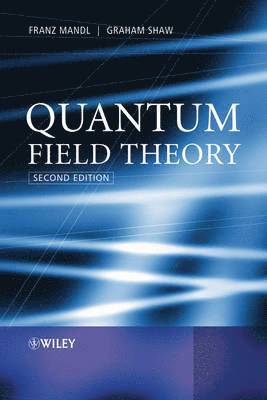
    Quantum Field Theory

    AvFranz Mandl,Graham Shaw

    Inbunden, Engelska, 2010

    1 673 kr

    Beställningsvara. Skickas inom 5-8 vardagar. Fri frakt över 249 kr.

    Fler format och utgåvor

    Häftad

    608 kr

    Beskrivning

    Following on from the successful first (1984) and revised (1993) editions, this extended and revised text is designed as a short and simple introduction to quantum field theory for final year physics students and for postgraduate students beginning research in theoretical and experimental particle physics. The three main objectives of the book are to: Explain the basic physics and formalism of quantum field theory To make the reader proficient in theory calculations using Feynman diagrams To introduce the reader to gauge theories, which play a central role in elementary particle physics. Thus, the first ten chapters deal with QED in the canonical formalism, and are little changed from the first edition. A brief introduction to gauge theories (Chapter 11) is then followed by two sections, which may be read independently of each other. They cover QCD and related topics (Chapters 12-15) and the unified electroweak theory (Chapters 16 - 19) respectively. Problems are provided at the end of each chapter. New to this edition: Five new chapters, giving an introduction to quantum chromodynamics and the methods used to understand it: in particular, path integrals and the renormalization group. The treatment of electroweak interactions has been revised and updated to take account of more recent experiments.

    Produktinformation

    • Utgivningsdatum:2010-04-09
    • Mått:175 x 249 x 30 mm
    • Vikt:953 g
    • Format:Inbunden
    • Språk:Engelska
    • Antal sidor:496
    • Upplaga:2
    • Förlag:John Wiley & Sons Inc
    • ISBN:9780471496830

    Utforska kategorier

    • Kvantfysik inom Naturvetenskap och teknik

    Mer om författaren

    Franz Mandl is the author of Quantum Field Theory, 2nd Edition, published by Wiley. Graham Shaw is the author of Quantum Field Theory, 2nd Edition, published by Wiley.

    Innehållsförteckning

    • Preface xiNotes xiii1 Photons and the Electromagnetic Field 11.1 Particles and Fields 11.2 The Electromagnetic Field in the Absence of Charges 21.2.1 The classical field 21.2.2 Harmonic oscillator 51.2.3 The quantized radiation field 71.3 The Electric Dipole Interaction 91.4 The Electromagnetic Field in the Presence of Charges 141.4.1 Classical electrodynamics 141.4.2 Quantum electrodynamics 161.4.3 Radiative transitions in atoms 171.4.4 Thomson scattering 181.5 Appendix: The Schrödinger, Heisenberg and Interaction Pictures 20Problems 222 Lagrangian Field Theory 252.1 Relativistic Notation 262.2 Classical Lagrangian Field Theory 272.3 Quantized Lagrangian Field Theory 302.4 Symmetries and Conservation Laws 31Problems 373 The Klein–Gordon Field 393.1 The Real Klein–Gordon Field 393.2 The Complex Klein–Gordon Field 433.3 Covariant Commutation Relations 463.4 The Meson Propagator 48Problems 534 The Dirac Field 554.1 The Number Representation for Fermions 554.2 The Dirac Equation 574.3 Second Quantization 614.3.1 The spin-statistics theorem 654.4 The Fermion Propagator 664.5 The Electromagnetic Interaction and Gauge Invariance 70Problems 715 Photons: Covariant Theory 735.1 The Classical Fields 735.2 Covariant Quantization 775.3 The Photon Propagator 81Problems 846 The S-Matrix Expansion 876.1 Natural Dimensions and Units 886.2 The S-Matrix Expansion 906.3 Wick’s Theorem 947 Feynman Diagrams and Rules in QED 997.1 Feynman Diagrams in Configuration Space 1007.2 Feynman Diagrams in Momentum Space 1107.2.1 The first-order terms S(1) 1127.2.2 Compton scattering 1137.2.3 Electron–electron scattering 1167.2.4 Closed loops 1177.3 Feynman Rules for QED 1187.4 Leptons 121Problems 1248 QED Processes in Lowest Order 1278.1 The Cross-Section 1288.2 Spin Sums 1318.3 Photon Polarization Sums 1338.4 Lepton Pair Production in (e+ e-) Collisions 1358.5 Bhabha Scattering 1398.6 Compton Scattering 1428.7 Scattering by an External Field 1478.8 Bremsstrahlung 1538.9 The Infrared Divergence 155Problems 1589 Radiative Corrections 1619.1 The Second-Order Radiative Corrections of QED 1629.2 The Photon Self-Energy 1679.3 The Electron Self-Energy 1729.4 External Line Renormalization 1769.5 The Vertex Modification 1789.6 Applications 1839.6.1 The anomalous magnetic moments 1839.6.2 The Lamb shift 1879.7 The Infrared Divergence 1919.8 Higher-Order Radiative Corrections 1939.9 Renormalizability 198Problems 20010 Regularization 20310.1 Mathematical Preliminaries 20410.1.1 Some standard integrals 20410.1.2 Feynman parameterization 20510.2 Cut-Off Regularization: The Electron Mass Shift 20610.3 Dimensional Regularization 20810.3.1 Introduction 20810.3.2 General results 21010.4 Vacuum Polarization 21110.5 The Anomalous Magnetic Moment 214Problems 21711 Gauge Theories 21911.1 The Simplest Gauge Theory: QED 22011.2 Quantum Chromodynamics 22211.2.1 Colour and confinement 22211.2.2 Global phase invariance and colour conservation 22511.2.3 SU(3) gauge invariance 22711.2.4 Quantum chromodynamics 22911.3 Alternative Interactions? 23011.3.1 Non-minimal interactions 23011.3.2 Renormalizability 23311.4 Appendix: Two Gauge Transformation Results 23511.4.1 The transformation law (11.26b) 23611.4.2 The SU(3) gauge invariance of Eq. (11.34) 237Problems 23812 Field Theory Methods 24112.1 Green Functions 24112.2 Feynman Diagrams and Feynman Rules 24612.2.1 The perturbation expansion 24612.2.2 The vacuum amplitude 24812.2.3 The photon propagator 24912.2.4 Connected Green functions 25212.3 Relation to S-Matrix Elements 25412.3.1 Crossing 25512.4 Functionals and Grassmann Fields 25612.4.1 Functionals 25712.4.2 Grassmann algebras and Grassmann fields 25912.5 The Generating Functional 26312.5.1 The free-field case 26712.5.2 The perturbation expansion 270Problems 27213 Path Integrals 27513.1 Functional Integration 27513.1.1 Classical fields 27613.1.2 Grassmann generators 28113.1.3 Grassmann fields 28313.2 Path Integrals 28513.2.1 The generating functional 28613.2.2 Free and interacting fields 28713.2.3 The free electromagnetic field 28913.2.4 The free spinor fields 29113.3 Perturbation Theory 29213.3.1 Wick’s theorem 29213.3.2 Interactions 29413.4 Gauge Independent Quantization? 297Problems 29814 Quantum Chromodynamics 29914.1 Gluon Fields 29914.1.1 The generating functional 30014.1.2 A mathematical analogy 30114.1.3 The Faddeev–Popov Method 30314.1.4 Gauge fixing and ghosts 30414.1.5 The electromagnetic field revisited 30614.2 Including Quarks 30714.2.1 The QCD Lagrangian 30714.2.2 The generating functional 30914.2.3 Free fields 31014.3 Perturbation Theory 31214.3.1 Wick’s theorem and propagators 31214.3.2 The perturbation expansion 31314.3.3 The vertex factors 31314.4 Feynman Rules for QCD 31814.5 Renormalizability of QCD 321Problems 32315 Asymptotic Freedom 32515.1 Electron–Positron Annihilation 32515.1.1 Two-jet events 32615.1.2 Three-jet events 32815.2 The Renormalization Scheme 33015.2.1 The electron propagator 33115.2.2 The photon propagator 33315.2.3 Charge renormalization 33515.3 The Renormalization Group 33615.3.1 The renormalization group equations 33715.3.2 Scale transformations 33915.3.3 The running charge 34115.4 The Strong Coupling Constant 34315.4.1 Colour factors 34415.4.2 Null diagrams 34515.4.3 Renormalization of the coupling constant 34615.4.4 The running coupling 35115.5 Applications 35215.6 Appendix: Some Loop Diagrams in QCD 35715.6.1 The gluon self-energy graphs 35715.6.2 The quark–gluon vertex corrections 360Problems 36216 Weak Interactions 36316.1 Introduction 36316.2 Leptonic Weak Interactions 36516.3 The Free Vector Boson Field 36916.4 The Feynman Rules for the IVB Theory 37116.5 Decay Rates 37216.6 Applications of the IVB Theory 37316.6.1 Muon decay 37316.6.2 Neutrino scattering 37916.6.3 The leptonic decay of the W boson 38016.7 Neutrino Masses 38116.7.1 Neutrino oscillations 38116.7.2 Dirac or Majorana neutrinos? 38316.8 Difficulties with the IVB Theory 385Problems 38717 A Gauge Theory of Weak Interactions 38917.1 QED Revisited 38917.2 Global Phase Transformations and Conserved Weak Currents 39117.3 The Gauge-Invariant Electroweak Interaction 39517.4 Properties of the Gauge Bosons 39917.5 Lepton and Gauge Boson Masses 40118 Spontaneous Symmetry Breaking 40318.1 The Goldstone Model 40418.2 The Higgs Model 40818.3 The Standard Electroweak Theory 41219 The Standard Electroweak Theory 41919.1 The Lagrangian Density in the Unitary Gauge 42019.2 Feynman Rules 42419.3 Elastic Neutrino–Electron Scattering 43219.4 Electron–Positron Annihilation 43519.5 The Higgs Boson 44219.5.1 Higgs boson decays 44419.5.2 Higgs boson searches 446Problems 448Appendix A The Dirac Equation 451A.1 The Dirac Equation 451A.2 Contraction Identities 453A.3 Traces 453A.4 Plane Wave Solutions 455A.5 Energy Projection Operators 456A.6 Helicity and Spin Projection Operators 456A.7 Relativistic Properties 458A.8 Particular Representations of the -Matrices 460Problems 462Appendix B Feynman Rules and Formulae for Perturbation Theory 463Index 473