• Fri frakt över 249 kr
  • •
  • Snabba leveranser
  • •
  • Billiga böcker
Kundservice

Du är på sajten för privatpersoner.

Företag, bibliotek eller offentlig verksamhet?

Du handlar på classic.bokus.com, där alla dina funktioner finns intakta.
Till classic.bokus.com
Bokus logotyp. Gå till startsidan.
  • Erbjudanden
  • Nyheter
  • Student
  • Topplistor
  • Barn & ungdom
  • Bokus Play
  • E-böcker
  • Pocketböcker
  • Spel & pussel

10% rabatt på allt med kod NYSTART10 →

Sidfot

Mina sidor

    Hjälp

    • Kundservice
    • Vanliga frågor och svar
    • Frakt och leverans
    • Retur vid ångerrätt
    • Reklamera vara
    • Betalning
    • Köpvillkor
    • Allmänna villkor
    • Information om webbplatsens tillgänglighet

    Om Bokus

    • Om oss
    • Pressrum
    • För studenter
    • För företag
    • För bibliotek och offentlig verksamhet
    • För leverantörer
    • Hållbarhet

    Populärt

    • Aktuella erbjudanden
    • Presentkort
    • Studentlitteratur
    • Nya böcker
    • Topplistor
    • Signerade böcker
    • Engelska böcker

    Inspiration

    • Boktips
    • BookTok
    • Populära bokserier
    • Barnbokskaraktärer
    • Populära författare
    Logotyp för Bokus
    Följ oss på Facebook (extern länk)Följ oss på Instagram (extern länk)Följ oss på YouTube (extern länk)Följ oss på TikTok (extern länk)
    bokus @ CookiesAnpassa cookiesIntegritetspolicyKöpvillkor
    Till Citymail hemsida (extern länk)Till Budbee hemsida (extern länk)Till Postnord hemsida (extern länk)Till Schenker hemsida (extern länk)Till Early Bird hemsida (extern länk)Till Walleys hemsida (extern länk)
    1. Naturvetenskap och teknik
    2. Matematik och naturvetenskap
    3. Kemi
    4. Fysikalisk kemi

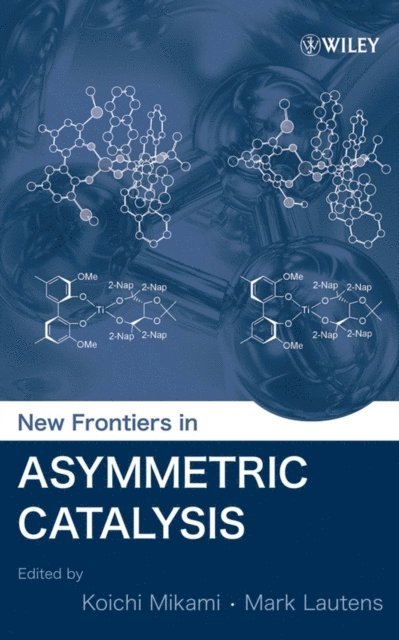
    New Frontiers in Asymmetric Catalysis

    AvKoichi Mikami,Mark Lautens

    Inbunden, Engelska, 2007

    1 871 kr

    Beställningsvara. Skickas inom 5-8 vardagar. Fri frakt över 249 kr.

    Beskrivning

    A compilation of recent advances and applications in asymmetric catalysis The field of asymmetric catalysis has grown rapidly and plays a key role in drug discovery and pharmaceuticals. New Frontiers in Asymmetric Catalysis gives readers a fundamental understanding of the concepts and applications of asymmetric catalysis reactions and discusses the latest developments and findings. With contributions from preeminent scientists in their respective fields, it covers: * "Rational" ligand design, which is critically dependent on the reaction type (reduction, oxidation, and C-C bond formation) * Recent findings on activation of C-H bonds, C-C bonds, and small molecules (C=O, HCN, RN=C, and CO2) and the latest developments on C-C bond reorganization, such as metathesis * Advances in "chirally economical" non-linear phenomena, racemic catalysis, and autocatalysis * Some of the recent discoveries that have led to a renaissance in the field of organocatalysis, including the development of chiral Brönstead acids and Lewis acidic metals bearing the conjugate base of the Brönstead acids as the ligands and the chiral bi-functional acid/base catalysts The book ends with a thought-provoking perspective on the future of asymmetric catalysis that addresses both the challenges and the unlimited potential in this burgeoning field. This is an authoritative, up-to-date reference for organic chemists in academia, government, and industries, including pharmaceuticals, biotech, fine chemicals, polymers, and agriculture. It is also an excellent textbook for graduate students studying advanced organic chemistry or chemical synthesis.

    Produktinformation

    • Utgivningsdatum:2007-05-25
    • Mått:165 x 243 x 28 mm
    • Vikt:765 g
    • Format:Inbunden
    • Språk:Engelska
    • Antal sidor:448
    • Förlag:John Wiley & Sons Inc
    • ISBN:9780471680260

    Utforska kategorier

    • Fysikalisk kemi inom Naturvetenskap och teknik

    Mer om författaren

    Koichi Mikami is Professor in the Department of Applied Chemistry at the Tokyo Institute of Technology. Mark Lautens is AstraZeneca Professor of Organic Synthesis and Merck Frosst/NSERC Industrial Research Chair in the Davenport Laboratories at the University of Toronto.

    Recensioner i media

    "[The] editors have succeeded admirably in inviting interesting authors to assemble a handy overview of the most important reactions and a number of concepts ... .The present monograph has achieved the goal of covering truly interesting reactions and catalysts." (Organic Chemistry Portal, May 2009) "...this book has definite value and is strongly recommended for inclusion in both academic and industrial research libraries."  (Angewandte Chemie, Intern. Edition, November 2007)

    Innehållsförteckning

    • PREFACE. CONTRIBUTORS.1 Ligand Design for Catalytic Asymmetric Reduction (Takeshi Ohkuma, Masato Kitamura, and Ryoji Noyori)1.1 Introduction.1.2 Hydrogenation of Olefins.1.3 Reduction of Ketones. 1.4 Reduction of Imines.References.2 Ligand Design for Oxidation (Tohru Yamada)2.1 Introduction.2.2 Catalytic Enantioselective Epoxidation of Unfunctionalized Olefins.2.3 Enantioselective Metal-Catalyzed Baeyer–Villiger Oxidation.2.4 Optical Resolution during Oxidation of Alcohols.2.5 Catalytic Enantioselective Oxidative Coupling of 2-Naphthols.2.6 Concluding Remarks.References.3 Ligand Design for C–C Bond Formation (Ryo Shintani and Tamio Hayashi).3.1 Introduction.3.2 1,4-Addition and Related Reactions.3.3 Cross-Coupling Reactions.References.4 Activation of Small Molecules (CO, HCN, RNC, and CO2) (Kyoko Nozaki).4.1 Introduction.4.2 Asymmetric Hydroformylation of Olefins.4.3 Asymmetric Hydrocarbohydroxylation and Related Reactions.4.4 Asymmetric Ketone Formation from Carbon–Carbon Multiple Bonds and CO.4.5 Asymmetric Hydrocyanation of Olefins.4.6 Asymmetric Addition of Cyanide and Isocyanide to Aldehydes or Imines.4.7 Asymmetric Addition of Carbon Dioxide.4.8 Conclusion and Outlook.References.5 Asymmetric Synthesis Based on Catalytic Activation of CH Bonds and CC Bonds (Zhiping Li and Chao-Jun Li)5.1 Introduction.5.2 Asymmetric Synthesis via Activation of C–H Bonds.5.3 Asymmetric Synthesis via Activation of C–C Bonds.5.4 Conclusions and Outlook.Acknowledgments.References.6 Recent Progress in the Metathesis Reaction (Miwako Mori).6.1 Introduction.6.2 Olefin Metathesis.6.3 Enyne Metathesis.6.4 Alkyne Metathesis.6.5 Conclusions.References.7 Nonlinear Effects in Asymmetric Catalysis (Henri B. Kagan)7.1 Introduction.7.2 Properties of Enantiomer Mixtures.7.3 Nonlinear Effect in Asymmetric Catalysis.7.4 Main Classes of Reactions.7.5 Asymmetric Amplification.7.6 Current Trends.7.7 Conclusion.Acknowledgment.References and Notes.8 Asymmetric Activation and Deactivation of Racemic Catalysts (Koichi Mikami and Kohsuke Aikawa).8.1 Introduction.8.2 Racemic Catalysis.8.2.1 Asymmetric Deactivation.8.3 Future Perspectives.References and Notes.9 Asymmetric Autocatalysis with Amplification of Chirality and Origin of Chiral Homogeneity of Biomolecules (Kenso Soai, Tsuneomi Kawasaki, and Itaru Sato).9.1 Introduction.9.2 Asymmetric Autocatalysis.9.3 Amplification of Chirality by Asymmetric Autocatalysis.9.4 Asymmetric Autocatalysis and Its Role in the Origin and Amplification of Chirality.9.5 Conclusions.Acknowledgment.References.10 Recent Advances in Catalytic Asymmetric Desymmetrization Reactions (Tomislav Rovis).10.1 Introduction.10.2 Allylic Alkylation.10.3 Ring Opening of Epoxides and Aziridines.10.4 Ring Opening of Bridged Systems.10.5 Olefin Metathesis.10.6 Acylation.10.7 Asymmetric Deprotonation.10.8 Oxidations.10.9 Cyclic Anhydride Desymmetrization.10.10 Miscellaneous.10.11 Concluding Remarks.Acknowledgments.References.11 History and Perspective of Chiral Organic Catalysts (Gerald Lelais and David W. C. MacMillan).11.1 Introduction.11.2 Historical Background.11.3 Iminium Catalysis: A New Concept in Organocatalysis.11.4 Enamine Catalysis: Birth, Rebirth, and Rapid Growth.11.5 Brønsted Acid Catalysis: Hydrogen-Bonding Activation.11.6 Phase Transfer Catalysis (PTC).11.7 Future Perspective.Acknowledgments.References and Notes.12 Chiral Brønsted/Lewis Acid Catalysts (Kazuaki Ishihara and Hisashi Yamamoto).12.1 Introduction.12.2 Chiral Brønsted Acid Catalysts.12.3 Chiral Lewis Acid Catalysts.12.4 Lewis Acid--Assisted Chiral Brønsted Acid Catalysts.12.5 Conclusions and Outlook.References.13 Chiral Bifunctional Acid/Base Catalysts (Masakatsu Shibasaki and Motomu Kanai)13.1 Introduction.13.2 Chiral Bro¨nsted Base Catalysis.13.3 Chiral Bronsted Base--Lewis Acid Bifunctional Catalysis.13.4 Chiral Bronsted Base--Bronsted Acid Bifunctional Catalysis.13.5 Chiral Lewis Base Catalysis.13.6 Chiral Lewis Base--Lewis Acid Bifunctional Catalysis.13.7 Conclusion.References and Notes.Index.