• Fri frakt över 249 kr
  • •
  • Snabba leveranser
  • •
  • Billiga böcker
Kundservice

Du är på sajten för privatpersoner.

Företag, bibliotek eller offentlig verksamhet?

Du handlar på classic.bokus.com, där alla dina funktioner finns intakta.
Till classic.bokus.com
Bokus logotyp. Gå till startsidan.
  • Erbjudanden
  • Nyheter
  • Student
  • Topplistor
  • Barn & ungdom
  • Bokus Play
  • E-böcker
  • Pocketböcker
  • Spel & pussel

10% rabatt på allt med kod: NYSTART10 →

Sidfot

Mina sidor

    Hjälp

    • Kundservice
    • Vanliga frågor och svar
    • Frakt och leverans
    • Retur vid ångerrätt
    • Reklamera vara
    • Betalning
    • Köpvillkor
    • Allmänna villkor
    • Information om webbplatsens tillgänglighet

    Om Bokus

    • Om oss
    • Pressrum
    • För studenter
    • För företag
    • För bibliotek och offentlig verksamhet
    • För leverantörer
    • Hållbarhet

    Populärt

    • Aktuella erbjudanden
    • Presentkort
    • Studentlitteratur
    • Nya böcker
    • Topplistor
    • Signerade böcker
    • Engelska böcker

    Inspiration

    • Boktips
    • BookTok
    • Populära bokserier
    • Barnbokskaraktärer
    • Populära författare
    Logotyp för Bokus
    Följ oss på Facebook (extern länk)Följ oss på Instagram (extern länk)Följ oss på YouTube (extern länk)Följ oss på TikTok (extern länk)
    bokus @ CookiesAnpassa cookiesIntegritetspolicyKöpvillkor
    Till Citymail hemsida (extern länk)Till Budbee hemsida (extern länk)Till Postnord hemsida (extern länk)Till Schenker hemsida (extern länk)Till Early Bird hemsida (extern länk)Till Walleys hemsida (extern länk)
    1. Naturvetenskap och teknik
    2. Teknik och industri
    3. Elektronik och kommunikationer

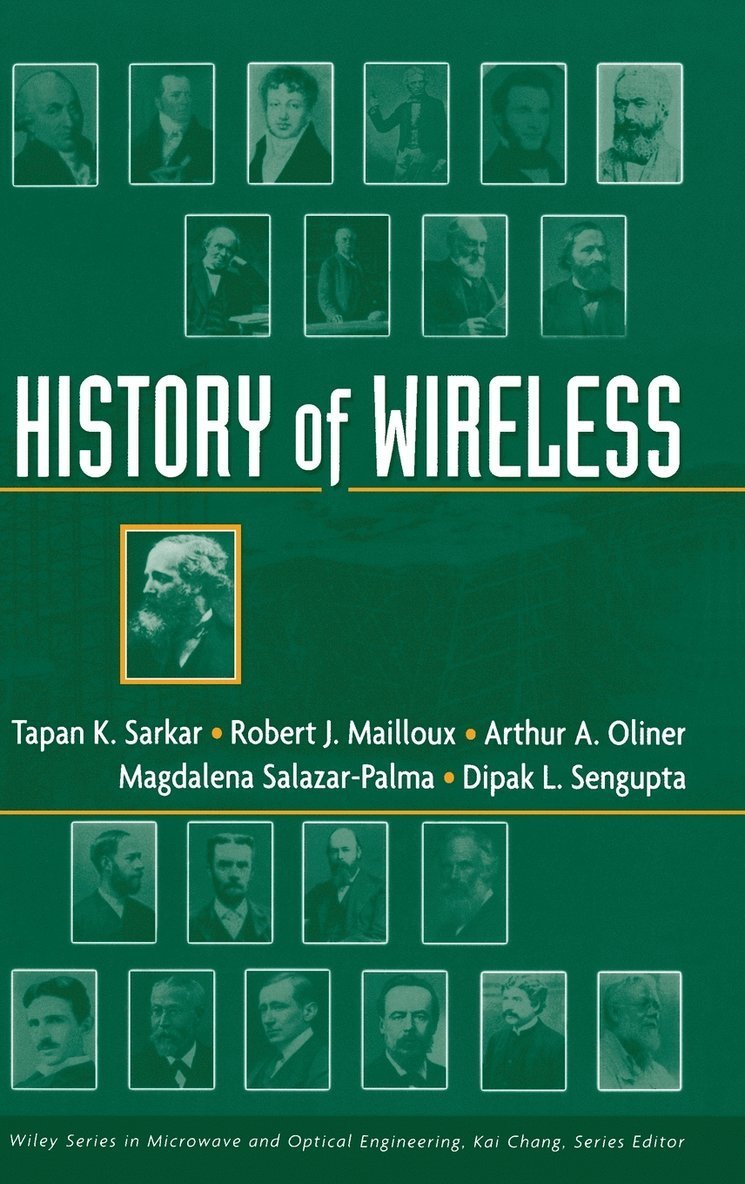
    History of Wireless

    AvT. K. Sarkar,Robert Mailloux

    Inbunden, Engelska, 2006

    Del 177 i serien Wiley Series in Microwave and Optical Engineering

    1 597 kr

    Beställningsvara. Skickas inom 5-8 vardagar. Fri frakt över 249 kr.

    Beskrivning

    Important new insights into how various components and systems evolved Premised on the idea that one cannot know a science without knowing its history, History of Wireless offers a lively new treatment that introduces previously unacknowledged pioneers and developments, setting a new standard for understanding the evolution of this important technology.Starting with the background-magnetism, electricity, light, and Maxwell's Electromagnetic Theory-this book offers new insights into the initial theory and experimental exploration of wireless. In addition to the well-known contributions of Maxwell, Hertz, and Marconi, it examines work done by Heaviside, Tesla, and passionate amateurs such as the Kentucky melon farmer Nathan Stubblefield and the unsung hero Antonio Meucci. Looking at the story from mathematical, physics, technical, and other perspectives, the clearly written text describes the development of wireless within a vivid scientific milieu.History of Wireless also goes into other key areas, including: The work of J. C. Bose and J. A. FlemingGerman, Japanese, and Soviet contributions to physics and applications of electromagnetic oscillations and wavesWireless telegraphic and telephonic development and attempts to achieve transatlantic wireless communicationsWireless telegraphy in South Africa in the early twentieth centuryAntenna development in Japan: past and presentSoviet quasi-optics at near-mm and sub-mm wavelengthsThe evolution of electromagnetic waveguidesThe history of phased array antennasAugmenting the typical, Marconi-centered approach, History of Wireless fills in the conventionally accepted story with attention to more specific, less-known discoveries and individuals, and challenges traditional assumptions about the origins and growth of wireless. This allows for a more comprehensive understanding of how various components and systems evolved. Written in a clear tone with a broad scientific audience in mind, this exciting and thorough treatment is sure to become a classic in the field.

    Produktinformation

    • Utgivningsdatum:2006-02-10
    • Mått:163 x 241 x 37 mm
    • Vikt:1 039 g
    • Format:Inbunden
    • Språk:Engelska
    • Serie:Wiley Series in Microwave and Optical Engineering
    • Antal sidor:688
    • Förlag:John Wiley & Sons Inc
    • ISBN:9780471718147

    Utforska kategorier

    • Elektronik och kommunikationer inom Naturvetenskap och teknik
    • Historia inom Historia och arkeologi

    Mer om författaren

    TAPAN K. SARKAR is a professor in the Department of Electrical and Computer Engineering at Syracuse University. ROBERT J. MAILLOUX is a retired senior scientist at the Sensors Directorate, Air Force Research Laboratory, Hanscom AFB, Massachusetts, and is currently Research Professor, University of Massachusetts, Amherst.ARTHUR A. OLINER is a University Professor Emeritus of Polytechnic University (formerly the Polytechnic Institute of Brooklyn). He is an elected member of the National Academy of Engineering, the recipient of two honorary doctorates and many prestigious awards, including two gold medals, and the coauthor of about 300 papers and three books.MAGDALENA SALAZAR-PALMA is a professor in the Departamento de Teoria de la Seal y Communicaciones, at Univerdidad Carlos III de Madrid (Spain). She has authored more than 260 publications in books, scientific journals, and symposium proceedings.DIPAK L. SENGUPTA is Emeritus Professor of Electrical and Computer Engineering at the University of Detroit Mercy, and a research scientist at the Radiation Laboratory, Department of Electrical Engineering and Computer Science, the University of Michigan, Ann Arbor. He is a Life Fellow of IEEE.

    Recensioner i media

    "This insightful, well written volume will appeal to a broad scientific audience and is sure to become a classic in its field." (Instrumentation and Technology, November/December 2006) "Well-illustrated with numerous chapter references...recommended." (CHOICE, July 2006)"...this book succeeds in challenging traditional assumptions about the origins and growth of wireless while painting an impressive and character-filled history of the technology." (Microwaves & RF Notepad)

    Innehållsförteckning

    • Preface. Acknowledgments.Chapter 1 Introduction.1.1 Prologue.1.2 Development of Magnetism.1.3 Development of Electricity.1.4 Development of the Theory of Light.1.5 Who Was Maxwell?1.6 What WasAs Maxwell's Electromagnetic Theory?1.7 Conclusions.Chapter 2 A Chronology of Developments of Wireless Communication and Supporting Electronics.2.1 Introduction.2.2 Acknowledgments.2.3 Background.2.4 Some Crucial Events of the Nineteenth Century.2.5 Some Crucial Events of the Twentieth Century.2.6 Epilogue.Chapter 3 Evolution of Electromagnetics in the Nineteenth Century.3.1 Introduction.3.2 Continental Electromagnetics.3.3 British Electromagnetics.3.4 Conclusion. Chapter 4 The Genesis of Maxwell's Equations.4.1 Introduction .4.2 On Faraday's Lines of Force.4.3 On Physical Lines of Force.4.4 A Dynarnical Theory of the Electromagnetic Field .Chapter 5 Maxwell, Hertz, the Maxwellians and the Early History of Electromagnetic Waves.5.1 Introduction.5.2 Speculations of Electromagnetic Propagation Before Maxwell.5.3 Maxwell's Electromagnetic Theory of Light.5.4 Acceptance of Maxwell's Theory.5.5 Hertz and the Maxwellians.5.6 Conclusion.Chapter 6 Oliver Heaviside.6.1 Introduction.6.2 Heaviside's Life.6.3 Heaviside's Contributions.6.4 Conclusions.6.5 Acknowledgments.Chapter 7 Wireless before Marconi.7.1 Introduction.7.2 Conduction Telegraph.7.3 Induction Telegraph .7.4 Electromagnetic Telegraph.Chapter 8 Nikola Tesla and His Contributions to Radio Development.8.1 Introduction.8.2 Invention of the Tesla Coil.8.3 Radio Controlled Vehicle.8.4 Colorado Springs Laboratory.8.5 Marconi and Braun Research.8.6 Long Island Laboratory.8.7 Conclusions.8.8 Acknowledgments.Chapter 9 An Appreciation of J. C. Bose's Pioneering Work in Millimeter and Microwaves.9.1 Introduction.9.2 Historical Perspective.9.3 A 60 GHz Transmission System.9.4 Development of the Receiver.9.5 Demonstration of Propagation.9.6 Demonstration of the Phenomenon of Refraction.9.7 Demonstration of the Phenomenon of Polarization.9.8 Demonstration of the Phenomenon Similar to Photoelectric Effect.9.9 Measurement of Wavelength.9.10 Development of the Galena Detector.9.1 1 Biological Effects of millimeter Waves.9.12 Conclusion9.1 3 Epilogue.9.14 Biographical Sketch. .Chapter 10 Sir John Ambrose Fleming - His Involvement in the Development of Wireless.10.1 Introduction.10.2 The Early Years.10.3 Research of the University Professor.10.4 Scientific Advisor to the Marconi Company.10.5 The Thermionic Valve.10.6 Later Life.Chapter 11 Historical German Contributions to Physics and Applications of Electromagnetic Oscillations and Waves.11.1 Introduction.1 1.2 Chronology of Historical German Contributions.11.3 Acknowledgments.Chapter 12 The Development of Wireless Telegraphy and Telephony, and Pioneering Attempts to Achieve Transatlantic Wireless Communications.12.1 Introduction.12.2 A Brief History of the Birth of Wireless.12.3 Experiments on Sparks and the Generation of Electromagnetic Waves.12.4 Early Receiving Device. 12.5 Continuous Wave Transmitters.12.6 Antenna Systems.12.7 Marconi's First Transatlantic Experiment .12.8 Marconi's Stations at Glace Bay.12.9 Fessenden's Brant Rock Station. .12.10 Transatlantic Experiments in the First Decade of the Twentieth Century.12.11 On Qualitykeliability of Marconi's Transmission.12.12 On Qualitykeliability of Fessenden's Transmission.12.13 Marine Wireless Communications.12.14 Wireless Telephony Is Born.12.15 The First Radio Propagation Experiments.12.16 Fessenden and Marconi, the Men.12.1 7 Closing Remarks.12.18 Acknowledgements.Chapter 13 Wireless Telegraphy in South Africa at the Turn of the Twentieth Century.13.1 Introduction.1 3.2 The Cape Colony.13.3 The South Ahcan Republic.13.4 The British Experience.13.5 After the South African War. 13.6 IEEE Milestone in Electrical Engineering.13.7 Acknowledgments.Chapter 14 The Antenna Development in Japan: Past and Present.14.1 Introduction.14.2 Maxwell, Hertz, and Their Followers in Japan.14.3 Marconi and the First Japanese Wireless Communication.14.4 Sea Battle of the Tsushima Straits and the Japanese Radiotelegraph .14.5 Yagi-Uda Antenna.14.6 Kinjiro Okabe and his Split-Anode Magnetron.14.7 Radar in World War II.14.8 Electrical Engineering Milestones in Japan.14.9 Conclusion.Chapter 15 Historical Background and Development of Soviet Quasioptics at Near-mm and Sub-mm Wavelengths.15.1 Introduction.15.2 Quasioptics in the Broad and Narrow Sense.15.3 Pioneering Research into "Hertz Optics" (1 888-1 900) and Lebedev's Contribution.15.4 Early Success: Free Space Gaussin-Beam Quasioptical Technologies.15.5 Alternative: Metallic Oversized Waveguides (since 1953) - Quasioptics in Disguise.15.6 Compromise No 1 : Discrete Beam Waveguides and East-West Competition (since 1961).15.7 Compromise No. 2: Continuous Beam Waveguides as a Widely Used USSR Technology (since 1963).15.8 Brief Survey of Modeling Methods and Tools Used in Quasioptics.15.9 New Frontiers of the XXI Century: Optics Goes Quasioptical.15.10 Acknowledgments.Chapter 16 The Evolution of Electromagnetic Waveguides: From Hollow Metallic Guides to Microwave Integrated Circuits.16.1 Hollow Metallic Waveguides.Chapter 17 A History of Phased Array Antennas.17.1 Introduction.17.2 The Early History.17.3 Electromechanical and Frequency Scanning.17.4 The Technology of Array Control.17.5 Phase Array Analysis and Synthesis.17.6 The Future.17.7 Author's Comments.17.8 Acknowledgments.References.Index.