• Fri frakt över 249 kr
  • •
  • Snabba leveranser
  • •
  • Billiga böcker
Kundservice

Du är på sajten för privatpersoner.

Företag, bibliotek eller offentlig verksamhet?

Du handlar på classic.bokus.com, där alla dina funktioner finns intakta.
Till classic.bokus.com
Bokus logotyp. Gå till startsidan.
  • Erbjudanden
  • Nyheter
  • Student
  • Topplistor
  • Barn & ungdom
  • Bokus Play
  • E-böcker
  • Pocketböcker
  • Spel & pussel

10% rabatt på allt med kod NYSTART10 →

Sidfot

Mina sidor

    Hjälp

    • Kundservice
    • Vanliga frågor och svar
    • Frakt och leverans
    • Retur vid ångerrätt
    • Reklamera vara
    • Betalning
    • Köpvillkor
    • Allmänna villkor
    • Information om webbplatsens tillgänglighet

    Om Bokus

    • Om oss
    • Pressrum
    • För studenter
    • För företag
    • För bibliotek och offentlig verksamhet
    • För leverantörer
    • Hållbarhet

    Populärt

    • Aktuella erbjudanden
    • Presentkort
    • Studentlitteratur
    • Nya böcker
    • Topplistor
    • Signerade böcker
    • Engelska böcker

    Inspiration

    • Boktips
    • BookTok
    • Populära bokserier
    • Barnbokskaraktärer
    • Populära författare
    Logotyp för Bokus
    Följ oss på Facebook (extern länk)Följ oss på Instagram (extern länk)Följ oss på YouTube (extern länk)Följ oss på TikTok (extern länk)
    bokus @ CookiesAnpassa cookiesIntegritetspolicyKöpvillkor
    Till Citymail hemsida (extern länk)Till Budbee hemsida (extern länk)Till Postnord hemsida (extern länk)Till Schenker hemsida (extern länk)Till Early Bird hemsida (extern länk)Till Walleys hemsida (extern länk)
    1. Ekonomi och Ledarskap
    2. Ledarskapsböcker
    3. Projektledning

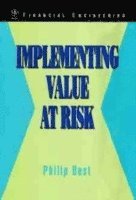
    Implementing Value at Risk

    AvPhilip Best

    Inbunden, Engelska, 1998

    Del i serien Wiley Series in Financial Engineering

    1 643 kr

    Beställningsvara. Skickas inom 5-8 vardagar. Fri frakt över 249 kr.

    Fler format och utgåvor

    E-bok

    1 885 kr

    Beskrivning

    Implementing Value at Risk Philip Best Value at Risk (VAR) is an estimate of the potential loss on a trading or investment portfolio. Its use has swept the banking world and is now accepted as an essential tool in any risk manager's briefcase. Perhaps the greatest strength of VAR is that it can cope with virtually all financial products, from simple securities through to complex exotic derivatives. This allows the risk taken, across diverse trading activities, to be compared. This said, VAR is no panacea. It is as critical to understand when the use of VAR is inappropriate as it is to understand the value VAR can add to a bank's understanding and control of its risks. This book aims to explain how VAR can be used as an integral part of a risk and business management framework, rather than as a stand-alone tool. The objectives of this book are to explain: What VAR is - and isn't! How to calculate VAR - the three main methods Why stress testing is needed to complement VAR How to make stress testing effective How to use VAR and stress testing to manage risk How to use VAR to improve a bank's performance VAR as a regulatory measure of risk and capital Risk management practitioners, general bank managers, consultants and students of finance and risk management will find this book, and the software package included, an invaluable addition to their library. Finance/Investment

    Produktinformation

    • Utgivningsdatum:1998-10-29
    • Mått:159 x 232 x 19 mm
    • Vikt:482 g
    • Format:Inbunden
    • Språk:Engelska
    • Serie:Wiley Series in Financial Engineering
    • Antal sidor:224
    • Förlag:John Wiley & Sons Inc
    • ISBN:9780471972051

    Utforska kategorier

    • Projektledning inom Ekonomi och Ledarskap

    Mer om författaren

    Philip Best is the author of Implementing Value at Risk, published by Wiley.

    Innehållsförteckning

    • Evolution of Value at Risk. Regulators and VAR. Review of VAR as a Risk Measurement Techniques. Covariance. Historical Simulation. Monte Carlo Simulation. Using VAR to Control Risk. VAR as a Business Management Tool. Implementing VAR. Conclusion.