• Fri frakt över 249 kr
  • •
  • Snabba leveranser
  • •
  • Billiga böcker
Kundservice

Du är på sajten för privatpersoner.

Företag, bibliotek eller offentlig verksamhet?

Du handlar på classic.bokus.com, där alla dina funktioner finns intakta.
Till classic.bokus.com
Bokus logotyp. Gå till startsidan.
  • Erbjudanden
  • Nyheter
  • Student
  • Topplistor
  • Barn & ungdom
  • Bokus Play
  • E-böcker
  • Pocketböcker
  • Spel & pussel

10% rabatt på allt med kod NYSTART10 →

Sidfot

Mina sidor

    Hjälp

    • Kundservice
    • Vanliga frågor och svar
    • Frakt och leverans
    • Retur vid ångerrätt
    • Reklamera vara
    • Betalning
    • Köpvillkor
    • Allmänna villkor
    • Information om webbplatsens tillgänglighet

    Om Bokus

    • Om oss
    • Pressrum
    • För studenter
    • För företag
    • För bibliotek och offentlig verksamhet
    • För leverantörer
    • Hållbarhet

    Populärt

    • Aktuella erbjudanden
    • Presentkort
    • Studentlitteratur
    • Nya böcker
    • Topplistor
    • Signerade böcker
    • Engelska böcker

    Inspiration

    • Boktips
    • BookTok
    • Populära bokserier
    • Barnbokskaraktärer
    • Populära författare
    Logotyp för Bokus
    Följ oss på Facebook (extern länk)Följ oss på Instagram (extern länk)Följ oss på YouTube (extern länk)Följ oss på TikTok (extern länk)
    bokus @ CookiesAnpassa cookiesIntegritetspolicyKöpvillkor
    Till Citymail hemsida (extern länk)Till Budbee hemsida (extern länk)Till Postnord hemsida (extern länk)Till Schenker hemsida (extern länk)Till Early Bird hemsida (extern länk)Till Walleys hemsida (extern länk)
    1. Ekonomi och Ledarskap
    2. Företagsekonomi
    3. Redovisning och finansiering
    4. Finansiering

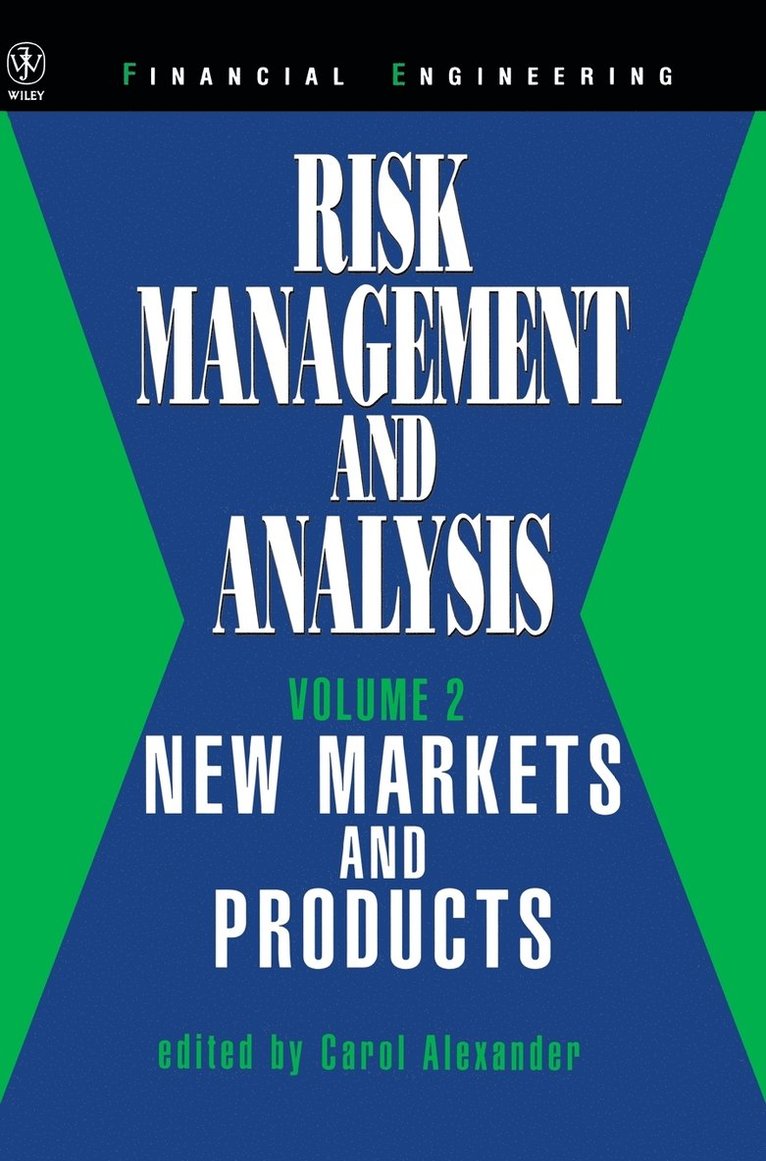
    Risk Management and Analysis, Volume 2

    New Markets and Products

    AvCarol Alexander

    Inbunden, Engelska, 1998

    Del 76 i serien Wiley Series in Financial Engineering

    1 408 kr

    Beställningsvara. Skickas inom 5-8 vardagar. Fri frakt över 249 kr.

    Beskrivning

    The author/editor has produced two stand-alone or companion volumes. Only one third of the original material remains.New Markets and Products begins with two chapters on emerging markets. The book then goes on to cover markets and products of increasing complexity: standard equity and interest rate derivatives, exotic options, swap (and swaptions), volatility trading and finally credit derivatives.The contributors are all acknowledged experts in their fields: Michael Howell, Mark Fox, Ian King, Chris Rogers, Andrew Street, Riccardo Rebonato, Edmond Levy, Bryan Thomas, Vincent Lacoste, Desmond Fitzgerald and Blythe Masters.New Markets and Products will be an essential reference tool for risk managers, institutional investors, fund managers, bankers, corporate treasurers and financial consultants."In this volume Carol Alexander has gathered together ten articles that are concerned with important recent developments in financial markets. Two of the articles are concerned with emerging markets. They explore the reasons for their growth and the nature of the investment opportunities available. The remaining eight articles are concerned with derivatives. There are chapters on equity derivatives, interest rate derivatives, exotic options, volatility trading, and credit derivatives. The final chapter on credit derivatives is particularly timely. This market is in the process of transforming the way banks manage credit risk. I have seen no other discussion of the market as comprehensive and useful as that provided by Blythe Masters. Market participants and students alike will find much useful and thought-provoking information in this volume."—John Hull, August 1998

    Produktinformation

    • Utgivningsdatum:1998-11-12
    • Mått:182 x 255 x 26 mm
    • Vikt:794 g
    • Format:Inbunden
    • Språk:Engelska
    • Serie:Wiley Series in Financial Engineering
    • Antal sidor:368
    • Förlag:John Wiley & Sons Inc
    • ISBN:9780471979593

    Utforska kategorier

    • Finansiering inom Ekonomi och Ledarskap

    Mer om författaren

    Carol Alexander obtained her PhD in Algebraic Number Theory, then worked at the Gemente Universiteit in Amsterdam and at UBS Phillips and Drew in London before joining the Mathematics Faculty of the University of Sussex in 1985. She holds a BSc in Mathematics with Experimental Psychology and an MSc in Econometrics and Mathematical Economics from the London School of Economics. Since 1990 Dr Alexander has been consulting, training, speaking at conferences, writing books and articles, and developing software in the areas of risk management and investment analysis. In 1996 she became the academic director of Algorithmics Inc (part-time) and in 1998 she eventually left the academic world to join Nikko Global Holdings as Director and Head of Market Risk Modelling. However, she retains a visiting fellowship at the University of Sussex. She has developed a number of computer programs and software packages for Risk and Investment analysis based on time series techniques. One of these was the winner of the first International Non-Linear Financial Forecasting Competition in 1997. Another used the concept of cointegration to build long-term index tracking tools for fund management, and long-short strategies for portfolio hedging. A third software module is based on her original research, using orthogonal factors to produce large GARCH covariance matrices for factor models.

    Recensioner i media

    "In what started as a second edition of the well received Handbook of Risk Management and Analysis, Carol Alexander has taken up the challenge of the increasing complexity of today's markets by selecting additional material to cover new aspects of risk modelling and new products, hence the present two volume edition. As before, the authors are well known not only for their mastery of the subject matter but also for their expository skills. Sound theories and tried methods are explained; new markets and products are clearly described. This is essential reading for the growing community of quantitatively-minded risk managers."—Dr Jacques Pézier, September 1998

    Innehållsförteckning

    • List of ContributorsAbout the ContributorsPrefaceForewordEmerging Markets I, Michael J. HowellIntroductionGrowing Countries not Poor CountriesCross-Border Capital FlowsMarkets in Emerging Financial EconomiesThe Future Size of Emerging Stock MarketsThe Growing Need for Financial DevelopmentConclusionAppendix 1: Selected Data on Emerging MarketsAppendix 2: Valuation MethodsEndnotesReferencesEmerging Markets II, Mark Fox and Ian KingIntroductionThe Beginning of Emerging MarketsDefining Emerging MarketsThe size of Emerging MarketsDo Emerging Markets Constitute a Separate Asset Class?Non-Performing LoansHistoryThe Present MarketBrady BondsHistoryStructures of Brady PlansThe Brady MarketAnalysing Brady BondsEvaluating Default RiskIncome GuaranteesTrading Strategies Exclusive to Brady BondsEurobondsHistoryA Changing RoleThe Role of Credit CurvesUsing Credit CurvesAnalysing Credit CurvesTrading Credit Curve ShapesLocal Markets and Emerging Market CurrenciesThe Role of Local Markets in the Investing CycleThe Character of Local Emerging Debt MarketsRussia - A Case StudyStrategic Uses for Investing in Local MarketsTrading and Managing Local Currency ExposureTrading and Managing Local Interest Rate ExposureEquitiesHistoryAnalysing Emerging Equity StocksTrading and Managing Emerging EquityMarket ExposureStrategic Uses for Investing in Emerging Equity MarketsBenchmarksDerivativesOptionsRepurchase AgreementsStructured NotesCredit DerivativesRelative Value TradesEquitiesSpecial Considerations in Evaluating Relative ValueA Matrix Approach to Regional and Asset AllocationPast ExperienceEndnotesThe Origins of Risk-Neutral Pricing and the Black-Scholes Formula, L.C.G. RogersIntroductionPortfolio ChoicesSome Notions and Notations from ProbabilityOptimal InvestmentThe Binomial Market and the Black-Scholes FormulaAppendix: Two Other ApproachesEndnotesReferencesEquity Derivatives Andrew StreetIntroductionAims and Scope of this ChapterClassification of Equity DerivativesGeneral Features of Pricing Equity DerivativesHistorical DevelopmentListed Equity DerivativesUnlisted or "Over-the-Counter" Equity DerivativesThe Utility of Equity DerivativesThe Evaluation of Risk and ReturnTax EfficiencyRegulatory EfficiencyLeverageImplementation of Specific Investment ViewsEfficiency and Cost EffectivenessThe Utility of Equity Derivatives for BorrowersThe Role of the Investment Bank in the Creation of Equity DerivativesCapitalCreditRisk AggregationTechnologyIndex ProductsExchange Traded Equity DerivativesOver-the-Counter Traded Equity DerivativesHybrid Equity DerivativesSingle Stocks, Bespoke Index ProductsFuture Development for Equity DerivativesGlossary of TermsReferencesInterest Rate Option Models: A Critical Survey, Riccardo RebonatoIntroduction and Outline of the ChapterYield Curve Models: A Statistical MotivationStatistical Analysis of the Evolution of RatesA Framework for Option PricingThe No-Arbitrage ConditionsDefinition of No-arbitrage in a Complete MarketThe Condition of No-arbitrage: Vasicek's ApproachThe condition of No-arbitrage: The Martingale ApproachFirst Choice of Numeraire: The Money Market AccountSecond Choice of Numeraire: A Discount BondThe General Link Between Different MeasuresThe Implementation ToolsLattice Approaches: Justification and ImplementationMonte Carlo (MC) ApproachesPDE Approaches: Finite Differences Schemes and Analytic SolutionsAnalysis of Specific ModelsBDT: Models Implications and Empirical FindingsExtended Vasicek (HW): Model Implications and Empirical FindingsLongstaff and Schwartz: Model Implications and Empirical FindingsThe HJM ApproachConclusions or "How to Choose the Best Model"ReferencesExotic Options I, Edmond LevyIntroductionAsian OptionsDefinition and UsesValuation ApproachesRisk Management of Asian OptionsBinary and Contingent Premium OptionsExamples and UsesValuation and HedgingCurrency Protected OptionsCross-Market ContractsValuation of Cross-Market ContractsCurrency Basket OptionsAppendix 1Appendix 2Appendix 3ReferencesExotic Options II, Bryan ThomasBarrier OptionsDefinitions and Examples of single barrier optionsAn Analytical Model of Single Barrier optionsAlternative Modelling MethodsRisk Management of Single Barrier optionsBarrier Options CombinationsRebatesDiscontinuous BarriersDouble Barrier OptionsSecond Market BarriersCompound OptionsDefinitions and ExampleGeske's ModelRisk ManagementExtensionsEven More Exotic OptionsReferencesCaptions and Swaptions Vincent LacosteChange of Numeraire: A General Valuation Method for SwaptionsIntroductory CommentsTechnical PropertiesApplication to SwaptionsHedging a SwaptionHedging Swptions Against Yield Curve ScenariosThe Hedging SpaceEstimated MethodsEmpirical ResultsConcluding remarks on Historical DataMarking to Market the Term structure of VolatilityCaptionsNon-Parametric estimation of the Volatility StructureConcluding remarksIs There a "Market Model of Interest Rates"?AppendixEndnotesReferencesTrading Volatility, M. Desmond FitzgeraldIntroductionBasics of Volatility TradingAnalysing Volatility Patterns for TradingRelative Volatility TradingSummaryCredit Derivatives, Blythe MastersBackground and Overview: The Case for Credit DerivativesWhat are Credit Derivatives?What is the Significance of Credit Derivatives?Basic Credit Derivative Structures and ApplicationsCredit (Default) SwapsTotal (Rate of) SwapsCredit OptionsDowngrade OptionsDynamic Credit SwapsOther Credit DerivativesA Portfolio Approach to Credit Risk ManagementWhy Credit Has Become a Risk-Management ChallengeThe Need for a Portfolio Approach to Credit RiskThe Challenges of Estimating Portfolio Credit RiskAssessing Credit Risk on a Portfolio Basis: MethodologyPractical Applications of Portfolio Methodology Using Credit DerivativesRegulatory Treatment of Credit DerivativesBalance Sheet Management: Synthetic SecuritizationInvestment ConsiderationsFilling Gaps in the Credit SpectrumTranscending Asset Class BarriersRecovery RateTermCommon Pricing ConsiderationsPredictive or Theoretical Pricing Models of Credit SwapsMark to Market and Valuation Methodologies for Credit SwapsRisk Equivalence of Total Return Swaps and Credit Swaps for Valuation PurposesRelative Value Analysis of Credit SwapsCounterparty ConsiderationsConclusionCredit Derivatives and Portfolio ManagementOther ImplicationsGlossary Endnotes/ReferencesIndex