Carol Alexander – författare
1 117 kr
Läs direkt efter köp
Written by leading market risk academic, Professor Carol Alexander, Value-at-Risk Models forms part four of the Market Risk Analysis four volume set. Building on the three previous volumes this book provides by far the most comprehensive, rigorous and detailed treatment of market VaR models. It rests on the basic knowledge of financial mathematics and statistics gained from Volume I, of factor models, principal component analysis, statistical models of volatility and correlation and copulas from Volume II and, from Volume III, knowledge of pricing and hedging financial instruments and of mapping portfolios of similar instruments to risk factors. A unifying characteristic of the series is the pedagogical approach to practical examples that are relevant to market risk analysis in practice.
All together, the Market Risk Analysis four volume set illustrates virtually every concept or formula with a practical, numerical example or a longer, empirical case study. Across all four volumes there are approximately 300 numerical and empirical examples, 400 graphs and figures and 30 case studies many of which are contained in interactive Excel spreadsheets available from the the accompanying CD-ROM . Empirical examples and case studies specific to this volume include:
Parametric linear value at risk (VaR)models: normal, Student t and normal mixture and their expected tail loss (ETL); New formulae for VaR based on autocorrelated returns; Historical simulation VaR models: how to scale historical VaR and volatility adjusted historical VaR; Monte Carlo simulation VaR models based on multivariate normal and Student t distributions, and based on copulas; Examples and case studies of numerous applications to interest rate sensitive, equity, commodity and international portfolios; Decomposition of systematic VaR of large portfolios into standard alone and marginal VaR components; Backtesting and the assessment of risk model risk; Hypothetical factor push and historical stress tests, and stress testing based on VaR and ETL.771 kr
Läs direkt efter köp
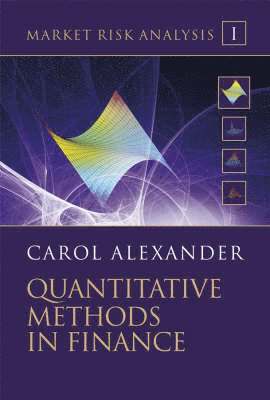
Written by leading market risk academic, Professor Carol Alexander, Quantitative Methods in Finance forms part one of the Market Risk Analysis four volume set. Starting from the basics, this book helps readers to take the first step towards becoming a properly qualified financial risk manager and asset manager, roles that are currently in huge demand. Accessible to intelligent readers with a moderate understanding of mathematics at high school level or to anyone with a university degree in mathematics, physics or engineering, no prior knowledge of finance is necessary. Instead the emphasis is on understanding ideas rather than on mathematical rigour, meaning that this book offers a fast-track introduction to financial analysis for readers with some quantitative background, highlighting those areas of mathematics that are particularly relevant to solving problems in financial risk management and asset management. Unique to this book is a focus on both continuous and discrete time finance so that Quantitative Methods in Finance is not only about the application of mathematics to finance; it also explains, in very pedagogical terms, how the continuous time and discrete time finance disciplines meet, providing a comprehensive, highly accessible guide which will provide readers with the tools to start applying their knowledge immediately.
All together, the Market Risk Analysis four volume set illustrates virtually every concept or formula with a practical, numerical example or a longer, empirical case study. Across all four volumes there are approximately 300 numerical and empirical examples, 400 graphs and figures and 30 case studies many of which are contained in interactive Excel spreadsheets available from the accompanying CD-ROM. Empirical examples and case studies specific to this volume include:
Principal component analysis of European equity indices; Calibration of Student t distribution by maximum likelihood; Orthogonal regression and estimation of equity factor models; Simulations of geometric Brownian motion, and of correlated Student t variables; Pricing European and American options with binomial trees, and European options with the Black-Scholes-Merton formula; Cubic spline fitting of yields curves and implied volatilities; Solution of Markowitz problem with no short sales and other constraints; Calculation of risk adjusted performance metrics including generalised Sharpe ratio, omega and kappa indices.912 kr
Läs direkt efter köp
All together, the Market Risk Analysis four volume set illustrates virtually every concept or formula with a practical, numerical example or a longer, empirical case study. Across all four volumes there are approximately 300 numerical and empirical examples, 400 graphs and figures and 30 case studies many of which are contained in interactive Excel spreadsheets available from the the accompanying CD-ROM. Empirical examples and case studies specific to this volume include:
Factor analysis with orthogonal regressions and using principal component factors; Estimation of symmetric and asymmetric, normal and Student t GARCH and E-GARCH parameters; Normal, Student t, Gumbel, Clayton, normal mixture copula densities, and simulations from these copulas with application to VaR and portfolio optimization; Principal component analysis of yield curves with applications to portfolio immunization and asset/liability management; Simulation of normal mixture and Markov switching GARCH returns; Cointegration based index tracking and pairs trading, with error correction and impulse response modelling; Markov switching regression models (Eviews code); GARCH term structure forecasting with volatility targeting; Non-linear quantile regressions with applications to hedging.1 132 kr
Läs direkt efter köp
Written by leading market risk academic, Professor Carol Alexander, Pricing, Hedging and Trading Financial Instruments forms part three of the Market Risk Analysis four volume set. This book is an in-depth, practical and accessible guide to the models that are used for pricing and the strategies that are used for hedging financial instruments, and to the markets in which they trade. It provides a comprehensive, rigorous and accessible introduction to bonds, swaps, futures and forwards and options, including variance swaps, volatility indices and their futures and options, to stochastic volatility models and to modelling the implied and local volatility surfaces.
All together, the Market Risk Analysis four volume set illustrates virtually every concept or formula with a practical, numerical example or a longer, empirical case study. Across all four volumes there are approximately 300 numerical and empirical examples, 400 graphs and figures and 30 case studies many of which are contained in interactive Excel spreadsheets available from the the accompanying CD-ROM . Empirical examples and case studies specific to this volume include:
Duration-Convexity approximation to bond portfolios, and portfolio immunization; Pricing floaters and vanilla, basis and variance swaps; Coupon stripping and yield curve fitting; Proxy hedging, and hedging international securities and energy futures portfolios; Pricing models for European exotics, including barriers, Asians, look-backs, choosers, capped, contingent, power, quanto, compo, exchange, ‘best-of’ and spread options; Libor model calibration; Dynamic models for implied volatility based on principal component analysis; Calibration of stochastic volatility models (Matlab code); Simulations from stochastic volatility and jump models; Duration, PV01 and volatility invariant cash flow mappings; Delta-gamma-theta-vega mappings for options portfolios; Volatility beta mapping to volatility indices.988 kr
Skickas inom 5-8 vardagar
1 002 kr
Skickas inom 5-8 vardagar
2 619 kr
Skickas inom 5-8 vardagar
807 kr
Skickas inom 5-8 vardagar
954 kr
Skickas inom 5-8 vardagar
Risk Management and Analysis, Volume 1
Measuring and Modelling Financial Risk
1 349 kr
Skickas inom 5-8 vardagar
Risk Management and Analysis, Volume 2
New Markets and Products
1 389 kr
Skickas inom 5-8 vardagar
276 kr
Skickas inom 3-6 vardagar
370 kr
Skickas inom 3-6 vardagar
919 kr
Skickas inom 5-8 vardagar
1 038 kr
Läs direkt efter köp
Identifying malpractice and misconduct should be top priority for financial risk managers today
Corruption and Fraud in Financial Markets identifies potential issues surrounding all types of fraud, misconduct, price/volume manipulation and other forms of malpractice. Chapters cover detection, prevention and regulation of corruption and fraud within different financial markets. Written by experts at the forefront of finance and risk management, this book details the many practices that bring potentially devastating consequences, including insider trading, bribery, false disclosure, frontrunning, options backdating, and improper execution or broker-agency relationships.
Informed but corrupt traders manipulate prices in dark pools run by investment banks, using anonymous deals to move prices in their own favour, extracting value from ordinary investors time and time again. Strategies such as wash, ladder and spoofing trades are rife, even on regulated exchanges – and in unregulated cryptocurrency exchanges one can even see these manipulative quotes happening real-time in the limit order book. More generally, financial market misconduct and fraud affects about 15 percent of publicly listed companies each year and the resulting fines can devastate an organisation''s budget and initiate a tailspin from which it may never recover.
This book gives you a deeper understanding of all these issues to help prevent you and your company from falling victim to unethical practices.
Learn about the different types of corruption and fraud and where they may be hiding in your organisation Identify improper relationships and conflicts of interest before they become a problem Understand the regulations surrounding market misconduct, and how they affect your firm Prevent budget-breaking fines and other potentially catastrophic consequencesSince the LIBOR scandal, many major banks have been fined billions of dollars for manipulation of prices, exchange rates and interest rates. Headline cases aside, misconduct and fraud is uncomfortably prevalent in a large number of financial firms; it can exist in a wide variety of forms, with practices in multiple departments, making self-governance complex. Corruption and Fraud in Financial Markets is a comprehensive guide to identifying and stopping potential problems before they reach the level of finable misconduct.
1 038 kr
Läs direkt efter köp
Identifying malpractice and misconduct should be top priority for financial risk managers today
Corruption and Fraud in Financial Markets identifies potential issues surrounding all types of fraud, misconduct, price/volume manipulation and other forms of malpractice. Chapters cover detection, prevention and regulation of corruption and fraud within different financial markets. Written by experts at the forefront of finance and risk management, this book details the many practices that bring potentially devastating consequences, including insider trading, bribery, false disclosure, frontrunning, options backdating, and improper execution or broker-agency relationships.
Informed but corrupt traders manipulate prices in dark pools run by investment banks, using anonymous deals to move prices in their own favour, extracting value from ordinary investors time and time again. Strategies such as wash, ladder and spoofing trades are rife, even on regulated exchanges – and in unregulated cryptocurrency exchanges one can even see these manipulative quotes happening real-time in the limit order book. More generally, financial market misconduct and fraud affects about 15 percent of publicly listed companies each year and the resulting fines can devastate an organisation''s budget and initiate a tailspin from which it may never recover.
This book gives you a deeper understanding of all these issues to help prevent you and your company from falling victim to unethical practices.
Learn about the different types of corruption and fraud and where they may be hiding in your organisation Identify improper relationships and conflicts of interest before they become a problem Understand the regulations surrounding market misconduct, and how they affect your firm Prevent budget-breaking fines and other potentially catastrophic consequencesSince the LIBOR scandal, many major banks have been fined billions of dollars for manipulation of prices, exchange rates and interest rates. Headline cases aside, misconduct and fraud is uncomfortably prevalent in a large number of financial firms; it can exist in a wide variety of forms, with practices in multiple departments, making self-governance complex. Corruption and Fraud in Financial Markets is a comprehensive guide to identifying and stopping potential problems before they reach the level of finable misconduct.
246 kr
Skickas inom 5-8 vardagar
236 kr
Skickas inom 3-6 vardagar