• Fri frakt över 249 kr
  • •
  • Snabba leveranser
  • •
  • Billiga böcker
Kundservice

Du är på sajten för privatpersoner.

Företag, bibliotek eller offentlig verksamhet?

Du handlar på classic.bokus.com, där alla dina funktioner finns intakta.
Till classic.bokus.com
Bokus logotyp. Gå till startsidan.
  • Erbjudanden
  • Nyheter
  • Student
  • Topplistor
  • Barn & ungdom
  • Bokus Play
  • E-böcker
  • Pocketböcker
  • Spel & pussel

10% rabatt på allt med kod: NYSTART10 →

Sidfot

Mina sidor

    Hjälp

    • Kundservice
    • Vanliga frågor och svar
    • Frakt och leverans
    • Retur vid ångerrätt
    • Reklamera vara
    • Betalning
    • Köpvillkor
    • Allmänna villkor
    • Information om webbplatsens tillgänglighet

    Om Bokus

    • Om oss
    • Pressrum
    • För studenter
    • För företag
    • För bibliotek och offentlig verksamhet
    • För leverantörer
    • Hållbarhet

    Populärt

    • Aktuella erbjudanden
    • Presentkort
    • Studentlitteratur
    • Nya böcker
    • Topplistor
    • Signerade böcker
    • Engelska böcker

    Inspiration

    • Boktips
    • BookTok
    • Populära bokserier
    • Barnbokskaraktärer
    • Populära författare
    Logotyp för Bokus
    Följ oss på Facebook (extern länk)Följ oss på Instagram (extern länk)Följ oss på YouTube (extern länk)Följ oss på TikTok (extern länk)
    bokus @ CookiesAnpassa cookiesIntegritetspolicyKöpvillkor
    Till Citymail hemsida (extern länk)Till Budbee hemsida (extern länk)Till Postnord hemsida (extern länk)Till Schenker hemsida (extern länk)Till Early Bird hemsida (extern länk)Till Walleys hemsida (extern länk)
    1. Ekonomi och Ledarskap
    2. Företagsekonomi
    3. Redovisning och finansiering
    4. Finansiering

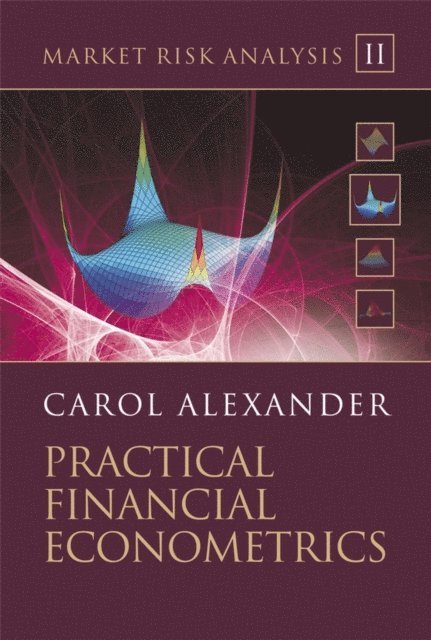
    Market Risk Analysis, Practical Financial Econometrics

    AvCarol Alexander

    John Wiley & Sons Inc

    2008

    Del i serien Market Risk Analysis

    972 kr

    Beställningsvara. Skickas inom 5-8 vardagar. Fri frakt över 249 kr.

    Fler format och utgåvor

    E-bok

    943 kr

    Beskrivning

    Written by leading market risk academic, Professor Carol Alexander, Practical Financial Econometrics forms part two of the Market Risk Analysis four volume set. It introduces the econometric techniques that are commonly applied to finance with a critical and selective exposition, emphasising the areas of econometrics, such as GARCH, cointegration and copulas that are required for resolving problems in market risk analysis. The book covers material for a one-semester graduate course in applied financial econometrics in a very pedagogical fashion as each time a concept is introduced an empirical example is given, and whenever possible this is illustrated with an Excel spreadsheet.All together, the Market Risk Analysis four volume set illustrates virtually every concept or formula with a practical, numerical example or a longer, empirical case study. Across all four volumes there are approximately 300 numerical and empirical examples, 400 graphs and figures and 30 case studies many of which are contained in interactive Excel spreadsheets available from the the accompanying CD-ROM. Empirical examples and case studies specific to this volume include: Factor analysis with orthogonal regressions and using principal component factors;Estimation of symmetric and asymmetric, normal and Student t GARCH and E-GARCH parameters;Normal, Student t, Gumbel, Clayton, normal mixture copula densities, and simulations from these copulas with application to VaR and portfolio optimization;Principal component analysis of yield curves with applications to portfolio immunization and asset/liability management;Simulation of normal mixture and Markov switching GARCH returns;Cointegration based index tracking and pairs trading, with error correction and impulse response modelling;Markov switching regression models (Eviews code);GARCH term structure forecasting with volatility targeting;Non-linear quantile regressions with applications to hedging.

    Produktinformation

    • Märke:John Wiley & Sons Inc
    • Utgivningsdatum:2008-04-18
    • Höjd:175 x 249 x 31 mm
    • Vikt:907 g
    • Språk:Engelska
    • Serie:Market Risk Analysis
    • Antal sidor:432
    • Förlag:John Wiley & Sons Inc
    • EAN:9780470998014

    Utforska kategorier

    • Finansiering inom Ekonomi och Ledarskap

    Mer om författaren

    Carol Alexander is a Professor of Risk Management at the ICMA Centre, University of Reading, and Chair of the Academic Advisory Council of the Professional Risk Manager’s International Association (PRMIA). She is the author of Market Models: A Guide to Financial Data Analysis(John Wiley & Sons Ltd, 2001) and has been editor and contributor of a very large number of books in finance and mathematics, including the multi-volume Professional Risk Manager's Handbook(McGraw-Hill, 2008 and PRMIA Publications). Carol has published nearly 100 academic journal articles, book chapters and books, the majority of which focus on financial risk management and mathematical finance. Professor Alexander is one of the world's leading authorities on market risk analysis. For further details, see www.icmacentre.rdg.ac.uk/alexander.

    Innehållsförteckning

    • List of Figures xiiiList of Tables xviiList of Examples xxForeword xxiiPreface to Volume II xxviII. 1 Factor Models 1II.1. 1 Introduction 1II.1. 2 Single Factor Models 2II.1.2. 1 Single Index Model 2II.1.2. 2 Estimating Portfolio Characteristics using OLS 4II.1.2. 3 Estimating Portfolio Risk using EWMA 6II.1.2. 4 Relationship between Beta, Correlation and Relative Volatility 8II.1.2. 5 Risk Decomposition in a Single Factor Model 10II.1. 3 Multi-Factor Models 11II.1.3. 1 Multi-factor Models of Asset or Portfolio Returns 11II.1.3. 2 Style Attribution Analysis 13II.1.3. 3 General Formulation of Multi-factor Model 16II.1.3. 4 Multi-factor Models of International Portfolios 18II.1. 4 Case Study: Estimation of Fundamental Factor Models 21II.1.4. 1 Estimating Systematic Risk for a Portfolio of US Stocks 22II.1.4. 2 Multicollinearity: A Problem with Fundamental Factor Models 23II.1.4. 3 Estimating Fundamental Factor Models by Orthogonal Regression 25II.1. 5 Analysis of Barra Model 27II.1.5. 1 Risk Indices, Descriptors and Fundamental Betas 28II.1.5. 2 Model Specification and Risk Decomposition 30II.1. 6 Tracking Error and Active Risk 31II.1.6. 1 Ex Post versus Ex Ante Measurement of Risk and Return 32II.1.6. 2 Definition of Active Returns 32II.1.6. 3 Definition of Active Weights 33II.1.6. 4 Ex Post Tracking Error 33II.1.6. 5 Ex Post Mean-Adjusted Tracking Error 36II.1.6. 6 Ex Ante Tracking Error 39II.1.6. 7 Ex Ante Mean-Adjusted Tracking Error 40II.1.6. 8 Clarification of the Definition of Active Risk 42II.1. 7 Summary and Conclusions 44II. 2 Principal Component Analysis 47II.2. 1 Introduction 47II.2. 2 Review of Principal Component Analysis 48II.2.2. 1 Definition of Principal Components 49II 2 Principal Component Representation 49II.2.2. 3 Frequently Asked Questions 50II.2. 3 Case Study: PCA of UK Government Yield Curves 53II.2.3. 1 Properties of UK Interest Rates 53II.2.3. 2 Volatility and Correlation of UK Spot Rates 55II.2.3. 3 PCA on UK Spot Rates Correlation Matrix 56II.2.3. 4 Principal Component Representation 58II.2.3. 5 PCA on UK Short Spot Rates Covariance Matrix 60II.2. 4 Term Structure Factor Models 61II.2.4. 1 Interest Rate Sensitive Portfolios 62II.2.4. 2 Factor Models for Currency Forward Positions 66II.2.4. 3 Factor Models for Commodity Futures Portfolios 70II.2.4. 4 Application to Portfolio Immunization 71II.2.4. 5 Application to Asset–Liability Management 72II.2.4. 6 Application to Portfolio Risk Measurement 73II.2.4. 7 Multiple Curve Factor Models 76II.2. 5 Equity PCA Factor Models 80II.2.5. 1 Model Structure 80II.2.5. 2 Specific Risks and Dimension Reduction 81II.2.5. 3 Case Study: PCA Factor Model for DJIA Portfolios 82II.2. 6 Summary and Conclusions 86II. 3 Classical Models of Volatility and Correlation 89II.3. 1 Introduction 89II.3. 2 Variance and Volatility 90II.3.2. 1 Volatility and the Square-Root-of-Time Rule 90II.3.3. 2 Constant Volatility Assumption 92II.3.2. 3 Volatility when Returns are Autocorrelated 92II.3.2. 4 Remarks about Volatility 93II.3. 3 Covariance and Correlation 94II.3.3. 1 Definition of Covariance and Correlation 94II.3.3. 2 Correlation Pitfalls 95II 3 Covariance Matrices 96II.3.3. 4 Scaling Covariance Matrices 97II.3. 4 Equally Weighted Averages 98II.3.4. 1 Unconditional Variance and Volatility 99II.3.4. 2 Unconditional Covariance and Correlation 102II.3.4. 3 Forecasting with Equally Weighted Averages 103II.3. 5 Precision of Equally Weighted Estimates 104II.3.5. 1 Confidence Intervals for Variance and Volatility 104II.3.5. 2 Standard Error of Variance Estimator 106II.3.5. 3 Standard Error of Volatility Estimator 107II.3.5. 4 Standard Error of Correlation Estimator 109II.3. 6 Case Study: Volatility and Correlation of US Treasuries 109II.3.6. 1 Choosing the Data 110II.3.6. 2 Our Data 111II.3.6. 3 Effect of Sample Period 112II.3.6. 4 How to Calculate Changes in Interest Rates 113II.3. 7 Equally Weighted Moving Averages 115II.3.7. 1 Effect of Volatility Clusters 115II.3.7. 2 Pitfalls of the Equally Weighted Moving Average Method 117II.3.7. 3 Three Ways to Forecast Long Term Volatility 118II.3. 8 Exponentially Weighted Moving Averages 120II.3.8. 1 Statistical Methodology 120II.3.8. 2 Interpretation of Lambda 121II.3.8. 3 Properties of EWMA Estimators 122II.3.8. 4 Forecasting with EWMA 123II.3.8. 5 Standard Errors for EWMA Forecasts 124II.3.8. 6 RiskMetrics TM Methodology 126II.3.8. 7 Orthogonal EWMA versus RiskMetrics EWMA 128II.3. 9 Summary and Conclusions 129II. 4 Introduction to GARCH Models 131II.4. 1 Introduction 131II.4. 2 The Symmetric Normal GARCH Model 135II.4.2. 1 Model Specification 135II.4.2. 2 Parameter Estimation 137II.4.2. 3 Volatility Estimates 141II.4.2. 4 GARCH Volatility Forecasts 142II.4.2. 5 Imposing Long Term Volatility 144II.4.2. 6 Comparison of GARCH and EWMA Volatility Models 147II.4. 3 Asymmetric GARCH Models 147II.4.3. 1 A-garch 148II.4.3. 2 Gjr-garch 150II.4.3. 3 Exponential GARCH 151II.4.3. 4 Analytic E-GARCH Volatility Term Structure Forecasts 154II.4.3. 5 Volatility Feedback 156II.4. 4 Non-Normal GARCH Models 157II.4.4. 1 Student t GARCH Models 157II.4.4. 2 Case Study: Comparison of GARCH Models for the Ftse 100 159II.4.4. 3 Normal Mixture GARCH Models 161II 4 Markov Switching GARCH 163II.4. 5 GARCH Covariance Matrices 164II.4.5. 1 Estimation of Multivariate GARCH Models 165II.4.5. 2 Constant and Dynamic Conditional Correlation GARCH 166II.4.5. 3 Factor GARCH 169II.4. 6 Orthogonal GARCH 171II.4.6. 1 Model Specification 171II.4.6. 2 Case Study: A Comparison of RiskMetrics and O-GARCH 173II.4.6. 3 Splicing Methods for Constructing Large Covariance Matrices 179II.4. 7 Monte Carlo Simulation with GARCH Models 180II.4.7. 1 Simulation with Volatility Clustering 180II.4.7. 2 Simulation with Volatility Clustering Regimes 183II.4.7. 3 Simulation with Correlation Clustering 185II.4. 8 Applications of GARCH Models 188II.4.8. 1 Option Pricing with GARCH Diffusions 188II.4.8. 2 Pricing Path-Dependent European Options 189II.4.8. 3 Value-at-Risk Measurement 192II.4.8. 4 Estimation of Time Varying Sensitivities 193II.4.8. 5 Portfolio Optimization 195II.4. 9 Summary and Conclusions 197II. 5 Time Series Models and Cointegration 201II.5. 1 Introduction 201II.5. 2 Stationary Processes 202II.5.2. 1 Time Series Models 203II.5.2. 2 Inversion and the Lag Operator 206II.5.2. 3 Response to Shocks 206II.5.2. 4 Estimation 208II.5.2. 5 Prediction 210II.5.2. 6 Multivariate Models for Stationary Processes 211II.5. 3 Stochastic Trends 212II.5.3. 1 Random Walks and Efficient Markets 212II.5.3. 2 Integrated Processes and Stochastic Trends 213II.5.3. 3 Deterministic Trends 214II.5.3. 4 Unit Root Tests 215II.5.3. 5 Unit Roots in Asset Prices 218II.5.3. 6 Unit Roots in Interest Rates, Credit Spreads and Implied Volatility 220II.5.3. 7 Reconciliation of Time Series and Continuous Time Models 223II.5.3. 8 Unit Roots in Commodity Prices 224II.5. 4 Long Term Equilibrium 225II.5.4. 1 Cointegration and Correlation Compared 225II.5.4. 2 Common Stochastic Trends 227II.5.4. 3 Formal Definition of Cointegration 228II.5.4. 4 Evidence of Cointegration in Financial Markets 229II.5.4. 5 Estimation and Testing in Cointegrated Systems 231II.5.4. 6 Application to Benchmark Tracking 239II.5.4. 7 Case Study: Cointegration Index Tracking in the Dow Jones Index 240II.5.5 Modelling Short Term Dynamics 243II.5.5.1 Error Correction Models 243II.5.5. 2 Granger Causality 246II.5.5. 3 Case Study: Pairs Trading Volatility Index Futures 247II.5. 6 Summary and Conclusions 250II. 6 Introduction to Copulas 253II.6. 1 Introduction 253II.6. 2 Concordance Metrics 255II.6.2. 1 Concordance 255II.6.2. 2 Rank Correlations 256II.6. 3 Copulas and Associated Theoretical Concepts 258II.6.3. 1 Simulation of a Single Random Variable 258II.6.3. 2 Definition of a Copula 259II.6.3. 3 Conditional Copula Distributions and their Quantile Curves 263II.6.3. 4 Tail Dependence 264II.6.3. 5 Bounds for Dependence 265II.6. 4 Examples of Copulas 266II.6.4. 1 Normal or Gaussian Copulas 266II.6.4. 2 Student t Copulas 268II.6.4. 3 Normal Mixture Copulas 269II.6.4. 4 Archimedean Copulas 271II.6. 5 Conditional Copula Distributions and Quantile Curves 273II.6.5. 1 Normal or Gaussian Copulas 273II.6.5. 2 Student t Copulas 274II.6.5. 3 Normal Mixture Copulas 275II.6.5. 4 Archimedean Copulas 275II.6.5. 5 Examples 276II.6. 6 Calibrating Copulas 279II.6.6. 1 Correspondence between Copulas and Rank Correlations 280II.6.6. 2 Maximum Likelihood Estimation 281II.6.6. 3 How to Choose the Best Copula 283II.6. 7 Simulation with Copulas 285II.6.7. 1 Using Conditional Copulas for Simulation 285II.6.7. 2 Simulation from Elliptical Copulas 286II.6.7. 3 Simulation with Normal and Student t Copulas 287II.6.7. 4 Simulation from Archimedean Copulas 290II.6. 8 Market Risk Applications 290II.6.8. 1 Value-at-Risk Estimation 291II.6.8. 2 Aggregation and Portfolio Diversification 292II.6.8. 3 Using Copulas for Portfolio Optimization 295II.6. 9 Summary and Conclusions 298II. 7 Advanced Econometric Models 301II.7. 1 Introduction 301II.7. 2 Quantile Regression 303II.7.2. 1 Review of Standard Regression 304II.7.2. 2 What is Quantile Regression? 305II.7.2. 3 Parameter Estimation in Quantile Regression 305II.7.2. 4 Inference in Linear Quantile Regression 307II.7.2. 5 Using Copulas for Non-linear Quantile Regression 307II.7. 3 Case Studies on Quantile Regression 309II.7.3. 1 Case Study 1: Quantile Regression of Vftse on FTSE 100 Index 309II.7.3. 2 Case Study 2: Hedging with Copula Quantile Regression 314II.7. 4 Other Non-Linear Regression Models 319II.7.4. 1 Non-linear Least Squares 319II.7.4. 2 Discrete Choice Models 321II.7. 5 Markov Switching Models 325II.7.5. 1 Testing for Structural Breaks 325II.7.5. 2 Model Specification 327II.7.5. 3 Financial Applications and Software 329II.7. 6 Modelling Ultra High Frequency Data 330II.7.6. 1 Data Sources and Filtering 330II.7.6. 2 Modelling the Time between Trades 332II.7.6. 3 Forecasting Volatility 334II.7. 7 Summary and Conclusions 337II. 8 Forecasting and Model Evaluation 341II.8. 1 Introduction 341II.8. 2 Returns Models 342II.8.2. 1 Goodness of Fit 343II.8.2. 2 Forecasting 347II.8.2. 3 Simulating Critical Values for Test Statistics 348II.8.2. 4 Specification Tests for Regime Switching Models 350II.8. 3 Volatility Models 350II.8.3. 1 Goodness of Fit of GARCH Models 351II.8.3. 2 Forecasting with GARCH Volatility Models 352II.8.3. 3 Moving Average Models 354II.8. 4 Forecasting the Tails of a Distribution 356II.8.4. 1 Confidence Intervals for Quantiles 356II.8.4. 2 Coverage Tests 357II.8.4. 3 Application of Coverage Tests to GARCH Models 360II.8.4. 4 Forecasting Conditional Correlations 361II.8. 5 Operational Evaluation 363II.8.5. 1 General Backtesting Algorithm 363II.8.5. 2 Alpha Models 365II.8.5. 3 Portfolio Optimization 366II.8.5. 4 Hedging with Futures 366II.8.5. 5 Value-at-Risk Measurement 367II.8.5. 6 Trading Implied Volatility 370II.8.5. 7 Trading Realized Volatility 372II.8.5. 8 Pricing and Hedging Options 373II.8. 6 Summary and Conclusions 375References 377Index 387