• Fri frakt över 249 kr
  • •
  • Snabba leveranser
  • •
  • Billiga böcker
Kundservice

Du är på sajten för privatpersoner.

Företag, bibliotek eller offentlig verksamhet?

Du handlar på classic.bokus.com, där alla dina funktioner finns intakta.
Till classic.bokus.com
Bokus logotyp. Gå till startsidan.
  • Erbjudanden
  • Student
  • Topplistor
  • Barn & ungdom
  • Bokus Play
  • E-böcker
  • Ljudböcker
  • Pocketböcker
  • Spel och pussel

5% studentrabatt – använd koden KURSBOK27 →

Sidfot

Mina sidor

    Hjälp

    • Kundservice
    • Vanliga frågor och svar
    • Frakt och leverans
    • Retur vid ångerrätt
    • Reklamera vara
    • Betalning
    • Köpvillkor
    • Allmänna villkor
    • Information om webbplatsens tillgänglighet

    Om Bokus

    • Om oss
    • Pressrum
    • För studenter
    • För företag
    • För bibliotek och offentlig verksamhet
    • För leverantörer
    • Hållbarhet

    Populärt

    • Aktuella erbjudanden
    • Presentkort
    • Studentlitteratur
    • Nya böcker
    • Topplistor
    • Signerade böcker
    • Engelska böcker

    Inspiration

    • Boktips
    • BookTok
    • Barnbokskaraktärer
    • Populära författare
    Logotyp för Bokus
    Följ oss på Facebook (extern länk)Följ oss på Instagram (extern länk)Följ oss på YouTube (extern länk)Följ oss på TikTok (extern länk)
    bokus @ CookiesAnpassa cookiesIntegritetspolicyKöpvillkor
    Till Citymail hemsida (extern länk)Till Budbee hemsida (extern länk)Till Postnord hemsida (extern länk)Till Schenker hemsida (extern länk)Till Early Bird hemsida (extern länk)Till Walleys hemsida (extern länk)
    1. Naturvetenskap och teknik
    2. Teknik och industri
    3. Elektronik och kommunikationer

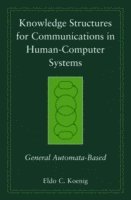
    Knowledge Structures for Communications in Human-Computer Systems

    General Automata-Based

    AvEldo C. Koenig

    Häftad, Engelska, 2006

    Del 56 i serien Practitioners

    1 015 kr

    Beställningsvara. Skickas inom 5-8 vardagar. Fri frakt över 249 kr.

    Fler format och utgåvor

    E-bok

    1 167 kr

    Beskrivning

    A comprehensive look at General automata and how it can be used to establish the fundamentals for communication in human-computer systems Drawing on author Eldo C. Koenig's extensive expertise and culling from his thirty-four previously published works, this seminal resource presents knowledge structures for communication in Human-Computer Systems (HCS) based on General automata. The resulting model provides knowledge representations for software engineering. Of the many features required for a method to achieve the desired communication in HCS, Knowledge Structures for Communications in Human-Computer Systems identifies six of them in great length-extracting and storing the knowledge of sentences; knowledge association; deductive processes; inferences; feedback; and sequencing of knowledge-along with illustrations for achieving them by the General Automata Method. After presenting the analysis for each feature, the book includes practical applications that illustrate the results. Koenig also describes algorithms and programs that achieve some of the features, and provides readers with additional algorithms and further research. Richly illustrated throughout to elucidate concepts, Knowledge Structures for Communications in Human-Computer Systems is an excellent teaching text suitable for both academic and industrial settings.

    Produktinformation

    • Utgivningsdatum:2006-11-24
    • Mått:155 x 234 x 17 mm
    • Vikt:431 g
    • Format:Häftad
    • Språk:Engelska
    • Serie:Practitioners
    • Antal sidor:296
    • Förlag:John Wiley & Sons Inc
    • ISBN:9780471998136

    Utforska kategorier

    • Elektronik och kommunikationer inom Naturvetenskap och teknik
    • Systemvetenskap och AI inom Data och IT
    • Människa – datorinteraktion inom Data och IT

    Mer om författaren

    Eldo C. Koenig began his professional career with the U.S.A. War Department, Manhattan District, in work associated with the atomic bomb. A retired professor of the University of Wisconsin–Madison's computer sciences department, Koenig is an active member of ACM, IEEE Computer Society, and the AAAS. He has published over fifty works pertaining to computers and computing and was the recipient of several prestigious awards, including the Allis-Chalmers Fellowship Award and the Alfred Noble Prize in 1951.

    Recensioner i media

    "Essential teaching resource; exhaustive bibliography, including Koenig's 34 previously published works on GAM in HCS." (CHOICE, April 2007) "Readers have been provided with more than sufficient detail-led analysis and practical illustrations…" (Kybernetes, Volume 36, No.34, 2007)

    Innehållsförteckning

    • Preface. 1. Introduction.1.1 Considerations for Establishing Knowledge Structures for Computers.1.2 Knowledge About Automata as a Subset of World Knowledge.1.2.1 General Automata.1.2.2 Extracting and Storing the Meanings of Sentences.1.2.3 Associating Knowledge.1.2.4 Establishing Conclusions and Inferences.Exercises.2. A General Automaton.2.1 Formal Analysis for a General Automaton.2.1.1 General Analysis.2.1.2 Graph Model.2.1.3 Select Properties of the Graph Model.2.2 An Application of the Disciplines to the Modeling of Natural Automata.2.2.1 A Case Study.2.2.2 Required State Changes.2.2.3 Algorithm for Determining Required State Changes.Exercises.3. A General Automaton: Detailed Analysis.3.1 Distinguishable Receptors and Effectors.3.2 Nonhomogeneous Environments.3.3 Transformation Response Components.3.4 Nonshared Environments Interpreted as Distinguishable.3.4.1 Model for Performance in Both Shared and Nonshared Environments.3.4.2 Model for Performance in Shared Environments.Exercises.4. Processing of Knowledge About Automata.4.1 Formulation of a Language Information Theory.4.1.1 Class 1 Sentence.4.1.2 Class 2 Sentence.4.1.3 Class 3 Sentence.4.1.4 Class 4 Sentence.4.1.5 Class 5 Sentence.4.1.6 Class 6 Sentence.4.1.7 Class 7 Sentence.4.2 Extracting and Storing the Meaning of Sentences by Computer.4.2.1 Description of an Algorithm.4.3 Knowledge Association.4.3.1 Association by Combining Graphs Through Common Points.4.3.2 Associations by Combining Graph (n + 1)-Tuples.4.3.3 Computer Methods for Association of Knowledge.4.4 Deductive Processes.4.4.1 Deductive Processes Related to Association Through Common Points.4.4.2 Deductive Processes Related to Association by Combining Graph Tuples.4.4.3 Deductive Processes with Aristotelian Form A as a Premise.4.5 Inferences.4.5.1 Inferences Related to a Single Graph Tuple of Associated Knowledge.4.5.2 Inferences Related to More than One Graph Tuple of Associated Knowledge.Exercises.5. A General System of Interactive Automata.5.1 Formal Analysis for a General System of Interactive Automata.5.1.1 General Analysis.5.1.2 Microsystem Model.5.1.3 Macrosystem Model.5.2 Example Applications.5.2.1 A Two-Component System.5.2.2 A System of Many Components.Exercises.6. Processing of Knowledge About Systems of Automata.6.1 A General System of Interactive Automata: Detailed Analysis.6.1.1 The Microsystem Model.6.1.2 The Macrosystem Model.6.2 Knowledge Structures for Sentences Describing Systems of Interactive Automata.Exercises.7. Changing Expressions of Knowledge for Communication from One Form and Style to Another.7.1 Introduction.7.2 Sets and Relations.7.3 Establishing Open Expressions and Open Sentences.7.4 Selecting Subsets of Open Expressions.7.5 Applying the Results of the Above Analysis.7.6 Summary and Conclusions.Exercises.8. Electronic Security Through Pseudo Languages.8.1 Introduction.8.2 Defi nitions, Sets, and Relations.8.3 Analysis for E-Security Through Pseudo Languages.8.3.1 A Basic E-Security System.8.3.2 A Two-Step Encryption System.8.3.3 E-Signing.8.4 Summary and Conclusions.Exercises.Appendix A: Analysis for an Effective Operation of a General Automaton.A.1 Introduction.A.2 Recursive Methods.A.3 Effective Operation Analysis.Exercises.Appendix B: Analysis for an Effective Operation of a General System of Interactive Automata.B.1 Introduction.B.2 Microsystem Graphs.B.3 Macrosystem Graphs.B.4 Example.Exercises.References.Index.