• Fri frakt över 249 kr
  • •
  • Snabba leveranser
  • •
  • Billiga böcker
Kundservice

Du är på sajten för privatpersoner.

Företag, bibliotek eller offentlig verksamhet?

Du handlar på classic.bokus.com, där alla dina funktioner finns intakta.
Till classic.bokus.com
Bokus logotyp. Gå till startsidan.
  • Erbjudanden
  • Nyheter
  • Student
  • Topplistor
  • Barn & ungdom
  • Bokus Play
  • E-böcker
  • Pocketböcker
  • Spel & pussel

10% rabatt på allt med kod: NYSTART10 →

Sidfot

Mina sidor

    Hjälp

    • Kundservice
    • Vanliga frågor och svar
    • Frakt och leverans
    • Retur vid ångerrätt
    • Reklamera vara
    • Betalning
    • Köpvillkor
    • Allmänna villkor
    • Information om webbplatsens tillgänglighet

    Om Bokus

    • Om oss
    • Pressrum
    • För studenter
    • För företag
    • För bibliotek och offentlig verksamhet
    • För leverantörer
    • Hållbarhet

    Populärt

    • Aktuella erbjudanden
    • Presentkort
    • Studentlitteratur
    • Nya böcker
    • Topplistor
    • Signerade böcker
    • Engelska böcker

    Inspiration

    • Boktips
    • BookTok
    • Populära bokserier
    • Barnbokskaraktärer
    • Populära författare
    Logotyp för Bokus
    Följ oss på Facebook (extern länk)Följ oss på Instagram (extern länk)Följ oss på YouTube (extern länk)Följ oss på TikTok (extern länk)
    bokus @ CookiesAnpassa cookiesIntegritetspolicyKöpvillkor
    Till Citymail hemsida (extern länk)Till Budbee hemsida (extern länk)Till Postnord hemsida (extern länk)Till Schenker hemsida (extern länk)Till Early Bird hemsida (extern länk)Till Walleys hemsida (extern länk)
    1. Juridik
    2. Rättsvetenskap
    3. Juridik: metod och teori

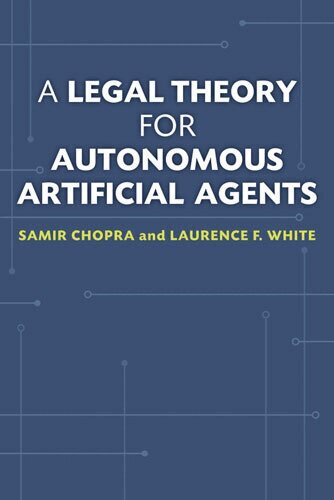
    Legal Theory for Autonomous Artificial Agents

    AvSamir Chopra,Laurence F. White

    Häftad, Engelska, 2011

    412 kr

    Beställningsvara. Skickas inom 5-8 vardagar. Fri frakt över 249 kr.

    Beskrivning

    “An extraordinarily good synthesis from an amazing range of philosophical, legal, and technological sources . . . the book will appeal to legal academics and students, lawyers involved in e-commerce and cyberspace legal issues, technologists, moral philosophers, and intelligent lay readers interested in high tech issues, privacy, [and] robotics.” —Kevin Ashley, University of Pittsburgh School of LawAs corporations and government agencies replace human employees with online customer service and automated phone systems, we become accustomed to doing business with nonhuman agents. If artificial intelligence (AI) technology advances as today’s leading researchers predict, these agents may soon function with such limited human input that they appear to act independently. When they achieve that level of autonomy, what legal status should they have?Samir Chopra and Laurence F. White present a carefully reasoned discussion of how existing philosophy and legal theory can accommodate increasingly sophisticated AI technology. Arguing for the legal personhood of an artificial agent, the authors discuss what it means to say it has “knowledge” and the ability to make a decision. They consider key questions such as who must take responsibility for an agent’s actions, whom the agent serves, and whether it could face a conflict of interest.

    Produktinformation

    • Utgivningsdatum:2011-07-18
    • Mått:152 x 229 x undefined mm
    • Format:Häftad
    • Språk:Engelska
    • Antal sidor:264
    • Förlag:The University of Michigan Press
    • ISBN:9780472051458

    Utforska kategorier

    • Juridik: metod och teori inom Juridik

    Mer om författaren

    Samir Chopra is Associate Professor of Philosophy at Brooklyn College of the City University of New York. Laurence F. White is a lawyer and policymaker specializing in law and technology and financial markets regulation.

    Recensioner i media

    "Chopra and White have produced an important and fascinating book on the emerging law of artificial agents. Their work combines a sophisticated understanding of technology with a deep insight about the law. The result is a magisterial survey that ranges over topics from tort liability for bots to the possibility that artificially intelligent agents might acquire legal personhood."—Lawrence B. Solum, University of Illinois