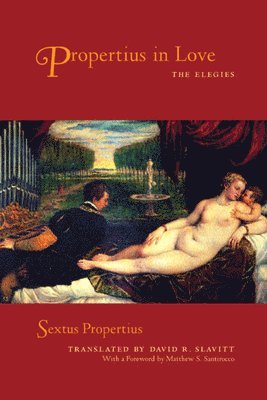
Häftad, Engelska, 2002
Propertius in Love
The Elegies
Del i serien University of California Press
394 kr
Beställningsvara. Skickas inom 5-8 vardagar. Fri frakt över 249 kr.
Beskrivning
Produktinformation
- Utgivningsdatum: 2002-06-03
- Mått: 140 x 210 x 20 mm
- Vikt: 363 g
- Format: Häftad
- Språk: Engelska
- Serie: University of California Press
- Antal sidor: 313
- Förlag: University of California Press
- Medarbetare: Matthew Santirocco
- ISBN: 9780520228795
- Översättare: David R. Slavitt
Utforska kategorier
Mer om författaren
David R. Slavitt is a member of the faculty at Bennington College and is the author of acclaimed translations of Virgil, Ovid, Seneca, Aeschylus, and Aristophanes, as well as Solomon Ibn Gabirol and the biblical Book of the Twelve Prophets, among other translations and many books of poetry.
Recensioner i media
"Goethe, whose Roman Elegies drew on him, recognized in Propertius a romantic sensibility akin to his own. Ezra Pound's Homage to Sextus Propertius, on the other hand, read the poet as a fellow satirist and political dissident. Whatever the merits of these, and other, competing interpretations, Propertius has by now certainly come into his own, acquiring a whole new generation of readers. Indeed, in his 1997 play about the scholar-poet Housman, Tom Stoppard suggests that Propertius is one of the poets who were responsible for "the invention of love" in the West. The occasion of a lively new version by the poet David Slavitt invites a reexamination of Propertius, with particular attention to what most recommends him to us today: his sophisticated exploration of love and gender relations, his difficult-we might almost say modernist poetics, his strikingly independent politics that are concomitant with an overriding commitment to love and to literature, and, finally, his attempt later in life to reinvent himself and his art."-from the foreword by Matthew S. Santirocco, New York University
Betyg & recensioner
0 recensioner
Inga recensioner tillgängliga.