• Fri frakt över 249 kr
  • •
  • Snabba leveranser
  • •
  • Billiga böcker
Kundservice

Du är på sajten för privatpersoner.

Företag, bibliotek eller offentlig verksamhet?

Du handlar på classic.bokus.com, där alla dina funktioner finns intakta.
Till classic.bokus.com
Bokus logotyp. Gå till startsidan.
  • Erbjudanden
  • Nyheter
  • Student
  • Topplistor
  • Barn & ungdom
  • Bokus Play
  • E-böcker
  • Pocketböcker
  • Spel & pussel

Må bättre, för mindre! Upp till 50% rabatt på hälsoböcker

Sidfot

Mina sidor

    Hjälp

    • Kundservice
    • Vanliga frågor och svar
    • Frakt och leverans
    • Retur vid ångerrätt
    • Reklamera vara
    • Betalning
    • Köpvillkor
    • Allmänna villkor
    • Information om webbplatsens tillgänglighet

    Om Bokus

    • Om oss
    • Pressrum
    • För studenter
    • För företag
    • För bibliotek och offentlig verksamhet
    • För leverantörer
    • Hållbarhet

    Populärt

    • Aktuella erbjudanden
    • Presentkort
    • Studentlitteratur
    • Nya böcker
    • Topplistor
    • Signerade böcker
    • Engelska böcker

    Inspiration

    • Boktips
    • BookTok
    • Populära bokserier
    • Barnbokskaraktärer
    • Populära författare
    Logotyp för Bokus
    Följ oss på Facebook (extern länk)Följ oss på Instagram (extern länk)Följ oss på YouTube (extern länk)Följ oss på TikTok (extern länk)
    bokus @ CookiesAnpassa cookiesIntegritetspolicyKöpvillkor
    Till Citymail hemsida (extern länk)Till Budbee hemsida (extern länk)Till Postnord hemsida (extern länk)Till Schenker hemsida (extern länk)Till Early Bird hemsida (extern länk)Till Walleys hemsida (extern länk)
    1. Skönlitteratur
    2. Litteraturvetenskap
    3. Litteraturvetenskap

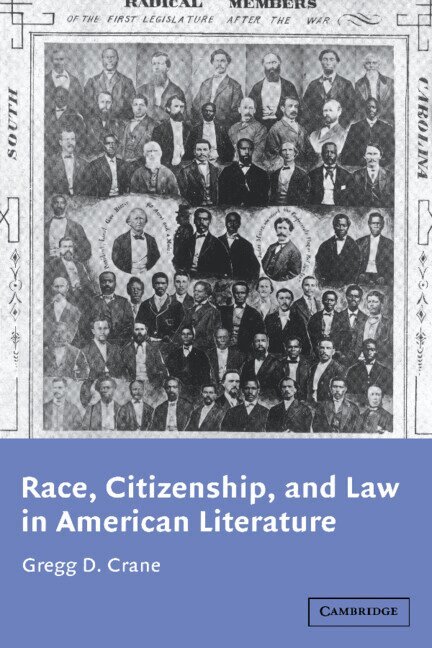
    Race, Citizenship, and Law in American Literature

    AvGregg D. Crane,Albert Gelpi

    Häftad, Engelska, 2002

    Del 128 i serien Cambridge Studies in American Literature and Culture

    658 kr

    Beställningsvara. Skickas inom 10-15 vardagar. Fri frakt över 249 kr.

    Fler format och utgåvor

    Inbunden

    1 396 kr

    Beskrivning

    In this broad ranging and powerful study, Gregg Crane examines the interaction between civic identity, race and justice in American law and literature. Crane recounts the efforts of literary and legal figures to bring the nation's law into line with the moral consensus that slavery and racial oppression were evil. By documenting an actual historical interaction central both to American literature and American constitutional law, Crane reveals the influence of literature on the constitutional discourse of citizenship. Covering such writers as Harriet Beecher Stowe, Ralph Waldo Emerson and Frederick Douglass, and a whole range of novelists, poets, philosophers, politicians, lawyers and judges, this is a remarkable book, that will revise the relationship between race and nationalism in American literature.

    Produktinformation

    • Utgivningsdatum:2002-01-24
    • Mått:152 x 228 x 16 mm
    • Vikt:433 g
    • Format:Häftad
    • Språk:Engelska
    • Serie:Cambridge Studies in American Literature and Culture
    • Antal sidor:312
    • Förlag:Cambridge University Press
    • ISBN:9780521010931

    Utforska kategorier

    • Litteraturvetenskap inom Skönlitteratur

    Mer om författaren

    Gregg Crane is Assistant Professor of English at Miami University. He has been a member of the State Bar of California since 1986. He has published in American Literary History, American Literature, Nineteenth-Century Literature and Hastings Constitutional Law Quarterly.

    Recensioner i media

    'A profound and moving book that deserves a wide audience. Crane displays a searching wisdom and precise imagination in brilliantly describing the moral universe where literature and law meet in key texts of the nineteenth century. An indispensable study of nationalism and race and their impact on American law and literature.' Eric Sundquist

    Innehållsförteckning

    • Acknowledgments; Introduction; 1. Higher law in the 1850s; 2. The look of higher law: Harriet Beecher Stowe's antislavery fiction; 3. Cosmopolitan constitutionalism: Emerson and Douglass; 4. The positivist alternative; 5. Charles Chesnutt and Moorfield Storey: citizenship and the flux of contract.