• Fri frakt över 249 kr
  • •
  • Snabba leveranser
  • •
  • Billiga böcker
Kundservice

Du är på sajten för privatpersoner.

Företag, bibliotek eller offentlig verksamhet?

Du handlar på classic.bokus.com, där alla dina funktioner finns intakta.
Till classic.bokus.com
Bokus logotyp. Gå till startsidan.
  • Erbjudanden
  • Nyheter
  • Student
  • Topplistor
  • Barn & ungdom
  • Bokus Play
  • E-böcker
  • Pocketböcker
  • Spel & pussel

10% rabatt på allt med kod: NYSTART10 →

Sidfot

Mina sidor

    Hjälp

    • Kundservice
    • Vanliga frågor och svar
    • Frakt och leverans
    • Retur vid ångerrätt
    • Reklamera vara
    • Betalning
    • Köpvillkor
    • Allmänna villkor
    • Information om webbplatsens tillgänglighet

    Om Bokus

    • Om oss
    • Pressrum
    • För studenter
    • För företag
    • För bibliotek och offentlig verksamhet
    • För leverantörer
    • Hållbarhet

    Populärt

    • Aktuella erbjudanden
    • Presentkort
    • Studentlitteratur
    • Nya böcker
    • Topplistor
    • Signerade böcker
    • Engelska böcker

    Inspiration

    • Boktips
    • BookTok
    • Populära bokserier
    • Barnbokskaraktärer
    • Populära författare
    Logotyp för Bokus
    Följ oss på Facebook (extern länk)Följ oss på Instagram (extern länk)Följ oss på YouTube (extern länk)Följ oss på TikTok (extern länk)
    bokus @ CookiesAnpassa cookiesIntegritetspolicyKöpvillkor
    Till Citymail hemsida (extern länk)Till Budbee hemsida (extern länk)Till Postnord hemsida (extern länk)Till Schenker hemsida (extern länk)Till Early Bird hemsida (extern länk)Till Walleys hemsida (extern länk)
    1. Skönlitteratur
    2. Litteraturvetenskap
    3. Litteraturvetenskap

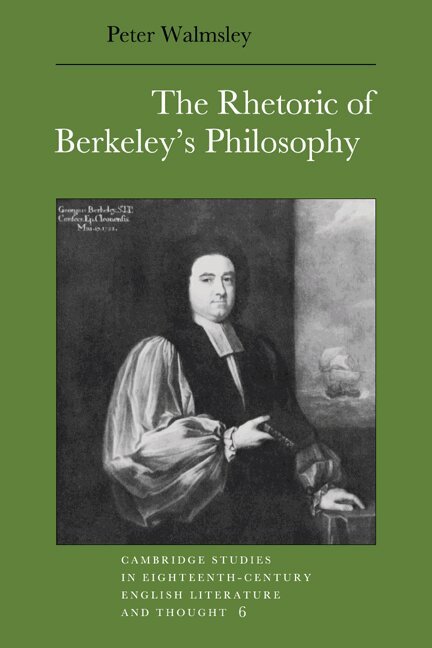
    The Rhetoric of Berkeley's Philosophy

    AvPeter Walmsley,Howard Erskine-Hill

    Häftad, Engelska, 2006

    Del 6 i serien Cambridge Studies in Eighteenth-Century English Literature and Thought

    533 kr

    Beställningsvara. Skickas inom 10-15 vardagar. Fri frakt över 249 kr.

    Fler format och utgåvor

    Inbunden

    1 473 kr

    Beskrivning

    The works of George Berkeley (1685-1753) have been the object of much philosophical analysis; but philosophers are writers as well as thinkers, and Berkeley was himself positively interested in the functions of language and style. He recognized that words are used not just to convey ideas, but to stir the emotions and influence the behaviour of the hearer or reader. The Rhetoric of Berkeley's Philosophy, first published in 1990, offers rhetorical and literary analyses of his four major philosophical texts, A Treatise Concerning the Principles of Human Knowledge, Three Dialogues between Hylas and Philonous, Alciphron and Siris. The Berkeley that emerges from this study is an accomplished stylist, one who builds structures of affective imagery, who creates dramatic voices in his texts, and who masters the range of philosophical genres - the treatise, the dialogue and the essay. Above all, Berkeley's awareness of the rhetorical functions of language is everywhere evident in his own style. His texts persuade as well as prove, enacting a process of inquiry so that the reader may, in the end, grasp Berkeley's truths as his own.

    Produktinformation

    • Utgivningsdatum:2006-11-02
    • Mått:152 x 228 x 16 mm
    • Vikt:347 g
    • Format:Häftad
    • Språk:Engelska
    • Serie:Cambridge Studies in Eighteenth-Century English Literature and Thought
    • Antal sidor:224
    • Förlag:Cambridge University Press
    • ISBN:9780521028035

    Utforska kategorier

    • Litteraturvetenskap inom Skönlitteratur

    Recensioner i media

    "...the reader can turn from Walmsley's work not only with fresh insights, but with new tools for approaching the works of Berkeley's contemporaries (especially Hume) and relating them to Berkeley's own works." Studies in English Literature

    Innehållsförteckning

    • Acknowledgments; Note to the reader; Introduction; Part I. The Principles of Human Knowledge: 1. Ideas and the ends of language; 2. Locke, roles, and passion; 3. The ends of morality and religion; 4. Metaphor and the evidence of things not seen; Part II. Three Dialogues between Hylas and Philonous: 5. The opportunities of dialogue; 6. The character of the elenchus; 7. Comic characters; 8. Comic form; Part III. Alciphron: 9. Argument into satire; 10. Conversations with ingenious men; Part IV. Siris: 11. The rude essay; 12. The method of inductive analogy; 13. The hoary maxims of the ancients; Conclusion; Select bibliography; Index.