• Fri frakt över 249 kr
  • •
  • Snabba leveranser
  • •
  • Billiga böcker
Kundservice

Du är på sajten för privatpersoner.

Företag, bibliotek eller offentlig verksamhet?

Du handlar på classic.bokus.com, där alla dina funktioner finns intakta.
Till classic.bokus.com
Bokus logotyp. Gå till startsidan.
  • Erbjudanden
  • Nyheter
  • Student
  • Topplistor
  • Barn & ungdom
  • Bokus Play
  • E-böcker
  • Pocketböcker
  • Spel & pussel

10% rabatt på allt med kod: NYSTART10 →

Sidfot

Mina sidor

    Hjälp

    • Kundservice
    • Vanliga frågor och svar
    • Frakt och leverans
    • Retur vid ångerrätt
    • Reklamera vara
    • Betalning
    • Köpvillkor
    • Allmänna villkor
    • Information om webbplatsens tillgänglighet

    Om Bokus

    • Om oss
    • Pressrum
    • För studenter
    • För företag
    • För bibliotek och offentlig verksamhet
    • För leverantörer
    • Hållbarhet

    Populärt

    • Aktuella erbjudanden
    • Presentkort
    • Studentlitteratur
    • Nya böcker
    • Topplistor
    • Signerade böcker
    • Engelska böcker

    Inspiration

    • Boktips
    • BookTok
    • Populära bokserier
    • Barnbokskaraktärer
    • Populära författare
    Logotyp för Bokus
    Följ oss på Facebook (extern länk)Följ oss på Instagram (extern länk)Följ oss på YouTube (extern länk)Följ oss på TikTok (extern länk)
    bokus @ CookiesAnpassa cookiesIntegritetspolicyKöpvillkor
    Till Citymail hemsida (extern länk)Till Budbee hemsida (extern länk)Till Postnord hemsida (extern länk)Till Schenker hemsida (extern länk)Till Early Bird hemsida (extern länk)Till Walleys hemsida (extern länk)
    1. Skönlitteratur
    2. Litteraturvetenskap
    3. Litteraturvetenskap

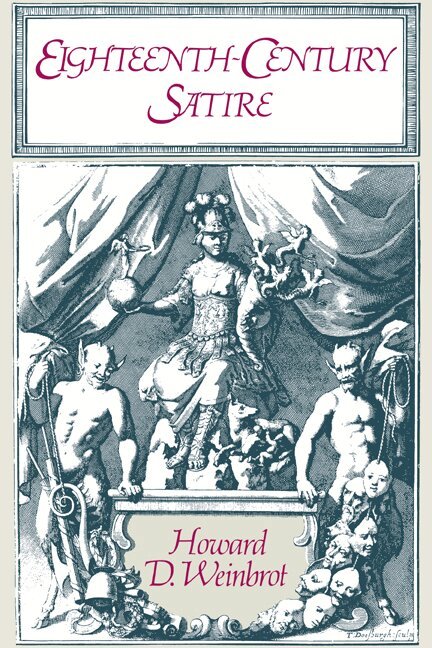
    Eighteenth-Century Satire

    Essays on Text and Context from Dryden to Peter Pindar

    AvHoward D. Weinbrot

    Häftad, Engelska, 2007

    656 kr

    Beställningsvara. Skickas inom 10-15 vardagar. Fri frakt över 249 kr.

    Beskrivning

    Howard D. Weinbrot here collects thirteen of his most important essays on Restoration and eighteenth-century British satire. Divided into sections on 'contexts' and 'texts', the essays range widely and deeply across the spectrum of satiric kinds, satirists, satires, and scholarly and critical problems. In 'Contexts', Professor Weinbrot discusses the pattern of formal verse satire of blame and praise popularized by Dryden in 1693 and influential throughout the next century, challenges the traditional view that Hprace and 'Augustanism' define eighteenth-century satire, and focuses on the vexed question of whether there was indeed a 'persona' or theory of masking at work in eighteenth-century satire. In 'Texts' he deals with several of the most important verse satirists and satires of the period and closely analyses them within their historical and artistic frameworks. Clearly written, learned, and often witty, this book is committed to critical inquiry that respects the integrity of its texts. It also emphasized the breadth of context that enriches our understanding of satire and the relationships among the nurturing culture, the producing poet, the poem producers, and the poem as received in its age.

    Produktinformation

    • Utgivningsdatum:2007-02-15
    • Mått:151 x 229 x 17 mm
    • Vikt:425 g
    • Format:Häftad
    • Språk:Engelska
    • Antal sidor:276
    • Förlag:Cambridge University Press
    • ISBN:9780521034098

    Utforska kategorier

    • Litteraturvetenskap inom Skönlitteratur

    Innehållsförteckning

    • Preface; Acknowledgments; List of abbreviations; Introduction: the achievement of Dryden's 'Discourse on Satyr'; Part I. Contexts: 1. The pattern of formal verse satire in the Restoration and the eighteenth century; 2. History, Horace and Augustus Caesar: some implications for eighteenth-century satire; 3. Masked men and satire and Pope: towards an historical basis for the eighteenth-century persona; Part II. Texts: 4. The swelling volume: the apocalyptic satire of Rochester's Letter from Artemisia in the Town to Chloe in the Country; 5. The 'Allusion to Horace': Rochester's imitative mode; 6. 'Natures holy bands' in Absalom and Achitophel: fathers and sons, satire and change; 7. The Rape of the Lock and the contexts of warfare; 8. 'Such as Sir Robert would approve'? Answers to Pope's answer from Horace; 9. The conventions of classical satire and the practice of Pope; 10. Persius, the opposition to Walpole, and Pope; 11. Johnson's London and Juvenal's third satire: the country as 'ironic' norm; 12. No 'mock debate': questions and answers in The Vanity of Human Wishes; 13. Pope, his successors, and the dissociation of satiric sensibility: an hypothesis; Notes; Index.