• Fri frakt över 249 kr
  • •
  • Snabba leveranser
  • •
  • Billiga böcker
Kundservice

Du är på sajten för privatpersoner.

Företag, bibliotek eller offentlig verksamhet?

Du handlar på classic.bokus.com, där alla dina funktioner finns intakta.
Till classic.bokus.com
Bokus logotyp. Gå till startsidan.
  • Erbjudanden
  • Nyheter
  • Student
  • Topplistor
  • Barn & ungdom
  • Bokus Play
  • E-böcker
  • Pocketböcker
  • Spel & pussel

10% rabatt på allt med kod: NYSTART10 →

Sidfot

Mina sidor

    Hjälp

    • Kundservice
    • Vanliga frågor och svar
    • Frakt och leverans
    • Retur vid ångerrätt
    • Reklamera vara
    • Betalning
    • Köpvillkor
    • Allmänna villkor
    • Information om webbplatsens tillgänglighet

    Om Bokus

    • Om oss
    • Pressrum
    • För studenter
    • För företag
    • För bibliotek och offentlig verksamhet
    • För leverantörer
    • Hållbarhet

    Populärt

    • Aktuella erbjudanden
    • Presentkort
    • Studentlitteratur
    • Nya böcker
    • Topplistor
    • Signerade böcker
    • Engelska böcker

    Inspiration

    • Boktips
    • BookTok
    • Populära bokserier
    • Barnbokskaraktärer
    • Populära författare
    Logotyp för Bokus
    Följ oss på Facebook (extern länk)Följ oss på Instagram (extern länk)Följ oss på YouTube (extern länk)Följ oss på TikTok (extern länk)
    bokus @ CookiesAnpassa cookiesIntegritetspolicyKöpvillkor
    Till Citymail hemsida (extern länk)Till Budbee hemsida (extern länk)Till Postnord hemsida (extern länk)Till Schenker hemsida (extern länk)Till Early Bird hemsida (extern länk)Till Walleys hemsida (extern länk)
    1. Naturvetenskap och teknik
    2. Geovetenskap
    3. Geovetenskap

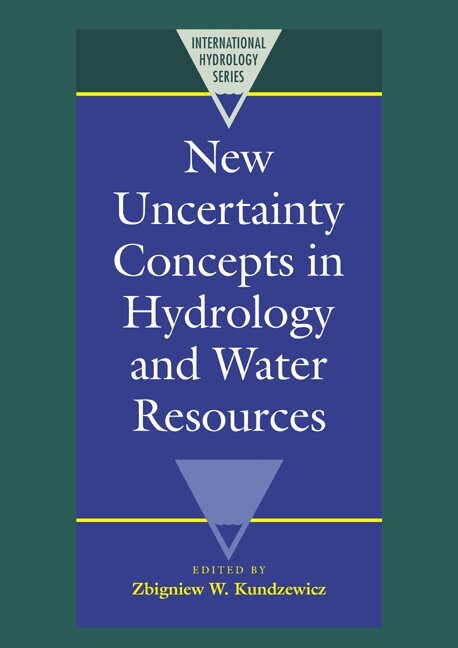
    New Uncertainty Concepts in Hydrology and Water Resources

    AvZbigniew W. Kundzewicz

    Häftad, Engelska, 2007

    Del i serien International Hydrology Series

    1 000 kr

    Beställningsvara. Skickas inom 10-15 vardagar. Fri frakt över 249 kr.

    Beskrivning

    One of the greatest problems hydrology research faces is how to quantify uncertainty, which is inherent in every hydrological process. This overview of uncertainty emphasizes non-orthodox concepts, such as random fields, fractals and fuzziness. This book reviews alternative and conventional methods of risk and uncertainty representation in hydrology and water resources. The water-related applications discussed in the book pertain to areas of strong interest, such as multifractals and climate change impacts. The authors represent a variety of research backgrounds, achieving a broad subject coverage. The material covered provides an important insight into theories of uncertainty related to the field of hydrology. The book is international in its scope, and will be welcomed by researchers and graduate students of hydrology and water resources.

    Produktinformation

    • Utgivningsdatum:2007-03-05
    • Mått:210 x 295 x 19 mm
    • Vikt:822 g
    • Format:Häftad
    • Språk:Engelska
    • Serie:International Hydrology Series
    • Antal sidor:340
    • Förlag:Cambridge University Press
    • ISBN:9780521036733

    Utforska kategorier

    • Geovetenskap inom Naturvetenskap och teknik

    Recensioner i media

    "Atmospheric science students who are not chemists or who do not have an extensive background in chemistry have long needed a primer on the physical chemical aspects of atmospheric (and other environmental) chemical processes. The book under review here mainly succeeds in fulfilling that need." James P. Friend, Bulletin of the American Meteorological Society

    Innehållsförteckning

    • List of authors; Preface; Part I. Introduction: 1. Hydrological uncertainty in perspective; Part II. Facets of Uncertainty: 2. Bayesian relative information measure - a tool for analysing the outputs of general circulation models; 3. A stochastic weather generator using atmospheric circulation patterns and its use to evaluate climate change effects; 4. Hydrological uncertainty - floods of Lake Eyre; 5. Some aspects of hydrological design under non-stationarity; 6. New plotting position rule for flood records considering historical data and palaeologic information; Part III. Novel Approaches to Uncertainty: Fractals, Fuzzy Sets and Pattern Recognition, Non-Parametric Methods: 7. Dispersion in stratified soils with fractal permeability distribution; 8. Multifractals and rain; 9. Is rain fractal?; 10. Multifractal structure of rainfall occurrence in West Africa; 11. Analysis of high-resolution rainfall data; 12. Application of fuzzy theory to snowmelt runoff; 13. On the value of fuzzy concepts in hydrology and water resources management; 14. Application of neural network in groundwater remediation under conditions of uncertainty; 15. Application of pattern recognition to rainfall-runoff analysis; 16. Nonparametric estimation of multivariate density and nonparametric regression; 17. Nonparametric approach to design flood estimation with pre-gauging data and information; Part IV. Random Fields: 18. Analysis of regional drought characteristics with empirical orthogonal functions; 19. Worth of radar data in real-time prediction of mean areal rainfall by nonadvective physically-based models; 20. Uncertainty analysis in radar-rainfall estimation; 21. Design of groundwater monitoring networks for landfills; 22. Spatial variability of evaporation from the land surface - random initial conditions; 23. Detecting outliers in flood data with geostatistical methods; Part V. Time Series and Stochastic Processes: 24. Prediction uncertainty in seasonal partial duration series; 25. A daily streamflow model based on a jump-diffusion process; 26. The influence of time discretization on inferred stochastic properties of point rainfall; 27. The distribution of the 1-day total precipitation amount; 28. Analysis of outliers in Norwegian flood data; 29. Stochastic modelling of the operation of hydrants in an irrigation network; 30. Order and disorder in hydroclimatological processes; 31. Towards the physical structure of river flow stochastic process; Part VI. Risk, Reliability and Related Criteria: 32. Stochastic approach to non-point pollution of surface waters; 33. Statistically safe sets methodology for optimal management of reservoirs in risk situations; 34. Risk assessment in control of reservoir systems; 35. Reliability-related criteria in water supply system studies; 36. Reliability analysis of reservoir operation; 37. Composite risk model of Ogee type spillway.