• Fri frakt över 249 kr
  • •
  • Snabba leveranser
  • •
  • Billiga böcker
Kundservice

Du är på sajten för privatpersoner.

Företag, bibliotek eller offentlig verksamhet?

Du handlar på classic.bokus.com, där alla dina funktioner finns intakta.
Till classic.bokus.com
Bokus logotyp. Gå till startsidan.
  • Erbjudanden
  • Nyheter
  • Student
  • Topplistor
  • Barn & ungdom
  • Bokus Play
  • E-böcker
  • Pocketböcker
  • Spel & pussel

10% rabatt på allt med kod: NYSTART10 →

Sidfot

Mina sidor

    Hjälp

    • Kundservice
    • Vanliga frågor och svar
    • Frakt och leverans
    • Retur vid ångerrätt
    • Reklamera vara
    • Betalning
    • Köpvillkor
    • Allmänna villkor
    • Information om webbplatsens tillgänglighet

    Om Bokus

    • Om oss
    • Pressrum
    • För studenter
    • För företag
    • För bibliotek och offentlig verksamhet
    • För leverantörer
    • Hållbarhet

    Populärt

    • Aktuella erbjudanden
    • Presentkort
    • Studentlitteratur
    • Nya böcker
    • Topplistor
    • Signerade böcker
    • Engelska böcker

    Inspiration

    • Boktips
    • BookTok
    • Populära bokserier
    • Barnbokskaraktärer
    • Populära författare
    Logotyp för Bokus
    Följ oss på Facebook (extern länk)Följ oss på Instagram (extern länk)Följ oss på YouTube (extern länk)Följ oss på TikTok (extern länk)
    bokus @ CookiesAnpassa cookiesIntegritetspolicyKöpvillkor
    Till Citymail hemsida (extern länk)Till Budbee hemsida (extern länk)Till Postnord hemsida (extern länk)Till Schenker hemsida (extern länk)Till Early Bird hemsida (extern länk)Till Walleys hemsida (extern länk)
    1. Ekonomi och Ledarskap
    2. Nationalekonomi
    3. Internationell ekonomi

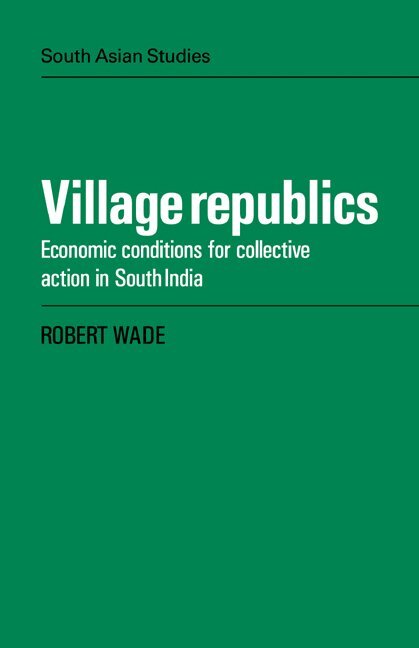
    Village Republics

    Economic Conditions for Collective Action in South India

    AvRobert Wade

    Häftad, Engelska, 2007

    Del 40 i serien Cambridge South Asian Studies

    477 kr

    Beställningsvara. Skickas inom 10-15 vardagar. Fri frakt över 249 kr.

    Beskrivning

    Why do some people get together to manage their common assets? Why do other groups of people leave those assets to be over-exploited by each member of the group? The answers could be crucial to the proper maintenance and use of 'common property resources', from grazing land through fish stocks to irrigation water. Robert Wade, drawing on research in areas of Andhra Pradesh where rain is scarce and unreliable, argues that some villagers develop and finance joint institutions for cooperative management of common property resources in grazing and irrigation - but others do not. The main reason lies in the risk of crop loss.Villages located towards the tail-end of irrigation systems, and with soils fertile enough to support a high density of livestock, show a larger amount of corporate organization than villages elsewhere. Placing his work in the wider context of both the developing world today and the open-field system of medieval Europe, the author argues that peasants can under certain conditions organize collectively. Privatization or state regulation are not the only ways of preventing degradation of common property resources in peasant societies.

    Produktinformation

    • Utgivningsdatum:2007-12-03
    • Mått:140 x 216 x 15 mm
    • Vikt:343 g
    • Format:Häftad
    • Språk:Engelska
    • Serie:Cambridge South Asian Studies
    • Antal sidor:256
    • Förlag:Cambridge University Press
    • ISBN:9780521051781

    Utforska kategorier

    • Internationell ekonomi inom Ekonomi och Ledarskap

    Innehållsförteckning

    • List of illustrations; List of tables; Preface; 1. The village as a corporate group; 2. The circumstances of village organization; 3. Kottapalle; 4. The social response to open-field husbandry; 5. The social response to irrigation; 6. The range of council activities; 7. The mode of public choice; 8. Variation between villages (1): social structure; 9. Variation between villages (2): ecology and risk; 10. Conclusions (1): the conditions for collective action; 11. Conclusions (2): theories of collective action; Appendix: water supply and irrigation network; Bibliography; Index.