• Fri frakt över 249 kr
  • •
  • Snabba leveranser
  • •
  • Billiga böcker
Kundservice

Du är på sajten för privatpersoner.

Företag, bibliotek eller offentlig verksamhet?

Du handlar på classic.bokus.com, där alla dina funktioner finns intakta.
Till classic.bokus.com
Bokus logotyp. Gå till startsidan.
  • Erbjudanden
  • Nyheter
  • Student
  • Topplistor
  • Barn & ungdom
  • Bokus Play
  • E-böcker
  • Pocketböcker
  • Spel & pussel

10% studentrabatt med kod TERM26

Sidfot

Mina sidor

    Hjälp

    • Kundservice
    • Vanliga frågor och svar
    • Frakt och leverans
    • Retur vid ångerrätt
    • Reklamera vara
    • Betalning
    • Köpvillkor
    • Allmänna villkor
    • Information om webbplatsens tillgänglighet

    Om Bokus

    • Om oss
    • Pressrum
    • För studenter
    • För företag
    • För bibliotek och offentlig verksamhet
    • För leverantörer
    • Hållbarhet

    Populärt

    • Aktuella erbjudanden
    • Presentkort
    • Studentlitteratur
    • Nya böcker
    • Topplistor
    • Signerade böcker
    • Engelska böcker

    Inspiration

    • Boktips
    • BookTok
    • Populära bokserier
    • Barnbokskaraktärer
    • Populära författare
    Logotyp för Bokus
    Följ oss på Facebook (extern länk)Följ oss på Instagram (extern länk)Följ oss på YouTube (extern länk)Följ oss på TikTok (extern länk)
    bokus @ CookiesAnpassa cookiesIntegritetspolicyKöpvillkor
    Till Citymail hemsida (extern länk)Till Budbee hemsida (extern länk)Till Postnord hemsida (extern länk)Till Schenker hemsida (extern länk)Till Early Bird hemsida (extern länk)Till Walleys hemsida (extern länk)
    1. Skönlitteratur
    2. Litteraturvetenskap
    3. Litteraturvetenskap

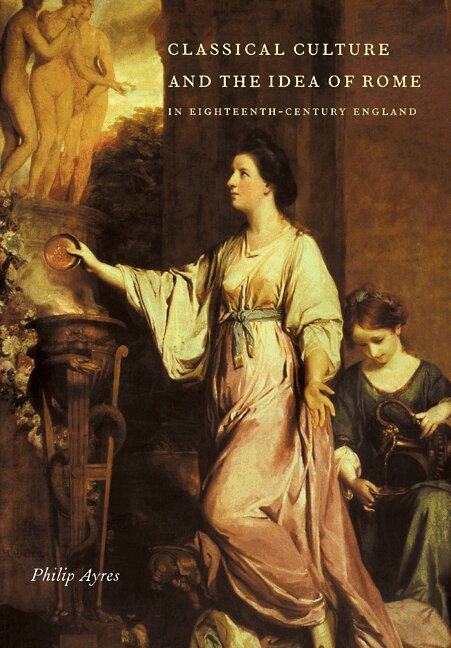
    Classical Culture and the Idea of Rome in Eighteenth-Century England

    AvPhilip Ayres

    Häftad, Engelska, 2009

    671 kr

    Beställningsvara. Skickas inom 10-15 vardagar. Fri frakt över 249 kr.

    Beskrivning

    This book looks at the aristocratic adoption of Roman ideals in eighteenth-century English culture and thought. Philip Ayres shows how, in the century following the Revolution of 1688, the ruling class promoted - by way of its patronage - a classical frame of mind embracing all the arts, on the foundations of 'liberty' and 'civic virtue'. The historical fact of a Roman Britain lent an added authenticity to a new 'Roman' present constructed by Lord Burlington and his circle. Ayres's study shows that the propensity to adopt the self-image of virtuous Romans was the attempt of a newly empowered oligarchy to dignify and vindicate itself by association with an idealized image of Republican Rome. This sense of affinity with the ideals of the free Roman Republic gave British classicism an authenticity impossible under the various versions of absolutism on the continent. Its discourse precluded any more thoroughgoing revolution by suggesting that Britain's liberty had been won by an 'oligarchy of virtue', which now defended, defined and emblematized the nation.

    Produktinformation

    • Utgivningsdatum:2009-03-19
    • Mått:152 x 229 x 16 mm
    • Vikt:490 g
    • Format:Häftad
    • Språk:Engelska
    • Antal sidor:296
    • Förlag:Cambridge University Press
    • ISBN:9780521105798

    Utforska kategorier

    • Litteraturvetenskap inom Skönlitteratur

    Recensioner i media

    Review of the hardback: 'Classical Culture and the Idea of Rome in Eighteenth-Century England is an elegant book of just the right size that pays proportionate attention to the various aspects with the right amount of references and quotations. The aesthetic pleasure of a well produced book adds to the intellectual joy.' Mnemosyne

    Innehållsförteckning

    • Preface; List of abbreviations; List of plates; 1. Oligarchy of virtue - liberty and the Roman analogy; Civic virtue and the Roman analogy; Literary personae: Pope, Swift, Johnson, Thomson, Fielding, Burke; 2. Virtue made visible - sensibility, sculpture, political gardens and temples; 3. Britannia Romana - Romano-British archaeology: pioneers; The Roman Knights and the recruitment of the aristocracy; Architect as archaeologist: Burlington; 4. Britannia Romana revived - architecture, collections, the numinous in landscape and house; 5. Beyond the mainstream: classical nostalgia and freethinking; Conclusion; Appendix: books on archaeology owned by Burlington: an annotated shelf-list; Bibliography; Notes; Index.