• Fri frakt över 249 kr
  • •
  • Snabba leveranser
  • •
  • Billiga böcker
Kundservice

Du är på sajten för privatpersoner.

Företag, bibliotek eller offentlig verksamhet?

Du handlar på classic.bokus.com, där alla dina funktioner finns intakta.
Till classic.bokus.com
Bokus logotyp. Gå till startsidan.
  • Erbjudanden
  • Nyheter
  • Student
  • Topplistor
  • Barn & ungdom
  • Bokus Play
  • E-böcker
  • Pocketböcker
  • Spel & pussel

10% rabatt på allt med kod: NYSTART10 →

Sidfot

Mina sidor

    Hjälp

    • Kundservice
    • Vanliga frågor och svar
    • Frakt och leverans
    • Retur vid ångerrätt
    • Reklamera vara
    • Betalning
    • Köpvillkor
    • Allmänna villkor
    • Information om webbplatsens tillgänglighet

    Om Bokus

    • Om oss
    • Pressrum
    • För studenter
    • För företag
    • För bibliotek och offentlig verksamhet
    • För leverantörer
    • Hållbarhet

    Populärt

    • Aktuella erbjudanden
    • Presentkort
    • Studentlitteratur
    • Nya böcker
    • Topplistor
    • Signerade böcker
    • Engelska böcker

    Inspiration

    • Boktips
    • BookTok
    • Populära bokserier
    • Barnbokskaraktärer
    • Populära författare
    Logotyp för Bokus
    Följ oss på Facebook (extern länk)Följ oss på Instagram (extern länk)Följ oss på YouTube (extern länk)Följ oss på TikTok (extern länk)
    bokus @ CookiesAnpassa cookiesIntegritetspolicyKöpvillkor
    Till Citymail hemsida (extern länk)Till Budbee hemsida (extern länk)Till Postnord hemsida (extern länk)Till Schenker hemsida (extern länk)Till Early Bird hemsida (extern länk)Till Walleys hemsida (extern länk)
    1. Ekonomi och Ledarskap
    2. Nationalekonomi

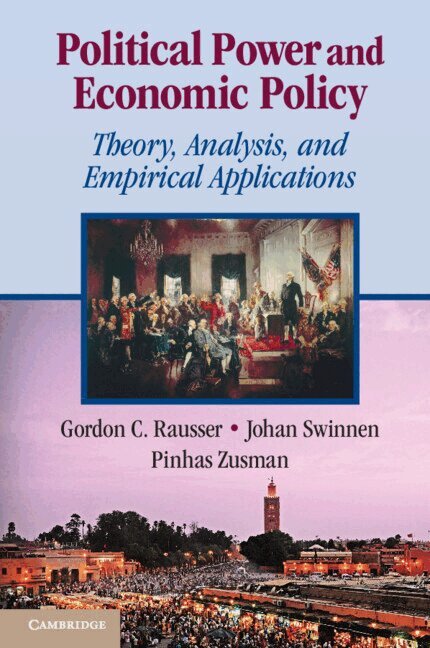
    Political Power and Economic Policy

    Theory, Analysis, and Empirical Applications

    AvGordon C. Rausser,Johan Swinnen

    Häftad, Engelska, 2011

    535 kr

    Beställningsvara. Skickas inom 10-15 vardagar. Fri frakt över 249 kr.

    Fler format och utgåvor

    Inbunden

    1 900 kr

    Beskrivning

    This book analyzes the links between political economics, governance structures and the distribution of political power in economic policy making. The book theoretically explains and empirically quantifies these interactions. The analysis includes both public good policies and redistributive policies. Part I of the book presents the conceptual foundations of political-economic bargaining and interest group analysis. After presenting the underlying theory, Part II of the book examines ideology, prescription and political power coefficients; Part III analyzes a number of specific structures; and Part IV presents a framework for political econometrics with a number of empirical applications and testable hypotheses. In all four parts of the book, four analytical dimensions of public policy are distinguished: governance structures, political economy, mechanism design and incidence.

    Produktinformation

    • Utgivningsdatum:2011-09-30
    • Mått:153 x 229 x 29 mm
    • Vikt:710 g
    • Format:Häftad
    • Språk:Engelska
    • Antal sidor:536
    • Förlag:Cambridge University Press
    • ISBN:9780521148009

    Utforska kategorier

    • Nationalekonomi inom Ekonomi och Ledarskap

    Mer om författaren

    Gordon C. Rausser is the Robert Gordon Sproul Distinguished Professor, University of California, Berkeley. He has taught economics and statistics at several eminent universities, served as Dean of the College of Natural Resources at the University of California, Berkeley, and twice served as Chair of the Giannini Foundation. Professor Rausser is the author or editor of 18 books, including co-editor of the four-volume Handbook of Agricultural Economics with Bruce L. Gardner; he has won 16 national awards and honors for teaching and research. He has been an associate editor of the Journal of the American Statistical Association and the Journal of Economic Dynamics and Control and an editor of the American Journal of Agricultural Economics, and he was recently named editor of the Annual Review of Resource Economics. He has also served as Senior Economist on the President's Council of Economic Advisors and Chief Economist at the Agency for International Development in Washington, DC. He co-founded LECG, Inc., and the Washington, DC-based Institute for Policy Reform. He has been elected a Fellow of the Agricultural and Applied Economics Association, the American Statistical Association and the American Association for the Advancement of Science. Johan Swinnen is Professor of Economics and Director of the LICOS Institute for Institutions and Economic Performance at the Catholic University of Leuven, Belgium, as well as a Visiting Professor at Stanford University (2010–2013). He is also a Senior Research Fellow at the Centre for European Policy Studies in Brussels. Professor Swinnen earlier served as a Lead Economist at the World Bank and as an Economic Advisor in the Office of the Director General, Economic and Financial Affairs, of the European Commission. He has been a guest editor of several journals (including World Development and The World Economy) and an associate editor of the American Journal of Agricultural Economics, the European Review of Agricultural Economics and the Review of Business and Economics. Professor Swinnen has also been an economic advisor to the United Nations Development Programme, the European Bank of Reconstruction and Development, the Organization for Economic Cooperation and Development, the United States Department of Agriculture, and the International Fund for Agricultural Development. Among his recent books are From Marx and Mao to the Market: The Economics and Politics of Agricultural Transition and Global Supply Chains, Standards, and the Poor. The late Pinhas Zusman was Professor Emeritus in the Department of Agricultural Economics at the Hebrew University, Jerusalem, where he taught for nearly 40 years. He began his professional career as Chief of Agricultural Planning for the Lachish Development Project in Israel from 1955 to 1957. After obtaining a Ph.D. from the University of California, Berkeley in 1961, and returning to Israel, Professor Zusman began a long career advising the Israeli government, including the Ministry of Agriculture and the Ministry of Defense, as well as the World Bank, on economic matters. Professor Zusman was president of the Israeli Economic Association from 1986 to 1988 and served on the Board of Governors of Ben-Gurion University of the Negev from 1991 until his death. He also served as an associate editor of The Journal of Economic Behavior and Organization.

    Recensioner i media

    'Gordon Rausser et al.'s Political Power and Economic Policy tells us what everybody wants to know in this new world where lobbying and political maneuvers have replaced economic sense. What is the relation between economic rationality and political maneuvering? And how do we contain the interest groups that have trumped the public well-being to accomplish their selfish ends?' George A. Akerlof, Nobel Laureate in Economics, 2001

    Innehållsförteckning

    • Part I. Political Power and Economic Analysis: 1. Public policy: the lens of political economy; 2. The Nash solution to the bargaining problem; 3. The Harsanyi solution to the bargaining problem; 4. Political-economic analysis; 5. Normative political-economic analysis; 6. Dynamic political-economic analysis; Part II. Ideology, Prescription, and Political Power Coefficients: 7. Political power, ideology, and political organizational structures; 8. Political power, influence, and lobbying; 9. Constitutional prescription and political power coefficients; Part III. Analysis of Specific Structures: 10. The political economy of commodity market intervention; 11. The political economy of public research and development; 12. Political-economic analysis of redistributive policy and public good investments; 13. Interest groups, coalition breaking, and productive policies; 14. Policy reform and compensation; 15. Political-economic analysis of land reform; 16. Political-economic analysis of water resource systems; 17. The political-economic lens on quality and public standard regulations; 18. Political-economic analysis in transition economies; 19. The power of bureaucracies: the European commission and EU policy reforms; Part IV. Empirical Applications of Political Power Estimation: 20. Political econometrics; 21. The political econometrics of the Israeli dairy industry; 22. Flexible policy instruments given a political power distribution; 23. Estimating statistical properties of power weight parameters and their temporal shifts; 24. Role of institutions in the joint determination of PERTs and PESTs.