• Fri frakt över 249 kr
  • •
  • Snabba leveranser
  • •
  • Billiga böcker
Kundservice

Du är på sajten för privatpersoner.

Företag, bibliotek eller offentlig verksamhet?

Du handlar på classic.bokus.com, där alla dina funktioner finns intakta.
Till classic.bokus.com
Bokus logotyp. Gå till startsidan.
  • Erbjudanden
  • Student
  • Topplistor
  • Barn & ungdom
  • Bokus Play
  • E-böcker
  • Ljudböcker
  • Pocketböcker
  • Spel och pussel

5% studentrabatt – använd koden KURSBOK27 →

Sidfot

Mina sidor

    Hjälp

    • Kundservice
    • Vanliga frågor och svar
    • Frakt och leverans
    • Retur vid ångerrätt
    • Reklamera vara
    • Betalning
    • Köpvillkor
    • Allmänna villkor
    • Information om webbplatsens tillgänglighet

    Om Bokus

    • Om oss
    • Pressrum
    • För studenter
    • För företag
    • För bibliotek och offentlig verksamhet
    • För leverantörer
    • Hållbarhet

    Populärt

    • Aktuella erbjudanden
    • Presentkort
    • Studentlitteratur
    • Nya böcker
    • Topplistor
    • Signerade böcker
    • Engelska böcker

    Inspiration

    • Boktips
    • BookTok
    • Barnbokskaraktärer
    • Populära författare
    Logotyp för Bokus
    Följ oss på Facebook (extern länk)Följ oss på Instagram (extern länk)Följ oss på YouTube (extern länk)Följ oss på TikTok (extern länk)
    bokus @ CookiesAnpassa cookiesIntegritetspolicyKöpvillkor
    Till Citymail hemsida (extern länk)Till Budbee hemsida (extern länk)Till Postnord hemsida (extern länk)Till Schenker hemsida (extern länk)Till Early Bird hemsida (extern länk)Till Walleys hemsida (extern länk)
    1. Språk och ordböcker
    2. Språkvetenskap och lingvistik

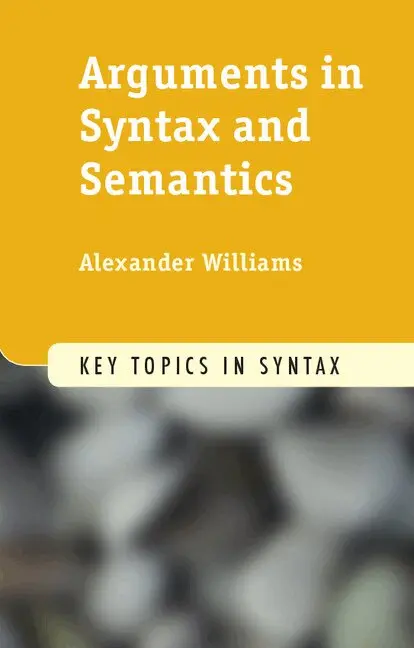
    Arguments in Syntax and Semantics

    AvAlexander Williams

    Häftad, Engelska, 2015

    Del i serien Key Topics in Syntax

    483 kr

    Beställningsvara. Skickas inom 7-10 vardagar. Fri frakt över 249 kr.

    Fler format och utgåvor

    Inbunden

    1 064 kr

    E-bok

    585 kr

    E-bok

    585 kr

    Beskrivning

    Argument structure - the pattern of underlying relations between a predicate and its dependents - is at the base of syntactic theory and the theory of the interface with semantics. This comprehensive guide explores the motives for thematic and event-structural decomposition, and its relation to structure in syntax. It also discusses broad patterns in the linking of syntactic to semantic relations, and includes insightful case studies on passive and resultative constructions. Semantically explicit and syntactically impartial, with a careful, interrogative approach, Williams clarifies notions of argument within both lexicalist and nonlexicalist approaches. Ideal for students and researchers in syntactic and semantic theory, this introduction includes: • A comprehensive overview of arguments in syntax and semantics • Discussion questions and suggestions for further reading • A glossary with helpful definitions of key terms.

    Produktinformation

    • Utgivningsdatum:2015-01-29
    • Mått:140 x 216 x 21 mm
    • Vikt:460 g
    • Format:Häftad
    • Språk:Engelska
    • Serie:Key Topics in Syntax
    • Antal sidor:396
    • Förlag:Cambridge University Press
    • ISBN:9780521151726

    Utforska kategorier

    • Språkvetenskap och lingvistik inom Språk och ordböcker

    Mer om författaren

    Alexander Williams is Assistant Professor in the Departments of Linguistics and Philosophy at the University of Maryland, College Park, where he teaches semantics, syntax, and philosophy of language.

    Recensioner i media

    'This is a superb book, so much clearer than anything I have seen in many years. It will definitely make a mark in the discussion. The author has a remarkable command of both syntax and semantics and is able to provide simple and exact explanations. Anyone familiar with the literature on plurals in particular can only marvel at the simplicity and clarity with which the problems are discussed here.' Marcus Kracht, Universität Bielefeld

    Innehållsförteckning

    • Abbreviations; Introduction; Part I. Background: 1. Syntax; 2. Semantics; Part II. Kinds of Arguments: 3. Arguments in syntax; 4. Arguments in semantics; 5. Implicit arguments; Part III. Analysis of Argument Relations: 6. Thematic relations; 7. Agent and patient; 8. Role iteration; 9. Separation; 10. Event structure; 11. Linking and framing; Part IV. Case Studies: 12. Passives; 13. Resultatives; Glossary; References; Index.