• Fri frakt över 249 kr
  • •
  • Snabba leveranser
  • •
  • Billiga böcker
Kundservice

Du är på sajten för privatpersoner.

Företag, bibliotek eller offentlig verksamhet?

Du handlar på classic.bokus.com, där alla dina funktioner finns intakta.
Till classic.bokus.com
Bokus logotyp. Gå till startsidan.
  • Erbjudanden
  • Student
  • Topplistor
  • Barn & ungdom
  • Bokus Play
  • E-böcker
  • Ljudböcker
  • Pocketböcker
  • Spel & pussel

10% rabatt på allt med kod NYSTART10 →

Sidfot

Mina sidor

    Hjälp

    • Kundservice
    • Vanliga frågor och svar
    • Frakt och leverans
    • Retur vid ångerrätt
    • Reklamera vara
    • Betalning
    • Köpvillkor
    • Allmänna villkor
    • Information om webbplatsens tillgänglighet

    Om Bokus

    • Om oss
    • Pressrum
    • För studenter
    • För företag
    • För bibliotek och offentlig verksamhet
    • För leverantörer
    • Hållbarhet

    Populärt

    • Aktuella erbjudanden
    • Presentkort
    • Studentlitteratur
    • Nya böcker
    • Topplistor
    • Signerade böcker
    • Engelska böcker

    Inspiration

    • Boktips
    • BookTok
    • Populära bokserier
    • Barnbokskaraktärer
    • Populära författare
    Logotyp för Bokus
    Följ oss på Facebook (extern länk)Följ oss på Instagram (extern länk)Följ oss på YouTube (extern länk)Följ oss på TikTok (extern länk)
    bokus @ CookiesAnpassa cookiesIntegritetspolicyKöpvillkor
    Till Citymail hemsida (extern länk)Till Budbee hemsida (extern länk)Till Postnord hemsida (extern länk)Till Schenker hemsida (extern länk)Till Early Bird hemsida (extern länk)Till Walleys hemsida (extern länk)
    1. Samhälle och politik
    2. Politik och statsskick
    3. Internationella relationer

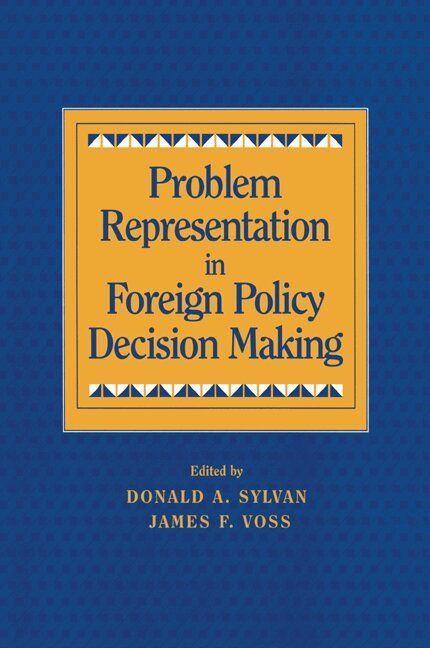
    Problem Representation in Foreign Policy Decision-Making

    AvDonald A. Sylvan,James F. Voss

    Häftad, Engelska, 2011

    443 kr

    Beställningsvara. Skickas inom 10-15 vardagar. Fri frakt över 249 kr.

    Beskrivning

    Previous studies of foreign policy decision making have largely focused on the choice among specified options rather than the prior question of how the options were specified in the first place. Such 'problem representation' is the focus of this volume. How do the game theorists' options and utilities come about? Concretely, for example, how and why in the Cuban missile crisis were blockade, air strike, and invasion chosen as options? To answer such questions, the editors contend the representation of the problem to which the options are a response, the determinants of that representation, and its ramifications must all be analyzed. The contributors to the volume consider these issues both conceptually and empirically, employing the methods of both international relations and political psychology.

    Produktinformation

    • Utgivningsdatum:2011-02-03
    • Mått:152 x 229 x 20 mm
    • Vikt:530 g
    • Format:Häftad
    • Språk:Engelska
    • Antal sidor:358
    • Förlag:Cambridge University Press
    • ISBN:9780521169578

    Utforska kategorier

    • Internationella relationer inom Samhälle och politik

    Recensioner i media

    "This volume is an excellent addition to the more advanced study of foreign policy analysis. Recommended for upper-division undergraduates and above." Choice

    Innehållsförteckning

    • Part I. Introducing Problem Presentation: 1. Introduction Donald A. Sylvan; 2. On the representation of problems: an informative processing approach to foreign policy decision making James F. Voss; Part II. Overarching Conceptual Issues: 3. The interpretation of foreign policy events: a cognitive process theory Charles S. Taber; 4. Problem identification in sequential policy decision making: the re-representation of problems Robert Billings and Charles F. Hermann; 5. Collective interpretations: how problem representations aggregate in foreign policy groups Ryan Beasley; 6. Image change and problem representation after the Cold War Martha Cottam and Dorcas E. McCoy: Part III. Empirical Analysis: 7. Problem representations and political expertise: evidence from 'think aloud' protocols of South African elite Helen Purkitt; 8. Reasoning and problem representation in foreign policy: groups, individuals, and stories Donald A. Sylvan and Deborah M. Haddad; 9. Representing problem representation Michael Young; 10. A problem solving perspective on decision-making processes and political strategies in committees Katherine Gannon; 11. When gender goes to combat: the impact of representations in collective decision-making Silvana Rubino-Hallman; 12. Representation of the Gulf Crisis as derived from the US Senate debate James F. Voss, Jennifer Wiley, Joel Kennet, Tonya Schooler and Laurie Ney Silfies; 13. Configuring issue areas: Belgian and Dutch representations of the role in foreign assistance in foreign policy Marijke Breuning; Part IV. Conclusion: 14. Reflecting on the study of problem representation: how are we studying it and what are we learning? Donald A. Sylvan.