• Fri frakt över 249 kr
  • •
  • Snabba leveranser
  • •
  • Billiga böcker
Kundservice

Du är på sajten för privatpersoner.

Företag, bibliotek eller offentlig verksamhet?

Du handlar på classic.bokus.com, där alla dina funktioner finns intakta.
Till classic.bokus.com
Bokus logotyp. Gå till startsidan.
  • Erbjudanden
  • Nyheter
  • Student
  • Topplistor
  • Barn & ungdom
  • Bokus Play
  • E-böcker
  • Pocketböcker
  • Spel & pussel

10% rabatt på allt med kod NYSTART10 →

Sidfot

Mina sidor

    Hjälp

    • Kundservice
    • Vanliga frågor och svar
    • Frakt och leverans
    • Retur vid ångerrätt
    • Reklamera vara
    • Betalning
    • Köpvillkor
    • Allmänna villkor
    • Information om webbplatsens tillgänglighet

    Om Bokus

    • Om oss
    • Pressrum
    • För studenter
    • För företag
    • För bibliotek och offentlig verksamhet
    • För leverantörer
    • Hållbarhet

    Populärt

    • Aktuella erbjudanden
    • Presentkort
    • Studentlitteratur
    • Nya böcker
    • Topplistor
    • Signerade böcker
    • Engelska böcker

    Inspiration

    • Boktips
    • BookTok
    • Populära bokserier
    • Barnbokskaraktärer
    • Populära författare
    Logotyp för Bokus
    Följ oss på Facebook (extern länk)Följ oss på Instagram (extern länk)Följ oss på YouTube (extern länk)Följ oss på TikTok (extern länk)
    bokus @ CookiesAnpassa cookiesIntegritetspolicyKöpvillkor
    Till Citymail hemsida (extern länk)Till Budbee hemsida (extern länk)Till Postnord hemsida (extern länk)Till Schenker hemsida (extern länk)Till Early Bird hemsida (extern länk)Till Walleys hemsida (extern länk)
    1. Naturvetenskap och teknik
    2. Matematik och naturvetenskap
    3. Fysik

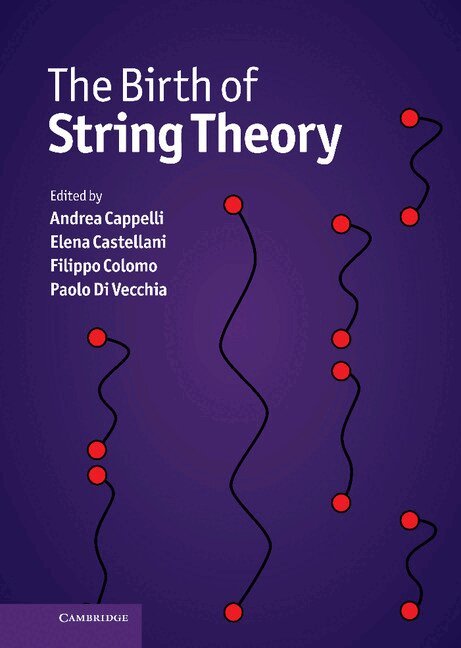
    The Birth of String Theory

    AvAndrea Cappelli,Elena Castellani

    Inbunden, Engelska, 2012

    1 308 kr

    Beställningsvara. Skickas inom 10-15 vardagar. Fri frakt över 249 kr.

    Beskrivning

    String theory is currently the best candidate for a unified theory of all forces and all forms of matter in nature. As such, it has become a focal point for physical and philosophical discussions. This unique book explores the history of the theory's early stages of development, as told by its main protagonists. The book journeys from the first version of the theory (the so-called dual resonance model) in the late sixties, as an attempt to describe the physics of strong interactions outside the framework of quantum field theory, to its reinterpretation around the mid-seventies as a quantum theory of gravity unified with the other forces, and its successive developments up to the superstring revolution in 1984. Providing important background information to current debates on the theory, this book is essential reading for students and researchers in physics, as well as historians and philosophers of science.

    Produktinformation

    • Utgivningsdatum:2012-04-12
    • Mått:170 x 244 x 37 mm
    • Vikt:1 250 g
    • Format:Inbunden
    • Språk:Engelska
    • Antal sidor:664
    • Förlag:Cambridge University Press
    • ISBN:9780521197908

    Utforska kategorier

    • Fysik inom Naturvetenskap och teknik

    Mer om författaren

    Andrea Cappelli graduated in physics from the University of Florence in 1983 and received his PhD from the same university in 1987. He is currently Director of Research at the Italian Istituto Nazionale di Fisica Nucleare (INFN), Section of Florence. His field of research is quantum field theory, the main tool of theoretical physics that allows one to describe elementary particles and fundamental forces. In particular, he is interested in the exact solutions of this theory that are possible in low-dimensional systems and in presence of extended symmetries such as conformal invariance. Andrea Cappelli has also been studying applications of exact solutions: to string theory, the theory that could unify particle physics with gravity and to condensed-matter systems in one or two space dimensions that present novel non-perturbative phenomena, such as fractionally charged excitations and are interesting for technological applications. Cappelli has published 60 papers in international journals and has edited one book of conference proceedings. He has co-organized several international conferences in Italy and abroad and coordinates the national research project, 'Low-Dimensional Field Theory, Integrable Systems and Applications'. He is also editor of the Journal of High-Energy Physics (JHEP) and the Journal of Statistical Physics (JSTAT). Elena Castellani is Associate Professor at the Department of Philosophy, University of Florence. Her research work has focussed on such issues as symmetry, physical objects, reductionism and emergence, structuralism and realism. Filippo Colomo is a Researcher at the Italian Istituto Nazionale di Fisica Nucleare, Florence. His current research interests lie in theoretical and mathematical physics. Paolo Di Vecchia is Professor of Theoretical Particle Physics at Nordita, Stockholm, and at the Niels Bohr Institute, Copenhagen. He has worked on several aspects of theoretical particle physics and has contributed to the development of string theory since its birth in 1968.

    Recensioner i media

    "These writings capture the excitement of the field and the rigor of the physical and mathematical constructs needed to capture a portion of the universe... this book remains uniquely valuable to students preparing to study string theory and those who study the history and philosophy of science. Highly recommended." J.R. Burciaga, Choice Magazine

    Innehållsförteckning

    • Part I. Overview: 1. Introduction and synopsis; 2. Rise and fall of the hadronic string G. Veneziano; 3. Gravity, unification, and the superstring J. H. Schwarz; 4. Early string theory as a challenging case study for philosophers E. Castellani; Part II. The Prehistory: The Analytic S-Matrix: 5. Introduction to Part II; 6. Particle theory in the sixties: from current algebra to the Veneziano amplitude M. Ademollo; 7. The path to the Veneziano model H. R. Rubinstein; 8. Two-component duality and strings P. G. O. Freund; 9. Note on the prehistory of string theory M. Gell-Mann; Part III. The Dual Resonance Model: 10. Introduction to Part III; 11. From the S-matrix to string theory P. Di Vecchia; 12. Reminiscence on the birth of string theory J. A. Shapiro; 13. Personal recollections D. Amati; 14. Early string theory at Fermilab and Rutgers L. Clavelli; 15. Dual amplitudes in higher dimensions: a personal view C. Lovelace; 16. Personal recollections on dual models R. Musto; 17. Remembering the 'supergroup' collaboration F. Nicodemi; 18. The '3-Reggeon vertex' S. Sciuto; Part IV. The String: 19. Introduction to Part IV; 20. From dual models to relativistic strings P. Goddard; 21. The first string theory: personal recollections L. Susskind; 22. The string picture of the Veneziano model H. B. Nielsen; 23. From the S-matrix to string theory Y. Nambu; 24. The analogue model for string amplitudes D. B. Fairlie; 25. Factorization in dual models and functional integration in string theory S. Mandelstam; 26. The hadronic origins of string theory R. C. Brower; Part V. Beyond the Bosonic String: 27. Introduction to Part V; 28. From dual fermion to superstring D. I. Olive; 29. Dual models with fermions: memoirs of an early string theorist P. Ramond; 30. Personal recollections A. Neveu; 31. Aspects of fermionic dual models E. Corrigan; 32. The dual quark models K. Bardakci and M. B. Halpern; 33. Remembering the dawn of relativistic strings J.-L. Gervais; 34. Early string theory in Cambridge: personal recollections C. Montonen; Part VI. The Superstring: 35. Introduction to Part VI; 36. Supersymmetry in string theory F. Gliozzi; 37. Gravity from strings: personal reminiscences of early developments T. Yoneya; 38. From the Nambu–Goto to the σ-model action L. Brink; 39. Locally supersymmetric action for superstring P. Di Vecchia; 40. Personal recollections E. Cremmer; 41. The scientific contributions of Joël Scherk J. H. Schwarz; Part VII. Preparing the String Renaissance: 42. Introduction to Part VII; 43. From strings to superstrings: a personal perspective M. B. Green; 44. Quarks, strings and beyond A. M. Polyakov; 45. The rise of the superstring theory A. Cappelli and F. Colomo; Appendices; Index.