• Fri frakt över 249 kr
  • •
  • Snabba leveranser
  • •
  • Billiga böcker
Kundservice

Du är på sajten för privatpersoner.

Företag, bibliotek eller offentlig verksamhet?

Du handlar på classic.bokus.com, där alla dina funktioner finns intakta.
Till classic.bokus.com
Bokus logotyp. Gå till startsidan.
  • Erbjudanden
  • Nyheter
  • Student
  • Topplistor
  • Barn & ungdom
  • Bokus Play
  • E-böcker
  • Pocketböcker
  • Spel & pussel

10% studentrabatt med kod TERM26

Sidfot

Mina sidor

    Hjälp

    • Kundservice
    • Vanliga frågor och svar
    • Frakt och leverans
    • Retur vid ångerrätt
    • Reklamera vara
    • Betalning
    • Köpvillkor
    • Allmänna villkor
    • Information om webbplatsens tillgänglighet

    Om Bokus

    • Om oss
    • Pressrum
    • För studenter
    • För företag
    • För bibliotek och offentlig verksamhet
    • För leverantörer
    • Hållbarhet

    Populärt

    • Aktuella erbjudanden
    • Presentkort
    • Studentlitteratur
    • Nya böcker
    • Topplistor
    • Signerade böcker
    • Engelska böcker

    Inspiration

    • Boktips
    • BookTok
    • Populära bokserier
    • Barnbokskaraktärer
    • Populära författare
    Logotyp för Bokus
    Följ oss på Facebook (extern länk)Följ oss på Instagram (extern länk)Följ oss på YouTube (extern länk)Följ oss på TikTok (extern länk)
    bokus @ CookiesAnpassa cookiesIntegritetspolicyKöpvillkor
    Till Citymail hemsida (extern länk)Till Budbee hemsida (extern länk)Till Postnord hemsida (extern länk)Till Schenker hemsida (extern länk)Till Early Bird hemsida (extern länk)Till Walleys hemsida (extern länk)
    1. Historia och arkeologi
    2. Historia
    3. Forntidens historia

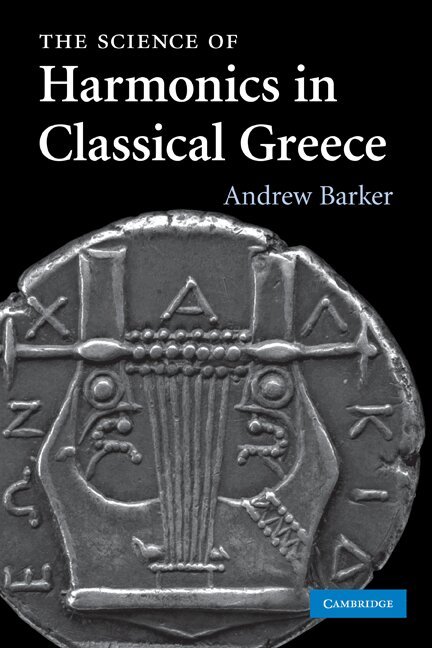
    The Science of Harmonics in Classical Greece

    AvAndrew Barker

    Häftad, Engelska, 2011

    781 kr

    Beställningsvara. Skickas inom 10-15 vardagar. Fri frakt över 249 kr.

    Fler format och utgåvor

    Inbunden

    1 817 kr

    Beskrivning

    The ancient science of harmonics investigates the arrangements of pitched sounds which form the basis of musical melody, and the principles which govern them. It was the most important branch of Greek musical theory, studied by philosophers, mathematicians and astronomers as well as by musical specialists. This 2007 book examines its development during the period when its central ideas and rival schools of thought were established, laying the foundations for the speculations of later antiquity, the Middle Ages and the Renaissance. It concentrates particularly on the theorists' methods and purposes and the controversies that their various approaches to the subject provoked. It also seeks to locate the discipline within the broader cultural environment of the period; and it investigates, sometimes with surprising results, the ways in which the theorists' work draws on and in some cases influences that of philosophers and other intellectuals.

    Produktinformation

    • Utgivningsdatum:2011-06-16
    • Mått:152 x 229 x 28 mm
    • Vikt:720 g
    • Format:Häftad
    • Språk:Engelska
    • Antal sidor:494
    • Förlag:Cambridge University Press
    • ISBN:9780521289955

    Utforska kategorier

    • Forntidens historia inom Historia och arkeologi

    Recensioner i media

    Review of the hardback: 'This is a fine, important book from one of the pillars of Greek musical scholarship, and should be carefully digested to the last footnote by every serious student of the subject.' Mnemosyne

    Innehållsförteckning

    • Part I. Preliminaries: Introduction; 1. Beginnings, and the problem of measurement; Part II. Empirical Harmonics: 2. Empirical harmonics before Aristoxenus; 3. The early empiricists in their cultural and intellectual contexts; 4. Interlude on Aristotle's account of a science and its methods; 5. Aristoxenus: the composition of the Elementa harmonica; 6. Aristoxenus: concepts and methods in Elementa harmonica Book 1; 7. Elementa harmonica Books 2-3: the science reconsidered; 8. Elementa harmonica Book 3 and its missing sequel; 9. Contexts and purposes of Aristoxenus' harmonics; Part III. Mathematical Harmonics: 10. Pythagorean harmonics in the fifth century: Philolaus; 11. Developments in Pythagorean harmonics: Archytas; 12. Plato; 13. Aristotle on the harmonic sciences; 14. Systematising mathematical harmonics: the Sectio canonis; 15. Quantification under attack: Theophrastus' critique; Postscript: The later centuries.