• Fri frakt över 249 kr
  • •
  • Snabba leveranser
  • •
  • Billiga böcker
Kundservice

Du är på sajten för privatpersoner.

Företag, bibliotek eller offentlig verksamhet?

Du handlar på classic.bokus.com, där alla dina funktioner finns intakta.
Till classic.bokus.com
Bokus logotyp. Gå till startsidan.
  • Erbjudanden
  • Nyheter
  • Student
  • Topplistor
  • Barn & ungdom
  • Bokus Play
  • E-böcker
  • Pocketböcker
  • Spel & pussel

Må bättre, för mindre! Upp till 50% rabatt på hälsoböcker

Sidfot

Mina sidor

    Hjälp

    • Kundservice
    • Vanliga frågor och svar
    • Frakt och leverans
    • Retur vid ångerrätt
    • Reklamera vara
    • Betalning
    • Köpvillkor
    • Allmänna villkor
    • Information om webbplatsens tillgänglighet

    Om Bokus

    • Om oss
    • Pressrum
    • För studenter
    • För företag
    • För bibliotek och offentlig verksamhet
    • För leverantörer
    • Hållbarhet

    Populärt

    • Aktuella erbjudanden
    • Presentkort
    • Studentlitteratur
    • Nya böcker
    • Topplistor
    • Signerade böcker
    • Engelska böcker

    Inspiration

    • Boktips
    • BookTok
    • Populära bokserier
    • Barnbokskaraktärer
    • Populära författare
    Logotyp för Bokus
    Följ oss på Facebook (extern länk)Följ oss på Instagram (extern länk)Följ oss på YouTube (extern länk)Följ oss på TikTok (extern länk)
    bokus @ CookiesAnpassa cookiesIntegritetspolicyKöpvillkor
    Till Citymail hemsida (extern länk)Till Budbee hemsida (extern länk)Till Postnord hemsida (extern länk)Till Schenker hemsida (extern länk)Till Early Bird hemsida (extern länk)Till Walleys hemsida (extern länk)
    1. Språk och ordböcker
    2. Språkvetenskap och lingvistik

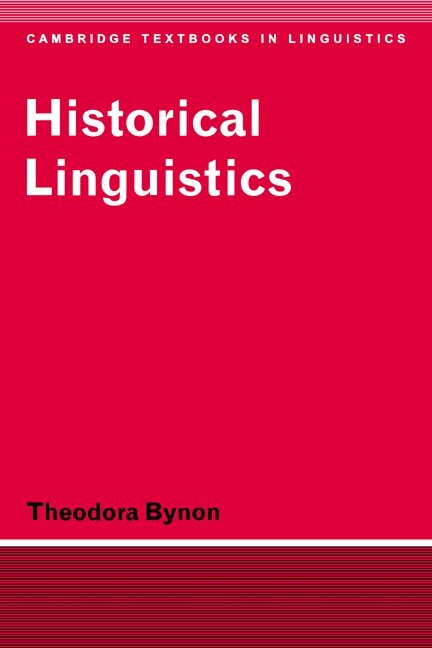
    Historical Linguistics

    AvTheodora Bynon,S. R. Anderson

    Häftad, Engelska, 1977

    Del i serien Cambridge Textbooks in Linguistics

    594 kr

    Beställningsvara. Skickas inom 10-15 vardagar. Fri frakt över 249 kr.

    Beskrivning

    Historical Linguistics is concerned with the process of language change through time. It investigates how and why the language of individuals, a social group or a whole 'speech community' develops in respect of its pronunciation, vocabulary and grammar. Dr Bynon regards language as essentially a dynamic phenomenon, whose character can be at best only partly understood by a static, and necessarily idealized, synchronic approach. In Part I she establishes the theoretical framework by providing a systematic survey of the three main models of language development - the neogrammarian, structuralist, and transformational generative. Examples drawn substantially from English and German, but also from classical languages, French, Welsh and a variety of others, are used to explain and compare these approaches. In Part II she turns to sociolinguistics and shows how changes within a language over a period of time, and changes brought about by contact between languages, are both indicators and agents of more general cultural developments. Accounts of bilingualism and of pidgin and Creole languages are included as well as wider-ranging examples of different kinds of borrowing such as loan words, loan translations and extensions of meaning. The student is provided with a practical and critical guide both to what has been done and what can be done to discover and verify these linguistic relationships. Designed primarily as a textbook for linguistics and philology students, this book will also be of interest to those studying English language, classics and modern languages.

    Produktinformation

    • Utgivningsdatum:1977-09-15
    • Mått:153 x 229 x 23 mm
    • Vikt:520 g
    • Format:Häftad
    • Språk:Engelska
    • Serie:Cambridge Textbooks in Linguistics
    • Antal sidor:324
    • Förlag:Cambridge University Press
    • ISBN:9780521291880

    Utforska kategorier

    • Språkvetenskap och lingvistik inom Språk och ordböcker

    Innehållsförteckning

    • Key to symbols used; Preface; Introduction; Part I. Models of Language Development: 1. The neogrammarian model; 2. The structuralist model of language evolution; 3. The transformational-generative model of language evolution; Part II. Language Contact: 4. The neogrammarian postulates and dialect geography; 5. The social motivation of language change; 6. Contact between languages; 7. Language and prehistory; Further reading; References; Additional bibliography; Index.